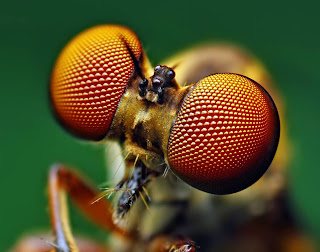
Robber fly - Nature photographer Thomas Shahan specializes in amazing portraits of tiny insects. It isn't easy. Shahan says that this Robber Fly (Holcocephala fusca), for instance, is "skittish" and doesn't like its picture taken.

Eye-popping bug photos

Nature by Numbers (Video)

"A Summary" – Apr 2, 2011 (Kryon channeled by Lee Carroll) (Subjects: Religion, Shift of Human Consciousness, 2012, Intelligent/Benevolent Design, EU, South America, 5 Currencies, Water Cycle (Heat up, Mini Ice Ace, Oceans, Fish, Earthquakes ..), Middle East, Internet, Israel, Dictators, Palestine, US, Japan (Quake/Tsunami Disasters , People, Society ...), Nuclear Power Revealed, Hydro Power, Geothermal Power, Moon, Financial Institutes (Recession, Realign integrity values ..) , China, North Korea, Global Unity,..... etc.) -
"The Quantum Factor" – Apr 10, 2011 (Kryon channeled by Lee Carroll) (Subjects: Galaxies, Universe, Intelligent design, Benevolent design, Aliens, Nikola Tesla (Quantum energy), Inter-Planetary Travel, DNA, Genes, Stem Cells, Cells, Rejuvenation, Shift of Human Consciousness, Spontaneous Remission, Religion, Dictators, Africa, China, Nuclear Power, Sustainable Development, Animals, Global Unity.. etc.) - (Text Version)

“ … Here is another one. A change in what Human nature will allow for government. "Careful, Kryon, don't talk about politics. You'll get in trouble." I won't get in trouble. I'm going to tell you to watch for leadership that cares about you. "You mean politics is going to change?" It already has. It's beginning. Watch for it. You're going to see a total phase-out of old energy dictatorships eventually. The potential is that you're going to see that before 2013.

They're going to fall over, you know, because the energy of the population will not sustain an old energy leader ..."
"Update on Current Events" – Jul 23, 2011 (Kryon channelled by Lee Carroll) - (Subjects: The Humanization of God, Gaia, Shift of Human Consciousness, 2012, Benevolent Design, Financial Institutes (Recession, System to Change ...), Water Cycle (Heat up, Mini Ice Ace, Oceans, Fish, Earthquakes ..), Nuclear Power Revealed, Geothermal Power, Hydro Power, Drinking Water from Seawater, No need for Oil as Much, Middle East in Peace, Persia/Iran Uprising, Muhammad, Israel, DNA, Two Dictators to fall soon, Africa, China, (Old) Souls, Species to go, Whales to Humans, Global Unity,..... etc.)
"Recalibration of Free Choice"– Mar 3, 2012 (Kryon Channelling by Lee Caroll) - (Subjects: (Old) Souls, Midpoint on 21-12-2012, Shift of Human Consciousness, Black & White vs. Color, 1 - Spirituality (Religions) shifting, Loose a Pope “soon”, 2 - Humans will change react to drama, 3 - Civilizations/Population on Earth, 4 - Alternate energy sources (Geothermal, Tidal (Paddle wheels), Wind), 5 – Financials Institutes/concepts will change (Integrity – Ethical) , 6 - News/Media/TV to change, 7 – Big Pharmaceutical company will collapse “soon”, (Keep people sick), (Integrity – Ethical) 8 – Wars will be over on Earth, Global Unity, … etc.) - (Text version)

“… 4 - Energy (again)


The natural resources of the planet are finite and will not support the continuation of what you've been doing. We've been saying this for a decade. Watch for increased science and increased funding for alternate ways of creating electricity (finally). Watch for the very companies who have the most to lose being the ones who fund it. It is the beginning of a full realization that a change of thinking is at hand. You can take things from Gaia that are energy, instead of physical resources. We speak yet again about geothermal, about tidal, about wind. Again, we plead with you not to over-engineer this. For one of the things that Human Beings do in a technological age is to over-engineer simple things. Look at nuclear - the most over-engineered and expensive steam engine in existence!

Your current ideas of capturing energy from tidal and wave motion don't have to be technical marvels. Think paddle wheel on a pier with waves, which will create energy in both directions [waves coming and going] tied to a generator that can power dozens of neighborhoods, not full cities. Think simple and decentralize the idea of utilities. The same goes for wind and geothermal. Think of utilities for groups of homes in a cluster. You won't have a grid failure if there is no grid. This is the way of the future, and you'll be more inclined to have it sooner than later if you do this, and it won't cost as much….”


"Fast-Tracking" - Feb 8, 2014 (Kryon Channelling by Lee Carroll) - (Reference to Fukushima / H-bomb nuclear pollution and a warning about nuclear > 20 Min)

Obama unveils landmark regulations to combat climate change

Obama unveils landmark regulations to combat climate change
In a bid to combat climate change, US President Barack Obama announced the Clean Power Plan on Monday, marking the first time power plants have been targeted by mandatory regulations on carbon dioxide emissions in the US.
Google: Earthday 2013
Showing posts with label Water Management. Show all posts

Friday, September 20, 2019

'Day Zero' looms in Australian Outback as climate change bites

Yahoo – AFP, Holly ROBERTSON, September 19, 2019

Angus Ferrier stands by his few remaining citrus trees at his drought-hit
orchard Stanthorpe, regional Queensland (AFP Photo/William WEST)

Stanthorpe (Australia) (AFP) - An unprecedented water shortage in drought-stricken eastern Australia is driving home the brutal realities of climate change and threatening the much-mythologised Outback way of life.

From sunny Queensland all the way to Sydney, more than a dozen small towns are facing their own "Day Zero" within months, a water crisis reminiscent of the taps being turned off in Cape Town and Chennai.

It's getting hotter, it's getting drier, and adding to the misery, precious water supplies are being tasked to fight hundreds of bushfires ripping through the Australian countryside.

In the small horticulture hub of Stanthorpe, Queensland, a prolonged crushing drought has left water supplies at the local dam sitting metres below normal levels.

Despite sitting within the basin of Australia's biggest river system -- as do all of the towns running dry -- Stanthorpe is set to run dry by Christmas.

Authorities will have no choice but to truck-in water at a monthly cost of Aus$1 million ($690,000) -- a temporary reprieve expected to remain sustainable for just 12 months.

In Angus Ferrier's orchard, citrus trees that once blossomed in orderly rows now lie in a twisted heap.

Cattle feeding on a drought-affected farm near Armidale in regional
New South Wales (AFP Photo/William WEST)

His farm's water own supply will be empty within weeks, so he has dug up thousands of trees and expects to sacrifice the same number again before the year is out.

"They were eight years old," he said, pulling a dried flower off a gnarled branch, "so eight years of your life, gone in a day."

Radical measures

The local growers' association believes drought will cost the region's economy Aus$100 million this season alone -- an enormous amount for a small community like Stanthorpe.

Farmers are taking radical measures just to survive, spending a small fortune to truck-in water for their crops or renting land in other districts that have been less badly affected.

"I do know of some growers who are literally bone dry and have decided to plant nothing this year and practically close their businesses down in the short-term," Ferrier said.

Their struggles have had a knock-on effect in town, where shops are on the brink of shutting, and desperation has led to several instances of water theft across the region.

To the south, the entire state of New South Wales was declared in drought last December. Some reservoirs are as low as one percent of capacity, and smaller towns such as Guyra have effectively already run dry.

Water is being trucked in until a fast-tracked Aus$13 million pipeline comes online at the end of September. But at current water usage rates, even the pipeline's supply will only last the wider 30,000-strong Armidale district another year.

Grazier Gordon Youman helps a struggling sheep back to its feet on his 
property at Guyra in regional New South Wales (AFP Photo/William WEST)

"We are looking at alternative sources of water, not just that which comes from the sky by way of rain," Armidale Regional Council CEO Susan Law said.

'Sunburnt Country'

"A hydrogeologist has identified nine sites around the Guyra region where we will be drilling to see if there's groundwater there to supplement our supply."

Australia -- dubbed the "Sunburnt Country" -- has long been buffeted by drought and floods.

But scientists say weather extremes are exacerbated by climate change, which Australians -- even some in these conservative bush areas -- increasingly acknowledge.

The government, anxious to support the country's huge coal mining and export sector, has rejected calls to make fighting climate change a priority on the grounds this would undermine economic growth.

Local authorities are scrambling to respond to the immediate crisis with measures such as pipelines and drilling, but there is growing pressure for a national policy response.

Storm King dam near Stanthorpe in regional Queensland used to be a popular
swimming spot, but there is hardly any water left now (AFP Photo/William WEST)

That could include dam-building and more stringent restrictions on using river water for irrigation.

"You get the feeling that everyone's on edge because you've got to watch everything you do -- you've got to be careful of every little drop you use," said Stanthorpe resident Tom Hehlen.

"That can be very stressful."

Guyra grazier Gordon Youman said the very fabric of Australia's Outback is at stake, with many farmers suffering mental health issues as they face the prospect of going broke.

"It's that core of the country -- where mum and dad and the kids work together -- they're the ones that are going to be pulled down," he said.

Related Articles:


"Recalibration of Free Choice"–  Mar 3, 2012 (Kryon Channelling by Lee Caroll) - (Subjects: (Old) Souls, Midpoint on 21-12-2012, Shift of Human Consciousness, Black & White vs. Color, 1 - Spirituality (Religions) shifting, Loose a Pope “soon”, 2 - Humans will change react to drama, 3 - Civilizations/Population on Earth,  4 - Alternate energy sources (Geothermal, Tidal (Paddle wheels), Wind), 5 – Financials Institutes/concepts will change (Integrity – Ethical) , 6 - News/Media/TV to change, 7 – Big Pharmaceutical company will collapse “soon”, (Keep people sick), (Integrity – Ethical)  8 – Wars will be over on Earth, Global Unity, … etc.) - (Text version)

“…  4 - Energy (again)

The natural resources of the planet are finite and will not support the continuation of what you've been doing. We've been saying this for a decade. Watch for increased science and increased funding for alternate ways of creating electricity (finally). Watch for the very companies who have the most to lose being the ones who fund it. It is the beginning of a full realization that a change of thinking is at hand. You can take things from Gaia that are energy, instead of physical resources. We speak yet again about geothermal, about tidal, about wind. Again, we plead with you not to over-engineer this. For one of the things that Human Beings do in a technological age is to over-engineer simple things. Look at nuclear - the most over-engineered and expensive steam engine in existence!

Your current ideas of capturing energy from tidal and wave motion don't have to be technical marvels. Think paddle wheel on a pier with waves, which will create energy in both directions [waves coming and going] tied to a generator that can power dozens of neighborhoods, not full cities. Think simple and decentralize the idea of utilities. The same goes for wind and geothermal. Think of utilities for groups of homes in a cluster. You won't have a grid failure if there is no grid. This is the way of the future, and you'll be more inclined to have it sooner than later if you do this, and it won't cost as much.

Water

We've told you that one of the greatest natural resources of the planet, which is going to shift and change and be mysterious to you, is fresh water. It's going to be the next gold, dear ones. So, we have also given you some hints and examples and again we plead: Even before the potentials of running out of it, learn how to desalinate water in real time without heat. It's there, it's doable, and some already have it in the lab. This will create inexpensive fresh water for the planet. 

There is a change of attitude that is starting to occur. Slowly you're starting to see it and the only thing getting in the way of it are those companies with the big money who currently have the old system. That's starting to change as well. For the big money always wants to invest in what it knows is coming next, but it wants to create what is coming next within the framework of what it has "on the shelf." What is on the shelf is oil, coal, dams, and non-renewable resource usage. It hasn't changed much in the last 100 years, has it? Now you will see a change of free choice. You're going to see decisions made in the boardrooms that would have curled the toes of those two generations ago. Now "the worst thing they could do" might become "the best thing they could do." That, dear ones, is a change of free choice concept. When the thinkers of tomorrow see options that were never options before, that is a shift. That was number four. ….”


“… New ideas are things you never thought of. These ideas will be given to you so you will have answers to the most profound questions that your societies have had since you were born. Inventions will bring clean water to every Human on the planet, cheaply and everywhere. Inventions will give you power, cheaply and everywhere. These ideas will wipe out all of the reasons you now have for pollution, and when you look back on it, you'll go, "This solution was always there. Why didn't we think of that? Why didn't we do this sooner?" Because it wasn't time and you were not ready. You hadn't planted the seeds and you were still battling the old energy, deciding whether you were going to terminate yourselves before 2012. Now you didn't…. and now you didn't.

It's funny, what you ponder about, and what your sociologists consider the "great current problems of mankind", for your new ideas will simply eliminate the very concepts of the questions just as they did in the past. Do you remember? Two hundred years ago, the predictions of sociologists said that you would run out of food, since there wasn't enough land to sustain a greater population. Then you discovered crop rotation and fertilizer. Suddenly, each plot of land could produce many times what it could before. Do you remember the predictions that you would run out of wood to heat your homes? Probably not. That was before electricity. It goes on and on.

So today's puzzles are just as quaint, as you will see. (1)How do you strengthen the power grids of your great nations so that they are not vulnerable to failure or don't require massive infrastructure improvement expenditures? Because cold is coming, and you are going to need more power. (2) What can you do about pollution? (3) What about world overpopulation? Some experts will tell you that a pandemic will be the answer; nature [Gaia] will kill off about one-third of the earth's population. The best minds of the century ponder these puzzles and tell you that you are headed for real problems. You have heard these things all your life.

Let me ask you this. (1) What if you could eliminate the power grid altogether? You can and will. (2) What if pollution-creating sources simply go away, due to new ideas and invention, and the environment starts to self-correct? (3) Overpopulation? You assume that humanity will continue to have children at an exponential rate since they are stupid and can't help themselves. This, dear ones, is a consciousness and education issue, and that is going to change. Imagine a zero growth attribute of many countries - something that will be common. Did you notice that some of your children today are actually starting to ponder if they should have any children at all? What a concept! ….”

Sunday, February 4, 2018

Tiny Michigan town in water fight with Nestle

Yahoo – AFP, Luc OLINGA, 4 February 2018

Maryann Borden looks over her yard at Twin Creek, which she says is not the
same since Nestle began pumping water in the region

Global food conglomerate Nestle is in a battle with critics in tiny Osceola Township, Michigan where residents complain the Swiss company's water extraction techniques are ruining the environment.

Maryann Borden, a retired teacher who has lived in the western Michigan town since 1953, has photos documenting changes in the Twin Creek river since Nestle began pumping water in the region in the early 2000s for its "Ice Mountain" brand of bottled water.

"It's not the same creek," Borden, 73, told AFP. "It's narrower and deeper and therefore warmer," compared with the "biting cold" water of her youth.

"The trout can't survive in it because the water is warmer," she added.

Located about four hours north of Detroit and with a population of just 900, Osceola Township is a sleepy rural community whose biggest employer is SpringHill Camp, a Christian-oriented program for kids.

The town opposes granting Nestle a permit to build a pumping booster station along a water pipeline that feeds a tanker load dock in Evart, another small town nearby.

The booster station would help the company pump more water from a controversial Osceola County wellhead if the Michigan Department of Environmental Quality approves the project. Nestle wants to pump 400 gallons of water a minute, up from the 250 a minute currently.

Town officials voted in January to appeal a county court's ruling in Nestle's favor, portending a judicial saga.

"If you look at the culverts, they provide an historic landmark," said Tim Ladd, manager of Osceola Township.

"You don't have to be a geologist or a hydrologist to see those water levels," he added. "The water lake tables are lower today than what they were two years ago."

Nestle rejects this argument and also has some backing among supporters who praise the company for keeping water rates low.

Area residents say water extraction techniques of the Nestle Waters bottling
facility in Stanwood, Michigan, have damaged the environment

"There's been no measurable changes to the streams, the aquatic life there," said Arlene Anderson-Vincent, natural resource manager at Nestle Waters North America, who notes that dams in the area "can affect those streams."

Nestle points to company-sponsored research that backs up its stance, but there has been no independent scientific review of the matter.

$200 a year

Much of the anger in Osceola Township, that voted heavily for President Donald Trump in the 2016 US election, is due to a sense the town is being exploited by a powerful multinational blinded by profit.

Nestle pays just $200 a year to the state of Michigan to pump more than 130 million gallons (590 million liters) of water.

Other US states have struck similar arrangements with big companies, authorizing them to pump as much water as they wish for a pittance as long as they build the infrastructure themselves. This includes the beverage giants Coca-Cola and PepsiCo, which sell water under the Dasani and Aquafina brands.

"Nestle has a reputation worldwide of going to poor rural communities, offering all kinds of economic benefits to the community that never really materialize, and taking as much water as they can get and when the stream runs dry they leave," said Peggy Case, president of the Michigan Citizens for Water Conservation.

Nestle said it spends $18 million a year in Michigan, including $2.4 million in taxes in 2016. The company employs 280 people at its factory in Mecosta County, about 40 minutes away from Osceola Township where about 50 Nestle workers live.

Demand for bottled water, such as these stacks at 
Nestle's facility in Stanwood, Michigan, is rising

Nestle is turning to Twin Creek River as demand for bottled water rises. Wholesale bottled water sales hit a total of $16.4 billion in 2016, surpassing soda sales of $12.5 billion for the first time, according to the Beverage Marketing consultancy.

Nestle's water brands in the US, which includes Poland Springs and Pure Life in addition to Ice Mountain, garnered 55.3 percent of the company's total worldwide water sales in 2016.

Affordable water?

Zackary Szakacs, city manager of Evart, credited Nestle with keeping water rates low in the region. The average income in Osceola Township is just $20,000 per year, around the poverty level for a family of three.

"Thank God we have two of those wells in the city of Evart because I would have to lay people off," Szakacs said.

"They help maintain and keep our water rates low so our residents that are poor that live in this community can afford to pay their monthly water bill."

After finding the chemical perchlorate at some wells in 2015, Nestle financed the cleanup.

Evart is only a couple of hours drive from Flint, where a major water contamination scandal has drawn national attention.

Access to affordable drinking water is becoming more problematic, and as many as 36 percent of US households may be unable to afford water within five years, according to a 2017 study by Michigan State University scholar Elizabeth Mack.


Related Articles:


"Recalibration of Free Choice"–  Mar 3, 2012 (Kryon Channelling by Lee Caroll) - (Subjects: (Old) Souls, Midpoint on 21-12-2012, Shift of Human Consciousness, Black & White vs. Color, 1 - Spirituality (Religions) shifting, Loose a Pope “soon”, 2 - Humans will change react to drama, 3 - Civilizations/Population on Earth,  4 - Alternate energy sources (Geothermal, Tidal (Paddle wheels), Wind), 5 – Financials Institutes/concepts will change (Integrity – Ethical) , 6 - News/Media/TV to change, 7 – Big Pharmaceutical company will collapse “soon”, (Keep people sick), (Integrity – Ethical)  8 – Wars will be over on Earth, Global Unity, … etc.) - (Text version)

“…  4 - Energy (again)

The natural resources of the planet are finite and will not support the continuation of what you've been doing. We've been saying this for a decade. Watch for increased science and increased funding for alternate ways of creating electricity (finally). Watch for the very companies who have the most to lose being the ones who fund it. It is the beginning of a full realization that a change of thinking is at hand. You can take things from Gaia that are energy, instead of physical resources. We speak yet again about geothermal, about tidal, about wind. Again, we plead with you not to over-engineer this. For one of the things that Human Beings do in a technological age is to over-engineer simple things. Look at nuclear - the most over-engineered and expensive steam engine in existence!

Your current ideas of capturing energy from tidal and wave motion don't have to be technical marvels. Think paddle wheel on a pier with waves, which will create energy in both directions [waves coming and going] tied to a generator that can power dozens of neighborhoods, not full cities. Think simple and decentralize the idea of utilities. The same goes for wind and geothermal. Think of utilities for groups of homes in a cluster. You won't have a grid failure if there is no grid. This is the way of the future, and you'll be more inclined to have it sooner than later if you do this, and it won't cost as much.

Water

We've told you that one of the greatest natural resources of the planet, which is going to shift and change and be mysterious to you, is fresh water. It's going to be the next gold, dear ones. So, we have also given you some hints and examples and again we plead: Even before the potentials of running out of it, learn how to desalinate water in real time without heat. It's there, it's doable, and some already have it in the lab. This will create inexpensive fresh water for the planet. 

There is a change of attitude that is starting to occur. Slowly you're starting to see it and the only thing getting in the way of it are those companies with the big money who currently have the old system. That's starting to change as well. For the big money always wants to invest in what it knows is coming next, but it wants to create what is coming next within the framework of what it has "on the shelf." What is on the shelf is oil, coal, dams, and non-renewable resource usage. It hasn't changed much in the last 100 years, has it? Now you will see a change of free choice. You're going to see decisions made in the boardrooms that would have curled the toes of those two generations ago. Now "the worst thing they could do" might become "the best thing they could do." That, dear ones, is a change of free choice concept. When the thinkers of tomorrow see options that were never options before, that is a shift. That was number four. ….”


“… New ideas are things you never thought of. These ideas will be given to you so you will have answers to the most profound questions that your societies have had since you were born. Inventions will bring clean water to every Human on the planet, cheaply and everywhere. Inventions will give you power, cheaply and everywhere. These ideas will wipe out all of the reasons you now have for pollution, and when you look back on it, you'll go, "This solution was always there. Why didn't we think of that? Why didn't we do this sooner?" Because it wasn't time and you were not ready. You hadn't planted the seeds and you were still battling the old energy, deciding whether you were going to terminate yourselves before 2012. Now you didn't…. and now you didn't.

It's funny, what you ponder about, and what your sociologists consider the "great current problems of mankind", for your new ideas will simply eliminate the very concepts of the questions just as they did in the past. Do you remember? Two hundred years ago, the predictions of sociologists said that you would run out of food, since there wasn't enough land to sustain a greater population. Then you discovered crop rotation and fertilizer. Suddenly, each plot of land could produce many times what it could before. Do you remember the predictions that you would run out of wood to heat your homes? Probably not. That was before electricity. It goes on and on.

So today's puzzles are just as quaint, as you will see. (1)How do you strengthen the power grids of your great nations so that they are not vulnerable to failure or don't require massive infrastructure improvement expenditures? Because cold is coming, and you are going to need more power. (2) What can you do about pollution? (3) What about world overpopulation? Some experts will tell you that a pandemic will be the answer; nature [Gaia] will kill off about one-third of the earth's population. The best minds of the century ponder these puzzles and tell you that you are headed for real problems. You have heard these things all your life.

Let me ask you this. (1) What if you could eliminate the power grid altogether? You can and will. (2) What if pollution-creating sources simply go away, due to new ideas and invention, and the environment starts to self-correct? (3) Overpopulation? You assume that humanity will continue to have children at an exponential rate since they are stupid and can't help themselves. This, dear ones, is a consciousness and education issue, and that is going to change. Imagine a zero growth attribute of many countries - something that will be common. Did you notice that some of your children today are actually starting to ponder if they should have any children at all? What a concept! ….”

Tuesday, January 3, 2017

From coal city to European Green Capital - Essen's extreme makeover

Coal, steel and heavy industry all featured prominently in Essen's past. But now the reinvented Ruhr region hub is showing off its environmental credentials as 2017's European Green Capital. Samantha Early paid a visit.

Deutsche Welle, 2 January 2017


Stepping on to the platform at Essen's central station on a clear winter's morning, the first thing to catch my eye is a giant billboard proclaiming this "the shopping city." Pondering the relative merits of retail therapy and sustainable living, I have to navigate the new European Green Capital quickly to make my first appointment.

At the headquarters of the local project team for Essen, European Green Capital of 2017, team leader Ralph Kindel explains that the city of 590,000 people (in the heart of the Ruhr metropolis of some 5.1 million) has a history of transformation - from a rural region to an industrial one with the discovery of coal, to the dark chapter of weapons manufacture under the Third Reich, then later as a hub of the "economic miracle" as Germany rebuilt. With the decline of the local steel and coal industries in the later 20th century, it faced what locals call the "Strukturwandel" - structural change.

"From green to gray to green again," is how Kindel describes it.

Ralph Kindel leads the project team for
Essen - European Green Capital 2017
He says the groundwork of a green city was laid in the 1920s by a visionary planner named Robert Schmidt. As the population exploded with industrialization, Schmidt realized workers needed green spaces to recuperate.

Several parks were set up and though that took a backseat for decades, new parks have since been established and Kindel says by 2020, the people of Essen will only need to travel 500 meters (a third of a mile) to access a network of green spaces.
"This ability to transform…makes Essen so exciting and also an example for Europe because we have mastered problems, and are tackling problems, that other regions in Europe will still be facing."

Green DNA

Essen was awarded the annual title by the European Commission. It was established to promote and reward cities' efforts to resolve environmental challenges. An expert panel and jury weigh up how well applicant cities are doing in areas including climate change mitigation and adaption, local transport, air quality and wastewater.

Winners are announced 18 months in advance. When Essen was made titleholder for 2017, the judges praised its "admirable efforts" to overcome its challenging industrial past and reinvent itself as a "green city."

The Krupp-Park includes a lake fed by rainwater. In Essen's industrial heyday,
clear blue sky was hard to spot

Kindel points to the more than 200 community projects planned as examples of ways the organization wants to use this year's special status to change presumptions about Essen as a city of coal, steel and smokestacks.

"No one expects to find so much green here," he says. "We want to present the reality."

The staff here seems to walk the talk, or pedal it, to be precise. There's a bike at reception which, project team member Christina Waimann tells me, is used to run errands. But she needs more than two wheels to give me a whistle-stop tour of Essen's green attractions. I'm relieved when she tells me her Smart car is very economical.

An example of water management

Our first destination is the Krupp-Park named for Friedrich Krupp, founder of what became ThyssenKrupp, the major global steel company which has its headquarters in Essen. Waimann says it's an example of the city's structural change and adaptation to climate change through sustainable architecture, landscaping and water management. A lake is filled by rainwater from the roof of the steel giant's headquarters and surrounding parkland.

The "Radschnellweg Ruhr," an Autobahn for bicycles to link the Ruhr cities, passes by the park, part of the 376 kilometers (234 miles) of city cycleways. As we head to our next destination, Waimann explains traffic jams are still a problem. The city is aiming for a quarter of trips to be made by bike by 2035.

Essen's greenest street

Promoting local food is one of
Essen's goals as a green city
In 15 minutes we reach what Waimann tells me is Essen's greenest street - Schuirweg. What makes it "green" is that it's home to farmers who are working alongside community gardeners and small growers to promote regional produce, one of the goals of Essen's Green Capital campaign. The argument goes that eating from close to home cuts down on transport emissions and increases awareness about food production.

Nikolas Weber's family has been farming in this area longer than he can count. Today they grow a wide variety of fruits, vegetables and grains as well as raising animals, selling the produce on site. They also rent out fields for other growers. For him, there's no better example of sustainability.

From filthy river to swimming spot

Perhaps one of the most concrete results of Essen's transformation is the fact that from May, people will be able to swim in the Ruhr River for the first time in generations. The Baldeneysee, a lake in the river, will become a certified bathing spot under EU standards. Kindel says the Ruhr was once one of the dirtiest industrial rivers in Europe, closed to swimmers since the early 1960s.

Come May, people can finally enjoy swimming in the Baldeneysee again

"It shows that we are no marketing gag… we are harvesting the results of all the work people have put in over in the past few decades and that makes us proud," he said.

Friends Stefan Booms, 25, and Simon Weber, 26 are enthusiastic about the city's new claim to fame and looking forward to swimming in the Ruhr. "It's great, we were in a canoe club for some months and we were on the river in that time but it's great to be allowed to swim again," Booms said. "I think we will try it!" added Weber.

Industrial heritage meets green future

My final stop is the Zeche Zollverein, a former coal mine which has been a UNESCO World Heritage site since 2001. I'm told no other place symbolizes Essen's transformation quite like this one. It's home to a museum and cultural centers as well as plant species from all over the world which arrived with the coal lorries and grow amidst the concrete, brick and steel structures. Kindel is looking forward to an international congress this year, when researchers will catalog the site's biodiversity.

Spahn has experienced many
of Essen's changes
Heinz Spahn has witnessed these changes more closely than most. Born in 1940, he worked at the Zollverein until closing day in 1986 and now shows visitors around. He recalls the days when the air smelt like rotten eggs due to sulfur and you had to check the wind direction before hanging washing out - lest the whites turn gray or yellow due to the air pollution. He's glad Essen's now a green capital.


He hopes the new title will bring more business and tourism to the city and says despite favoring isolation in nature over city bustle, he's proud to be an Essener.

Wednesday, December 7, 2016

Climate change is a catalyst for war: Dutch armed forces chief

DutchNews, December 6, 2016

Photo: Defensie.nl 

Climate change is an important catalyst for war, terrorism and major migration patterns, Dutch armed forces chief Tom Middendorp has told a conference in The Hague. 

‘Climate change is not something which can be ignored,’ Middendorp is quoted as saying by the AD. 

The army chief said he became interested in the impact of climate change after serving in Afghanistan and realised that water distribution was a key issue in the region. Once that had been settled, peace returned because the Taliban could no longer exploit divisions between the various villages, he said.

‘If you realise that water plays a major role in the dynamics between villages, you can focus attention on it,’ he said. ‘The conflicts we have been involved in forced us to look for other causes.’ 

Failed harvests, caused by extreme drought, are also an important source of popular discontent and helped propel Syria into civil war, Middendorp says.

‘Many farmers moved to the cities with their families and ended up in poor outlying districts. That is where the conflict began,’ he said. ‘I know there is no easy cause to pinpoint, but many studies show climate change did make a contribution.’

Related Articles:


"Recalibration of Free Choice"–  Mar 3, 2012 (Kryon Channelling by Lee Caroll) - (Subjects: (Old) Souls, Midpoint on 21-12-2012, Shift of Human Consciousness, Black & White vs. Color, 1 - Spirituality (Religions) shifting, Loose a Pope “soon”, 2 - Humans will change react to drama, 3 - Civilizations/Population on Earth,  4 - Alternate energy sources (Geothermal, Tidal (Paddle wheels), Wind), 5 – Financials Institutes/concepts will change (Integrity – Ethical) , 6 - News/Media/TV to change, 7 – Big Pharmaceutical company will collapse “soon”, (Keep people sick), (Integrity – Ethical)  8 – Wars will be over on Earth, Global Unity, … etc.) - (Text version)

“…  4 - Energy (again)

The natural resources of the planet are finite and will not support the continuation of what you've been doing. We've been saying this for a decade. Watch for increased science and increased funding for alternate ways of creating electricity (finally). Watch for the very companies who have the most to lose being the ones who fund it. It is the beginning of a full realization that a change of thinking is at hand. You can take things from Gaia that are energy, instead of physical resources. We speak yet again about geothermal, about tidal, about wind. Again, we plead with you not to over-engineer this. For one of the things that Human Beings do in a technological age is to over-engineer simple things. Look at nuclear - the most over-engineered and expensive steam engine in existence!

Your current ideas of capturing energy from tidal and wave motion don't have to be technical marvels. Think paddle wheel on a pier with waves, which will create energy in both directions [waves coming and going] tied to a generator that can power dozens of neighborhoods, not full cities. Think simple and decentralize the idea of utilities. The same goes for wind and geothermal. Think of utilities for groups of homes in a cluster. You won't have a grid failure if there is no grid. This is the way of the future, and you'll be more inclined to have it sooner than later if you do this, and it won't cost as much.

Water

We've told you that one of the greatest natural resources of the planet, which is going to shift and change and be mysterious to you, is fresh water. It's going to be the next gold, dear ones. So, we have also given you some hints and examples and again we plead: Even before the potentials of running out of it, learn how to desalinate water in real time without heat. It's there, it's doable, and some already have it in the lab. This will create inexpensive fresh water for the planet. 

There is a change of attitude that is starting to occur. Slowly you're starting to see it and the only thing getting in the way of it are those companies with the big money who currently have the old system. That's starting to change as well. For the big money always wants to invest in what it knows is coming next, but it wants to create what is coming next within the framework of what it has "on the shelf." What is on the shelf is oil, coal, dams, and non-renewable resource usage. It hasn't changed much in the last 100 years, has it? Now you will see a change of free choice. You're going to see decisions made in the boardrooms that would have curled the toes of those two generations ago. Now "the worst thing they could do" might become "the best thing they could do." That, dear ones, is a change of free choice concept. When the thinkers of tomorrow see options that were never options before, that is a shift. That was number four. ….”

Wednesday, March 23, 2016

Coal plants use enough water to supply 1 bn people: Greenpeace

Yahoo – AFP, 22 March 2016

Coal plants use water at almost every step of the process, from mining and 
washing coal to the treatment of combustion waste (AFP Photo/Patrik Stollarz)

Coal plants are draining an already dwindling global water supply, Greenpeace warned on Tuesday, consuming enough to meet the basic needs of one billion people and deepening a worldwide crisis.

Announcing its first global plant-by-plant study, Greenpeace said coal power use will increase with newly built plants, causing "huge stress" on the world's major river basins and threatening communities.

In its report "The Great Water Grab: How the Coal Industry is Deepening the Global Water Crisis", released in Hong Kong, the environmental activist group urged governments to stop depending on coal, a major source of electricity and a pollutant.

China's rise to become the world's 
second-largest economy was largely 
powered by cheap, dirty coal (AFP
Photo/Johannes Eisele)
It highlighted Asian giants China and India as being at the forefront of the battle with their heavy use of coal.

Coal plants use water at almost every step of the process, from mining and washing coal to the treatment of combustion waste, the report said.

"By choosing to continue huge investments in coal to power their economies for decades to come, governments would commit the world to a future of an ever more desperate fight for scarce water resources," the report said.

The watchdog looked at data from the world's 8,359 coal plants and information on another 2,600 planned plants.

It found that the existing plants "consume enough water to meet the basic water needs of over one billion people".

More than a quarter of the existing and proposed plants were located in what they described as a red-list of "over-withdrawal" areas, where water resources are being used faster than they can be replenished.

Over 40 percent of planned and existing plants are in areas categorised as "high water stress".

It named China, India and Turkey as three countries that have the most planned plants on areas that are running dry.

China's rise to become the world's second-largest economy was largely powered by cheap, dirty coal. Although the world's top greenhouse gas emitter has in recent years taken strides into renewable options, it still relies heavily on coal to power its industries and heat homes.

"Policy makers are not aware how much water is being used by coal plants," Harri Lammi, a Greenpeace senior global campaigner on coal, told AFP.

"Huge numbers of people" could be threatened, losing farms and ground water, if coal power expansion continues, he said.

The report added that countries were also risking their economies and social stability as they faced "stark choices" over allocating water supplies to the coal industry or to meet people's basic needs.

It urged governments to switch to renewable energy, which requires less water, and to prevent proposed coal plants in red-list areas from going ahead.

Plants in the most at-risk areas should be phased out and facilities over 40 years old should be retired, it said.

Related Articles:


"Recalibration of Free Choice"–  Mar 3, 2012 (Kryon Channelling by Lee Caroll) - (Subjects: (Old) Souls, Midpoint on 21-12-2012, Shift of Human Consciousness, Black & White vs. Color, 1 - Spirituality (Religions) shifting, Loose a Pope “soon”, 2 - Humans will change react to drama, 3 - Civilizations/Population on Earth,  4 - Alternate energy sources (Geothermal, Tidal (Paddle wheels), Wind), 5 – Financials Institutes/concepts will change (Integrity – Ethical) , 6 - News/Media/TV to change, 7 – Big Pharmaceutical company will collapse “soon”, (Keep people sick), (Integrity – Ethical)  8 – Wars will be over on Earth, Global Unity, … etc.) - (Text version)

“…  4 - Energy (again)

The natural resources of the planet are finite and will not support the continuation of what you've been doing. We've been saying this for a decade. Watch for increased science and increased funding for alternate ways of creating electricity (finally). Watch for the very companies who have the most to lose being the ones who fund it. It is the beginning of a full realization that a change of thinking is at hand. You can take things from Gaia that are energy, instead of physical resources. We speak yet again about geothermal, about tidal, about wind. Again, we plead with you not to over-engineer this. For one of the things that Human Beings do in a technological age is to over-engineer simple things. Look at nuclear - the most over-engineered and expensive steam engine in existence!

Your current ideas of capturing energy from tidal and wave motion don't have to be technical marvels. Think paddle wheel on a pier with waves, which will create energy in both directions [waves coming and going] tied to a generator that can power dozens of neighborhoods, not full cities. Think simple and decentralize the idea of utilities. The same goes for wind and geothermal. Think of utilities for groups of homes in a cluster. You won't have a grid failure if there is no grid. This is the way of the future, and you'll be more inclined to have it sooner than later if you do this, and it won't cost as much.

Water

We've told you that one of the greatest natural resources of the planet, which is going to shift and change and be mysterious to you, is fresh water. It's going to be the next gold, dear ones. So, we have also given you some hints and examples and again we plead: Even before the potentials of running out of it, learn how to desalinate water in real time without heat. It's there, it's doable, and some already have it in the lab. This will create inexpensive fresh water for the planet. 

There is a change of attitude that is starting to occur. Slowly you're starting to see it and the only thing getting in the way of it are those companies with the big money who currently have the old system. That's starting to change as well. For the big money always wants to invest in what it knows is coming next, but it wants to create what is coming next within the framework of what it has "on the shelf." What is on the shelf is oil, coal, dams, and non-renewable resource usage. It hasn't changed much in the last 100 years, has it? Now you will see a change of free choice. You're going to see decisions made in the boardrooms that would have curled the toes of those two generations ago. Now "the worst thing they could do" might become "the best thing they could do." That, dear ones, is a change of free choice concept. When the thinkers of tomorrow see options that were never options before, that is a shift. That was number four. ….”