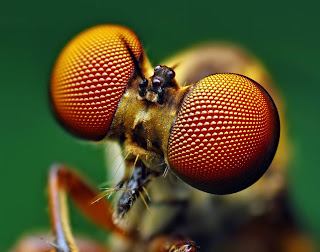
Robber fly - Nature photographer Thomas Shahan specializes in amazing portraits of tiny insects. It isn't easy. Shahan says that this Robber Fly (Holcocephala fusca), for instance, is "skittish" and doesn't like its picture taken.

Eye-popping bug photos

Nature by Numbers (Video)

"A Summary" – Apr 2, 2011 (Kryon channeled by Lee Carroll) (Subjects: Religion, Shift of Human Consciousness, 2012, Intelligent/Benevolent Design, EU, South America, 5 Currencies, Water Cycle (Heat up, Mini Ice Ace, Oceans, Fish, Earthquakes ..), Middle East, Internet, Israel, Dictators, Palestine, US, Japan (Quake/Tsunami Disasters , People, Society ...), Nuclear Power Revealed, Hydro Power, Geothermal Power, Moon, Financial Institutes (Recession, Realign integrity values ..) , China, North Korea, Global Unity,..... etc.) -
"The Quantum Factor" – Apr 10, 2011 (Kryon channeled by Lee Carroll) (Subjects: Galaxies, Universe, Intelligent design, Benevolent design, Aliens, Nikola Tesla (Quantum energy), Inter-Planetary Travel, DNA, Genes, Stem Cells, Cells, Rejuvenation, Shift of Human Consciousness, Spontaneous Remission, Religion, Dictators, Africa, China, Nuclear Power, Sustainable Development, Animals, Global Unity.. etc.) - (Text Version)


“ … Here is another one. A change in what Human nature will allow for government. "Careful, Kryon, don't talk about politics. You'll get in trouble." I won't get in trouble. I'm going to tell you to watch for leadership that cares about you. "You mean politics is going to change?" It already has. It's beginning. Watch for it. You're going to see a total phase-out of old energy dictatorships eventually. The potential is that you're going to see that before 2013.

They're going to fall over, you know, because the energy of the population will not sustain an old energy leader ..."

(Live Kryon Channelings was given 7 times within the United Nations building.)

"Update on Current Events" – Jul 23, 2011 (Kryon channelled by Lee Carroll) - (Subjects: The Humanization of God, Gaia, Shift of Human Consciousness, 2012, Benevolent Design, Financial Institutes (Recession, System to Change ...), Water Cycle (Heat up, Mini Ice Ace, Oceans, Fish, Earthquakes ..), Nuclear Power Revealed, Geothermal Power, Hydro Power, Drinking Water from Seawater, No need for Oil as Much, Middle East in Peace, Persia/Iran Uprising, Muhammad, Israel, DNA, Two Dictators to fall soon, Africa, China, (Old) Souls, Species to go, Whales to Humans, Global Unity,..... etc.)

"Recalibration of Free Choice"– Mar 3, 2012 (Kryon Channelling by Lee Caroll) - (Subjects: (Old) Souls, Midpoint on 21-12-2012, Shift of Human Consciousness, Black & White vs. Color, 1 - Spirituality (Religions) shifting, Loose a Pope “soon”, 2 - Humans will change react to drama, 3 - Civilizations/Population on Earth, 4 - Alternate energy sources (Geothermal, Tidal (Paddle wheels), Wind), 5 – Financials Institutes/concepts will change (Integrity – Ethical) , 6 - News/Media/TV to change, 7 – Big Pharmaceutical company will collapse “soon”, (Keep people sick), (Integrity – Ethical) 8 – Wars will be over on Earth, Global Unity, … etc.) - (Text version)

“… 4 - Energy (again)


The natural resources of the planet are finite and will not support the continuation of what you've been doing. We've been saying this for a decade. Watch for increased science and increased funding for alternate ways of creating electricity (finally). Watch for the very companies who have the most to lose being the ones who fund it. It is the beginning of a full realization that a change of thinking is at hand. You can take things from Gaia that are energy, instead of physical resources. We speak yet again about geothermal, about tidal, about wind. Again, we plead with you not to over-engineer this. For one of the things that Human Beings do in a technological age is to over-engineer simple things. Look at nuclear - the most over-engineered and expensive steam engine in existence!

Your current ideas of capturing energy from tidal and wave motion don't have to be technical marvels. Think paddle wheel on a pier with waves, which will create energy in both directions [waves coming and going] tied to a generator that can power dozens of neighborhoods, not full cities. Think simple and decentralize the idea of utilities. The same goes for wind and geothermal. Think of utilities for groups of homes in a cluster. You won't have a grid failure if there is no grid. This is the way of the future, and you'll be more inclined to have it sooner than later if you do this, and it won't cost as much….”


"Fast-Tracking" - Feb 8, 2014 (Kryon Channelling by Lee Carroll) - (Reference to Fukushima / H-bomb nuclear pollution and a warning about nuclear > 20 Min)

Obama unveils landmark regulations to combat climate change

Obama unveils landmark regulations to combat climate change
In a bid to combat climate change, US President Barack Obama announced the Clean Power Plan on Monday, marking the first time power plants have been targeted by mandatory regulations on carbon dioxide emissions in the US.
Google: Earthday 2013
Showing posts with label Cradle-to-cradle. Show all posts

Thursday, January 28, 2010

Environmentally-friendly artificial grass?


Imagine a lawn or a sports field made from artificial grass. It's hard to imagine something more unnatural, but Desso, a major Belgian-Dutch carpet manufacturer, is planning to introduce completely recyclable, environmentally-friendly artificial grass this year.

Desso's managing director Stef Kranendijk explains why artificial grass is better for the environment than the natural stuff:

"A vast amount of expensive water is necessary to keep playing fields green. And then there's the pesticides and herbicides used to get rid of the weeds, that's a real assault on the environment. You can also play far fewer matches on natural grass. If you are planning a competition, you need at least five playing fields; that uses five times the water and pesticides."

Farewell

The artificial grass industry focuses primarily on the sports market. The walls of the reception centre at the Desso factory in Dendermonde is resplendent with shirts from well-known clubs, including the Spanish national football team, the Philadelphia Eagles, Arsenal and Anderlecht FC, that have all bid natural grass playing fields farewell.

Mr Kranendijk says the company has still got a lot to achieve: "Just eight percent of the sports fields in the European Union are artificial grass, so we've got a long way to go".

Unfortunately artificial grass is made of plastic, or to be slightly more precise, polyethylene. And until now, when it wore out, that huge plastic carpet ended up in an incinerator or was dumped on a rubbish tip. But things are changing: Desso is planning to develop a grass carpet that is completely recyclable; when the plastic playing field has worn out, it will be returned to the factory and entirely reused without any loss of quality.

The principle is called Cradle-to-Cradle or C2C. It was originally a US recycling philosophy, but the principle is winning more and more adherents in the Netherlands. It's hardly a surprising phenomena as 100 percent recycling is good for the environment, cheaper in the long run and gives companies a very valuable green image. It's a win-win situation all round. Mr Kranendijk is the first to admit that his clients are prepared to pay extra for a super-environmentally-friendly product.

Basics

Just because 100 percent C2C is not yet possible doesn't detract from the basic idea. It is still impossible to expect that the plastic for the artificial grass will be created from plants - futuristic biopolymers - or that the vehicles transporting the carpet will run on green electricity, but that is the ultimate aim: 100 percent recyclable and zero percent pollution.

Desso is making a valiant attempt: the electricity that runs the factory is water-generated. It's not perfect, after all, reservoirs and dams also damage the environment, but the electricity generated is far cleaner than the electricity generated by coal, gas or nuclear power plants. A significant proportion of the water is also re-claimed and re-used and the company hopes to raise that proportion to 100 percent in the near future.


Competition

And then there is the recyclable artificial grass itself. Understandably, Mr Kranendijk refused to reveal exactly how Desso plans to make it, as competition is stiff. However, he did say that the blades of grass and the backing will be created from the same material. It is far from simple and has taken years of research as the two components perform very, very different functions and must fulfil other requirements. However, success is on the horizon and once the playing field has worn out, the entire grass carpet will be taken up and melted down into new polyethylene granules and used to make another artificial playing field.

At the moment, C2C artificial grass is in the final phase of development and the company hopes to lay the first 100 percent recyclable sports field in April, where athletes can train to their hearts’ content, happy in the knowledge that it's made of eco-plastic.

Friday, March 7, 2008

Netherlands' 'ugliest' city home to huge solar power venture

The Earth Times, Energy Environment News , DPA , Thu, 06 Mar 2008 02:10:06 GMT

Amsterdam - The central Dutch city of Almere is to be home to the world's third-largest solar energy installation, built on a 7,000-square-metre artificial island, and is set to provide 10 per cent of the city's domestic hot water. The solar energy installation will provide around 10 per cent of the energy used to supply hot water to some 2,700 homes in the city.

On February 29, Almere and the energy provider Nuon signed a contract for the development of the solar power field.

"The size of this solar power field is unprecedented in the Netherlands," Nuon press spokeswoman Susanne Klawer told Deutsche Presse-Agentur dpa.

"It is also the third largest solar power field in the world. Only Denmark and Sweden have bigger ones."

With an area of 7,000 square metres, the size of approximately three football fields, the solar power field covers just less than half the surface of the 15,000 square metre island. The solar power island is scheduled to open on June 21, 2009 - a symbolic date since June 21 is the longest day in the northern hemisphere.

The energy will be used for a city-heating system.

Usually, each home has its own central heating boiler or immersion heater which heats up the water used in a home's radiators and taps. In city heating, the water is heated centrally for an entire city or city quarter.

Once heated, the water runs through an underground system of pipes and tubes to all homes and buildings, providing them with hot water for heating and domestic use.

Nuon and the municipality claim the solar collector island will not only be environmentally-friendly, but also "a landmark piece of design."

It is, however, doubtful the Dutch inhabitants will agree with that.

Almere, founded in 1976 and now with some 178,000 inhabitants, has traditionally advertised itself as a city of modern and trendy design - but the Dutch public perceive it as desolate and boring.

Late last week, Almere was dubbed as the "ugliest city of the Netherlands" after a survey by the Dutch daily Volkskrant newspaper.

Nuon says the sun collectors are expected to cut by 50 per cent the carbon dioxide levels required to generate the necessary energy for the 2,700 homes.

"The sun collector island is one of several large-scale revolutionary initiatives by Almere that will benefit the environment," says Almere spokesman Peter Spek.

"We have also commissioned American architect William McDonough to develop an entire cradle-to-cradle neighbourhood, called Almere Poort (Gate of Almere). It will be completed within the next five years," he says.

Cradle-to-cradle is the theory that says everything humanity needs can be made from environmentally-friendly, 100-per-cent sustainable material.

In 2002, McDonough and German chemist and university professor Michael Baungart published their theory in a book Cradle to Cradle: Remaking the Way We Make Things.

The two have since been commissioned to develop a number of cradle- to-cradle projects.

Last year, the town of Venlo in the southern Netherlands began to develop Western Europe's largest horticulture centre - serving some 30 million consumers within a 150-kilometre radius stretching from the Netherlands to Germany's industrial Ruhr heartland - according to the cradle-to-cradle ideology.

Almere, the eighth largest city of the Netherlands, has now followed suit.

"Almere Poort will contain sustainable homes and the energy provided for these homes will also originate from sustainable energy," says Spek.

Asked whether the consumer will also benefit financially from solar energy, Nuon spokeswoman Klawer diplomatically says "the consumer will not see prices rise."

Spek points out that "building a sun collector field and other environmentally-friendly facilities requires a major investment."

"Someone has to pay for that," he adds.

Nuon says it is receiving a 1.5 million euros (2.27 million dollars) in a subsidy for the solar collector project, as part of European Union projects Crescendo and Concerto.

Asked about the total costs of the project and the number of years until the investment will start to pay off for Nuon, the company says it "does not release such information until after the project has been completed."

Tuesday, December 11, 2007

Pitt Unveils Sustainable Designs for New Orleans

By Alec Appelbaum, Architectural Records

Brad Pitt commissioned 14 busy architects to complete distinct designs in two months, told them to aim for a reusability standard so tough that only a handful of products meet it, and then demanded that all firms modify their plans however the client wants—if the client chooses their plans at all. A Hollywood brat ordering a new chateau? Not quite. This is how Pitt is helping rebuild a flood-ravaged New Orleans neighborhood with his “Make It Right” project, which last week unveiled 13 design models for replacing 150 houses in the Lower Ninth Ward destroyed by Hurricane Katrina and its aftermath.

Pitt inaugurated Make It Right in September and foundation employees have been working with 150 deed-holders, each of whom will pick a design and order modifications in the next several months. Architects include Adjaye Associates, BNIM, Constructs, Graft, KieranTimberlake, Morphosis, MRVDV, Pugh + Scarpa, and Shigeru Ban. Five local firms—Billes Architects, Concordia, Eskew Dumez Ripple, Trahan Architects, and John Williams Architects, which serves as executive architect for the whole project—also prepared plans.

All designs emphasize open porches, solar heat and light, and water resistance, but they differ in how they stack porches, detail roofs, and establish circulation patterns. That’s part of the goal, says Pitt spokesperson Virginia Miller: “The architects got a good sense of what was important. I heard a (deed-holder) say ‘I want my bedroom away from the front, for safety,’ but so many people wanted porches.” Among the individual prototypes’ unique features, Morphosis’ house can float while Adjaye’s stacks a porch, with carved walkways, atop a ground floor.

Make It Right hopes to start construction by spring 2008 and complete all 150 houses by autumn. The average cost of residences will be $150,000 and the foundation will coordinate no-interest loans to ensure that this price tag is capped at 30 percent of a deed-holder’s income. To subsidize construction, Pitt and film producer Steve Bing have promised to match up to $10 million in donations. The pair is also seeking sponsorship of materials or houses via the Web site makeitrightnola.org.

McDonough + Partners, whose “cradle-to-cradle” affiliates seek materials that biodegrade or offer eternal reuse, will help the foundation decide which donated materials offer the most economic and sustainable value. But William McDonough emphasizes that the goal with this project is to get people into durable houses rather than deliver a flawless prototype. “We’re looking at the full range, from stick-built through structural insulated panel,” he explains. “Designs will be reviewed through a cradle-to-cradle lens, but we’re trying to be realistic and humble about what we can do.”

Since the residences must be elevated five feet from the ground, to guard against floods, McDonough sees their ability to house future generations as a key measure of their success. “Part of the evaluation is the issue of social engagement,” he says of the designs’ porches, lawns, and close spacing.

This same model could work in communities elsewhere. To that end, James Timberlake, a principal of KieranTimberlake, says that he hopes Pitt shares the flexible designs with residents throughout the devastated Gulf Coast. “Our plans, along with several others, are a framework for personalization,” he says.

Sunday, December 2, 2007

Dutch horticulture, traffic, key to green future

Monstersandcritics.com, Dec 1, 2007, 12:19 GMT

Amsterdam - If the people of Venlo have their way, new buildings in this busy nexus of the Netherlands, Germany and Belgium will generate more energy than they use.

This ambitious target has been gaining momentum in the province of Limburg, southern Netherlands, since the airing of a television documentary about the revolutionary concept of 'cradle-to-cradle' living that produces zero garbage and zero pollution yet allows maximum economic activity.

The idea would to be have things up and running by the time the once-a-decade mammoth flower show - Floriade - starts drawing world tourists to the region in 2012.

In fact, the horticulture industry and Floriade are lynchpins in the recycling concept of the Planet Prosperity Foundation (PPF), the group launching the project. A meeting in early November drew 650 producers, entrepreneurs, environmentalists and local politicians to discuss the way forward.

As world governments head to Bali, Indonesia, in December to discuss what happens after the two-year-old Kyoto Protocol on climate change - imposing mandatory cuts on industrial nations' emissions - expires in 2012, projects like this one are sure to attract attention.

Carbon dioxide is key to the Venlo concept. Plans call for trucks to collect carbon dioxide emissions in on-board storage tanks and deliver the gas to hot houses, where bacteria and algae will turn the CO2 into fuel. There's no shortage of carbon dioxide in the region, with five highways headed to Germany alone from Venlo, a major transport hub on Europe's InterCity train line.

New industrial parks are to make wide use of ecological roofs of moss and solar panels. The Floriade will be powered by solar and biofuels, and materials used in construction will be biodegradable or reusable.

The region was inspired by the 2006 Dutch public television documentary 'Afval = Voedsel,' or Garbage equals Food, which spotlighted the work of the dynamic German-American eco team, Michael Braungart and William McDonough.

Braungart, a chemist and German university professor in Lower Saxony, and McDonough, an architect, have made their name brainstorming award-winning designs - like an eco-friendly production facility for Ford motors in the United States. In 2002, they wrote a book, 'Cradle to Cradle: Remaking the Way We Make Things.'

The two believe that everything humanity needs can be made of environmentally friendly, 100-per-cent sustainable material. Moss, used on the Ford factory, is a key element because it guarantees maximum insulation and, not coincidentally, also absorbs carbon dioxide.

Within months of the programme's airing, local politicians in tiny Venlo, a city of 92,000, decided to become the pioneering ground for the cradle-to-cradle theory.

Braungart emphasized at the November conference that Venlo and the surrounding region are an ideal testing ground.

The region is Western Europe's largest horticulture centre, serving some 30 million consumers within a 150 kilometre radius stretching from the Netherlands to Germany's industrial Ruhr heartland. It is an important centre of industrial production. And trucks criss-cross the region with products, goods and services, with the logistics sector engaging some 30,000 people in Venlo alone.

To get the ball rolling, Harry Loozen and Dick Thesingh, director and marketing manager of the Chamber of Commerce of the Dutch province of Limburg-Noord, contacted the province of Limburg, the Floriade, and several other public and private partners.

Together, they founded the Planet Prosperity Foundation (PPF), whose director, Roger Cox, is an enthusiastic promoter.

'All cities cope with sustainability problems. They all need to comply with the Kyoto Protocol. That's why we advocate the implementation of the cradle-to-cradle on the regional level,' he said.

Braungart was impressed with the turnout.

'The enormous number of participants at this conference and their enthusiasm demonstrates that there is a strong public interest in pushing forward with cradle-to-cradle,' he said.

He also encouraged each sector to pursue change 'without fearing to make mistakes. Just do it.'

The meeting drew a large number of architects and designers, established banks such as ABN Amro and ING Bank, and international producers such as printing company Oce Technologies.

One of the world's largest carpet manufacturers, Shaw Floors, of Dalton, Georgia, US, described how its production costs dropped dramatically after it had implemented the cradle-to-cradle theory in its production process. Its 23-billion-kilogramme annual garbage output had dropped drastically.

The 21 workshops even had some immediate results. A snack producer decided to switch to recycled packaging, and several companies pledged to buy only new furniture made of reusable fabric.