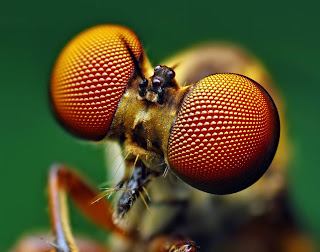
Robber fly - Nature photographer Thomas Shahan specializes in amazing portraits of tiny insects. It isn't easy. Shahan says that this Robber Fly (Holcocephala fusca), for instance, is "skittish" and doesn't like its picture taken.

Eye-popping bug photos

Nature by Numbers (Video)

"A Summary" – Apr 2, 2011 (Kryon channeled by Lee Carroll) (Subjects: Religion, Shift of Human Consciousness, 2012, Intelligent/Benevolent Design, EU, South America, 5 Currencies, Water Cycle (Heat up, Mini Ice Ace, Oceans, Fish, Earthquakes ..), Middle East, Internet, Israel, Dictators, Palestine, US, Japan (Quake/Tsunami Disasters , People, Society ...), Nuclear Power Revealed, Hydro Power, Geothermal Power, Moon, Financial Institutes (Recession, Realign integrity values ..) , China, North Korea, Global Unity,..... etc.) -
"The Quantum Factor" – Apr 10, 2011 (Kryon channeled by Lee Carroll) (Subjects: Galaxies, Universe, Intelligent design, Benevolent design, Aliens, Nikola Tesla (Quantum energy), Inter-Planetary Travel, DNA, Genes, Stem Cells, Cells, Rejuvenation, Shift of Human Consciousness, Spontaneous Remission, Religion, Dictators, Africa, China, Nuclear Power, Sustainable Development, Animals, Global Unity.. etc.) - (Text Version)


“ … Here is another one. A change in what Human nature will allow for government. "Careful, Kryon, don't talk about politics. You'll get in trouble." I won't get in trouble. I'm going to tell you to watch for leadership that cares about you. "You mean politics is going to change?" It already has. It's beginning. Watch for it. You're going to see a total phase-out of old energy dictatorships eventually. The potential is that you're going to see that before 2013.

They're going to fall over, you know, because the energy of the population will not sustain an old energy leader ..."

(Live Kryon Channelings was given 7 times within the United Nations building.)

"Update on Current Events" – Jul 23, 2011 (Kryon channelled by Lee Carroll) - (Subjects: The Humanization of God, Gaia, Shift of Human Consciousness, 2012, Benevolent Design, Financial Institutes (Recession, System to Change ...), Water Cycle (Heat up, Mini Ice Ace, Oceans, Fish, Earthquakes ..), Nuclear Power Revealed, Geothermal Power, Hydro Power, Drinking Water from Seawater, No need for Oil as Much, Middle East in Peace, Persia/Iran Uprising, Muhammad, Israel, DNA, Two Dictators to fall soon, Africa, China, (Old) Souls, Species to go, Whales to Humans, Global Unity,..... etc.)

"Recalibration of Free Choice"– Mar 3, 2012 (Kryon Channelling by Lee Caroll) - (Subjects: (Old) Souls, Midpoint on 21-12-2012, Shift of Human Consciousness, Black & White vs. Color, 1 - Spirituality (Religions) shifting, Loose a Pope “soon”, 2 - Humans will change react to drama, 3 - Civilizations/Population on Earth, 4 - Alternate energy sources (Geothermal, Tidal (Paddle wheels), Wind), 5 – Financials Institutes/concepts will change (Integrity – Ethical) , 6 - News/Media/TV to change, 7 – Big Pharmaceutical company will collapse “soon”, (Keep people sick), (Integrity – Ethical) 8 – Wars will be over on Earth, Global Unity, … etc.) - (Text version)

“… 4 - Energy (again)


The natural resources of the planet are finite and will not support the continuation of what you've been doing. We've been saying this for a decade. Watch for increased science and increased funding for alternate ways of creating electricity (finally). Watch for the very companies who have the most to lose being the ones who fund it. It is the beginning of a full realization that a change of thinking is at hand. You can take things from Gaia that are energy, instead of physical resources. We speak yet again about geothermal, about tidal, about wind. Again, we plead with you not to over-engineer this. For one of the things that Human Beings do in a technological age is to over-engineer simple things. Look at nuclear - the most over-engineered and expensive steam engine in existence!

Your current ideas of capturing energy from tidal and wave motion don't have to be technical marvels. Think paddle wheel on a pier with waves, which will create energy in both directions [waves coming and going] tied to a generator that can power dozens of neighborhoods, not full cities. Think simple and decentralize the idea of utilities. The same goes for wind and geothermal. Think of utilities for groups of homes in a cluster. You won't have a grid failure if there is no grid. This is the way of the future, and you'll be more inclined to have it sooner than later if you do this, and it won't cost as much….”


"Fast-Tracking" - Feb 8, 2014 (Kryon Channelling by Lee Carroll) - (Reference to Fukushima / H-bomb nuclear pollution and a warning about nuclear > 20 Min)

Obama unveils landmark regulations to combat climate change

Obama unveils landmark regulations to combat climate change
In a bid to combat climate change, US President Barack Obama announced the Clean Power Plan on Monday, marking the first time power plants have been targeted by mandatory regulations on carbon dioxide emissions in the US.
Google: Earthday 2013
Showing posts with label Water Cycle. Show all posts

Friday, August 5, 2022

Great Barrier Reef sees fragile coral comeback

 Yahoo – AFP, Andrew BEATTY, August 4, 2022 

Parts of Australia's beleaguered Great Barrier Reef now have the highest levels of coral cover seen in decades, a government report said Thursday, suggesting the aquatic wonder could survive given the chance. 

Portions of the vast UNESCO heritage site showed a marked increase in coral cover in the last year, reaching levels not seen in 36 years of monitoring, the Australian Institute of Marine Science said. 

Scientists surveying 87 sites said northern and central parts of the reef had bounced back from damage more quickly than some had expected, thanks mainly to fast-growing Acropora -- a branching coral that supports thousands of marine species. 

"These latest results demonstrate the reef can still recover in periods free of intense disturbances," said the Australian Institute of Marine Science's CEO Paul Hardisty. 

But far from declaring victory, Hardisty warned the gains could easily be reversed by cyclones, new bleaching events or crown-of-thorns outbreaks. 

He pointed to a reversal in fortunes for the southern portion of the reef, which a year ago had appeared to be on the mend, but was now in decline again. 

"This shows how vulnerable the reef is to the continued acute and severe disturbances that are occurring more often, and are longer-lasting," he said. 

Coral coverage has increased by 36 percent across sites monitored in the northern part of the reef, up from 27 percent in 2021. 

But the picture was less encouraging as the scientists moved south, with a smaller increase in cover in the reef's central belt and a marked decrease in coral cover in the south. 

The spread of coral-killing crown-of-thorns starfish has also taken a toll. 

Only fierce lobbying by the Australian government stopped the reef from being labelled "in danger" by UNESCO -- a potentially devastating blow to the country's multi-billion-dollar tourism industry. 

Many fear that the speeding rate of damage could cause the reef to be destroyed entirely. 

Marine scientist Terry Hughes said it was "good news" that coral was regrowing, but warned the species driving the recovery were very vulnerable to ocean heating. 

He added that replacing large, old, slow-growing corals that had defined the reef was likely "no longer possible. Instead we're seeing partial reassembly of fast-growing, weedy corals before the next disturbance." 

Zoe Richards a researcher at the Coral Conservation and Research Group at Curtin University also cautioned against over-optimism. 

"This recovery trend is driven by a handful of Acropora species which often grow in a boom-and-bust pattern," she said. "This means that the next thermal stress event could easily decimate these coral communities once again." 

"We are already finding evidence that each mass bleaching event leads to local extinctions of rarer species, so the short-term success of a handful of fast-growing coral species masks the full story about the largely hidden losses of biodiversity."

Related Article:

"....The Prediction: The Renewal of the Life Cycle

When you change the temperature strata of the oceans of the earth, things start to change, for the life cycle of the food in the ocean depends upon that which is the smallest. The plankton of the planet survive in certain temperatures, and that's changing. Throw away what you think you know about how it's all supposed to work, and instead think "renewal" or "how did it begin." This will serve you to understand what is happening now. This cycle is built to replenish the ocean with life and not always by sustaining the kind that was there.

Let us just talk about the ocean for a moment. We won't even get to what's happening in the air and what mammals might experience. Let's just speak of the ocean. Have you heard about the salmon? What has your science warned you against? You're overfishing! The sea is dying. The coral is dying. The reefs are going away. You're not seeing the food chain that used to be there. You've overfished everything. Fishing quotas have been set up to help this. Oh, all those little people in the red room - they don't know about the purple. Red people only know about the red paradigm.

Did you hear about the salmon recently? There's too many of them! In the very place where quotas are in place so you won't overfish, they're jumping in the boats! Against all odds and any projections from environmentalists or biologists, they're overrunning the oceans in Alaska - way too many fish.

What does that tell you? Is it possible that Gaia takes care of itself? That's what it tells you! Perhaps this alignment is going to keep humanity fed. Did anybody think of this? What if Gaia is in alliance with you? What if the increase in consciousness that raised your DNA vibration has alerted Gaia to change the weather cycle and get ready to feed humanity? Are you looking at the ocean where the oil spill occurred? It's recovering in a way that was not predicted. What's happening?

The life cycle itself is being altered by the temperature change of the ocean and much of what you have believed is the paradigm of life in the sea is slowly changing. A new system of life is appearing, as it has before, and is upon you in your lifetime. It will compliment what you know and expose you to a new concept: Gaia regularly refreshes the life cycle on Earth.

Within this process, there will be the extinction of certain plants and animals, birds and fish. My advice to you, especially to those environmentalists, is to understand the cycle of life so that you may relax with what nature has always done. It puts life on the planet to serve the planet for a time. When certain life no longer serves the planet in the ways it used to, it takes it away. The extinction of life, especially through weather change, is normal for Gaia. It is honored, appropriate and normal, even if you don't think so. Don't try to save all the disappearing animals, fish and birds! Some are supposed to go away. And, dear ones, don't assign all this activity to something you did to cause it!

The red people are stressing. The purple is here, and they are trying to figure out what they did wrong. They don't know they are in the Rainbow Room. They think they are in the RED ROOM. This is what the Rainbow Room does; it changes colors. So as the room does what it has always done, the red people are sitting there in fear trying to figure out what it is that they did that possibly could have caused the purple to appear.

The Rainbow Room is beautiful. The color purple is significant. Going from red to purple has metaphysical significance within this parable, but I'll let you figure it out. For those who are into colors, there's a reason why I gave those two. The earth is becoming more sacred than it's ever been before. Gaia is with you in this. It's cooperating in ways you never thought it could, in the way biologists said it would not. You think you're killing it? Instead, it's giving birth to an altered ecological system. ...."

Tuesday, June 30, 2020

South Pole warming three times faster than rest of Earth: study

Yahoo – AFP, Patrick GALEY, June 29, 2020

For years it had been thought that the South Pole had stayed cool even as the
continent heated up (AFP Photo/FERNANDA REBULL)

Paris (AFP) - The South Pole has warmed three times faster than the rest of the planet in the last 30 years due to warmer tropical ocean temperatures, new research showed Monday.

Antarctica's temperature varies widely according to season and region, and for years it had been thought that the South Pole had stayed cool even as the continent heated up.

Researchers in New Zealand, Britain and the United States analysed 60 years of weather station data and used computer modelling to show what was causing the accelerated warming.

They found that warmer ocean temperatures in the western Pacific had over the decades lowered atmospheric pressure over the Weddell Sea in the southern Atlantic.

This in turn had increased the flow of warm air directly over the South Pole -- warming it by more than 1.83C (about 3.3F) since 1989.

Authors of the research said the natural warming trend was likely boosted by manmade greenhouse gas emissions and could be masking the heating effect of carbon pollution over the South Pole.

"While temperatures were known to be warming across West Antarctica and the Antarctic Peninsula during the 20th century, the South Pole was cooling," said Kyle Clem, a researcher at Victoria University of Wellington, and lead study author.

"It was suspected that this part of Antarctica... might be immune to/isolated from warming. We found this is not the case any more," he told AFP.

The data showed that the South Pole -- the most remote spot on Earth -- was now warming at a rate of around 0.6C (1.1F) a decade, compared with around 0.2C (1.4F) for the rest of the planet.

The authors of the study, published in the Nature Climate Change journal, attributed the change to a phenomenon known as the Interdecadal Pacific Oscillation (IPO).

The IPO cycle lasts roughly 15-30 years, and alternates between a "positive" state -- in which the tropical Pacific is hotter and the northern Pacific is colder than average -- and a "negative" state where the temperature anomaly is reversed.

The IPO flipped to a negative cycle at the start of the century, driving greater convection and more pressure extremes at high latitudes, leading to a strong flow of warmer air right over the South Pole.

Clem said that the 1.83C (3.3F) level of warming exceeded 99.99 percent of all modelled 30-year warming trends.

"While the warming was just within the natural variability of climate models, it was highly likely human activity had contributed," he said.

Related Articles:


(Subjects: Religion, Shift of Human Consciousness, 2012, Intelligent/Benevolent Design, EU, South America, 5 Currencies, Water Cycle (Heat up, Mini Ice Ace, Oceans, Fish, Earthquakes ..), Middle East, Internet, Israel, Dictators, Palestine, US, Japan (Quake/Tsunami Disasters , People, Society ...), Nuclear Power Revealed, Hydro Power, Geothermal Power, Moon, Financial Institutes (Recession, Realign integrity values ..) , China, North Korea, Global Unity,..... etc.) - (Text version)

“… The Weather

Let's talk about the weather. We retreat to exactly what we told you before in this very chair. The water cycle is a cooling cycle, not a heating cycle. You're going to have more severe winters and storms. It's going to get colder. But it gets warmer before it gets colder. That is the cycle, and it has always been the cycle. You can see it in the rings of the trees and the cores of the ice. Don't let your scientists pull the political wool over your eyes for their own purposes. Start seeing these things for what they are. It's a recurring cycle based on four Earth alignment attributes, including the wobble (the precession). You're in this cycle. Prepare.

The beginnings of it will be with you from now at least until the end of the 2012 36-year window, and you can watch it work. The first thing that happens is that the ice melts at the poles, but not completely. It's the way it has happened before. As the redistribution of weight from the poles to the oceans of the earth takes place, the weight is redistributed to the crust, and that creates earthquakes. And the earthquakes that will be the most powerful are the ones that are closest to the poles. We told you that some time ago. So it's not a mystery that suddenly you have some of the most powerful earthquakes that you've ever had. Not only that, but a cooling ocean creates larger storms.

What do the conspiracists do with all this? "See? We're doomed. Here it comes," they say. "Here it comes! The end is here!" Twenty-two years ago, we gave you the information that is happening today. We told you about the weather. We told you to get ready for it, but we still haven't told you why the water cycle is needed. We've hinted at it since it is very controversial, and we'll lose many readers right here and now. Here's the prediction: The scientists are going to laugh and biologists are going to scratch their heads and roll their eyes.

The Refreshing of the Cycle of Life

When you change the temperature of the waters of the planet, it changes the life cycle of the ocean and it eventually renews itself. The life cycle of the planet has a limit to its viability over time. There has to be a refreshing of the very cycle of life, and this is what the water cycle does. Are there any places you've seen too many fish lately? Yes. Millions of salmon in the north. Odd that it was in Alaska, isn't it? Alaska is very close to the poles where the water temperature is being felt first. Oh, again the experts will tell you that this is not the reason. It's about hatcheries and rivers. But nobody predicted this, did they? Science is fast to give you reasons, but slow to give you logic in advance. They always seem to be surprised.

We are saying things we haven't said before. Again, watch for this, an actual change in the life cycle of the planet's oceans because of the water temperature shift. Biologists are going to have to start redesigning the paradigm of how everything works, including reefs, ocean bottoms, and how plankton survive and reproduce. Listen, this is not the first time that the life cycle has been refreshed! But again, this may take generations of humanity to complete. In the process, you may again lose species. This is normal. Gaia is slow, and Humans are impatient. Your textbooks may someday tell of how naive humanity was back in 2011 when they tried to blame weather changes on everything but a natural cycle. Now you know why there is a water cycle.

So what does that tell you about Gaia? Gaia is beginning the cycle of refreshing life on over-fished oceans. It tells you that in the cracks, there is love and caring about the Humans who live on the earth. There's a reason you're here. There's a plan here, and a benevolent Universe and quantum energy with intelligent design. All is there for you, precious, sacred Human Being. …”

Tuesday, February 25, 2020

Bushfires burned a fifth of Australia's forest: study

Yahoo – AFP, Patrick GALEY, February 24, 2020

Australia's annual average forest loss to wild fires is typically well below 2 percent --
but a study has shown around 21 percent was lost between September and January
(AFP Photo/SAEED KHAN)

Paris (AFP) - Australia's wildfires have destroyed more than a fifth of the country's forests, making the blazes "globally unprecedented" following a years-long drought linked to climate change, researchers said Monday.

Climate scientists are currently examining data from the disaster, which destroyed swathes of southeastern Australia, to determine to what extent they can be attributed to rising temperatures.

In a special edition of the journal Nature Climate Change, Australian researchers examined several other aspects of the blazes, including investigations into their extent and possible causes.

One study showed that between September 2019 and January 2020 around 5.8 million hectares of broadleaf forest were burned in New South Wales and Victoria.

This accounts for roughly 21 percent of the nation's forested area, making this fire season proportionately the most devastating on record.

"Halfway through Spring 2019 we realised that a very large part of the eastern Australian forest could be burned in this single season," Matthias Boer, from the Hawkesbury Institute for the Environment at Western Sydney University, Penrith, told AFP.

One study author warned the data almost certainly underestimates the extent of
forest loss as the island state of Tasmania was not covered by the research (AFP 
Photo/PETER PARKS)

"The shock came from realising that this season was off the charts globally in terms of the percentage of the continental section of a forest biome that burned."

Boer said his study almost certainly underestimates the extent of forest loss as the island state of Tasmania was not covered in the data.

Australia's annual average forest loss to wild fires is typically well below 2 percent.

Droughts linked to sea temperature

Another study published Monday looked at the conditions that made the fires so damaging -- a years-long dry spell in Australia's Murray-Darling Basin.

Droughts create more fuel for wildfires and make it harder for forests to recover after each blaze.

Andrew King, from the University of Melbourne, and colleagues looked at a phenomenon known as the Indian Ocean Dipole (IOD), which has a direct effect on rainfall levels in Australia and elsewhere.

Since 2017 much of Australia has experienced widespread drought, something the study attributed to a relative lack of negative IOD events -- when there are warmer than normal sea surface temperatures in the east Indian Ocean with cooler waters in the west.

Climate scientists are currently examining data from the disaster, which saw swathes 
of southeastern Australia destroyed, to determine to what extent they can be attributed
to rising temperatures (AFP Photo/TOM BANNIGAN)

These events tend to shift weather patterns and typically bring greater rainfall to southeast Australia, and are made less frequent as global sea temperatures warm.

King and the team examined rainfall statistics and found that the winter of 2016 saw extremely heavy precipitation and a corresponding negative IOD event.

Since then, the Murray-Darling Basin has experienced 12 consecutive seasons with below-average rainfall, the longest period on record since 1900.

"With climate change there have been projections that there will be more positive IOD events and fewer negative IOD events," King told AFP.

"This would mean that we'd expect more dry seasons in Australia and possibly worse droughts."

Boer said that climate change was all but certain to make Australia more prone to wildfires and urged the government to strengthen fire readiness measures and "take urgent and effective action on climate change."

Related Articles:


(*)  Kryon explains what is going on with the Weather/Climate Change 
(**) Kryon gives Australia fire suggestions

Sunday, January 19, 2020

Right fire for right future: how cultural burning can protect Australia from catastrophic blazes

The Guardian, Lorena Allam, Sat 18 Jan 2020

Traditional knowledge has already reduced bushfires and emissions in the top end, so why isn’t it used more widely?

Kija Rangers conduct prescribed burning in the East Kimberley in 2019.
Photograph: Supplied/Kimberley Land Council

Indigenous fire practitioners have warned that Australia’s bush will regenerate as a “time bomb” prone to catastrophic blazes, and issued a plea to put to use traditional knowledge which is already working across the top end to reduce bushfires and greenhouse gas emissions.

“This is a time bomb ticking now because all that canopy has been wiped out,” says Oliver Costello of the national Indigenous Firesticks Alliance.

“A lot of areas will end up regenerating really strongly, but they’ll return in the wrong way. We’ll end up with the wrong species compositions and balance.

 “That’s why we need to get Indigenous fire practices out into the landscape in the coming months, to start to read the country and look at areas that need restoration burning in the short term.”

As Australia comes to terms with this season’s catastrophic fires, Indigenous practitioners like Costello are advocating a return to “cultural burning”.

What is cultural burning?

Small-scale burns at the right times of year and in the right places can minimise the risk of big wildfires in drier times, and are important for the health and regeneration of particular plants and animals.

Different species relate to fire in different ways, Costello explains. Wombats, for example, dig burrows to escape, while koalas climb into the canopy.

“When you understand the fire relationships they have, their own fire culture, then you are really applying the right fire for that culture so that you’re supporting the identity of that place.

“When you do that, you get more productive landscapes, you get healthier plants and animals, you get regeneration, you discourage invasive elements, which are sometimes native species that might belong in the system next door.

“It’s so important to apply that right fire for right country, so you can maintain the right balance.”

Aboriginal rangers and traditional owners conduct burns in the Katiti-Petermann
 Indigenous Protected Area, in the remote desert country near the Western
Australia and Northern Territory border. Photograph: Helen Davidson/The Guardian

Dr David Bowman is a professor of pyrogeography and fire science at the University of Tasmania. Bowman describes Indigenous fire management as “little fires tending the earth affectionately”.

“The affectional is the opposite of mechanical. It’s with emotion. So it can be reverence, affection, fear, a whole range of emotions, but it’s an emotional relationship you have with land using fire to create mosaics and flammable habitat mosaics, which are really good for biodiversity and a really good way of managing fuel load.”

Where is it used in Australia?

In northern Australia, Indigenous land ownership is widespread. Caring for country and ranger programs in protected areas has delivered a degree of autonomy to traditional owners to walk the country, burning according to seasonal need and cultural knowledge.

Indigenous fire management involves “cool” fires in targeted areas during the early dry season, between March and July. The fires burn slowly and in patches.

In the Kimberley, the Land council holds community fire planning meetings throughout the early dry season to ensure the correct people are burning their country.

“Traditional owners are consulted and native title holders design burn lines and fire walk routes,” the KLC acting CEO Tyronne Garstone says.

“These burn lines are approved by the group and Indigenous rangers perform the on-ground work, backed up by modern technology with rangers taking constant weather readings and recording the conditions of the day.

“They work very well at combining the old people’s fire practices with modern techniques.”

Even so, climate change is affecting their ability to do “right way” fire management, Garstone says.

“These ‘right way’ fire days are getting fewer and fire behaviour is changing along the same lines as over east. Late season conditions are also driving more fires in unusual ways due to the climatic conditions we are currently facing.”

Kija Rangers conduct prescribed or ‘cool’ burning in the East Kimberley
in the dry season, 2019. Photograph: Supplied/Kimberley Land Council

How effective is it?

The Darwin centre for bushfire research at Charles Darwin University maps bushfires weekly. Since traditional burning was reintroduced on a large scale, the centre has collected enough data to show that the area of land destroyed by wildfires has more than halved, from 26.5m hectares in 2000, to just 11.5m hectares in 2019.

“We have annual fires up here,” the centre’s research fellow Andrew Edwards says. “Forty per cent of the top end could burn every year. So we had to do something about that.”

“We were originally much more interested in biodiversity, Aboriginal employment and getting people back on country to manage it properly, but when the carbon economy came along we saw a way to manage fire to abate greenhouse gas emissions.

“It was pretty bad before that happened,” Edwards says. “It was just fires running wild across huge tracts of north Australia that nobody was doing anything about.”

Edwards says the top end cooperative model can be adapted to southern conditions.

“That’s what needs to be looked at. Obviously there’s a lot more infrastructure to set up, but it’s collaboration and education.

“If we want to manage our natural environment properly, we need to be doing prescribed burning. There’s so much cultural knowledge out there still, and it’s being totally ignored. There’s hundreds of Indigenous rangers out there now doing this work.”

The Oriners and Sefton Savannah Burning Project creates carbon credits, using
strict scientific methodologies, approved through a rigorous accreditation process
with the Department of Environment, to store carbon in the natural landscape.
Photograph: Richard Wainwright/Caritas Australia

Will these practices be widely adopted?

In southern Australia, Oliver Costello says, Aboriginal knowledge systems are far less valued but hold important solutions.

The Coag national bushfire management policy includes a commitment to “promote Indigenous Australians’ use of fire”, but Indigenous fire groups like Firesticks Alliance say they need more resources to build capacity.

“There are a lot of policy settings at a high level that support us, but there’s nothing in between. There’re no resources,” Costello says.

“There’s no investment really outside of northern Australia Indigenous fire management of any significance, and they had to build a whole new economy to support it through carbon.

“There’s always investment going into future firefighting capacity, more trucks, more helicopters, more this, more that. What we need is people getting out into the landscape now, with the knowledge to start to heal it.

A small cool burn managed by Indigenous firesticks alliance.
Photograph: Firesticks Alliance Indigenous Corporation/PA

Professor Bowman says it is possible to “blend Aboriginal with European and modern scientific approaches to create an opportunity for all land users and land owners”.

He suggests small-scale local “Green fire” groups modelled on the Landcare program.

“I would like to see a crossover between Indigenous and mainstream fire management groups, where there can be exchange and recognition.

“Because in the end there’s two things which are important to [remember]: all humans have come from a fire management background in their cultures, it’s just that some cultures ended up obliterating that knowledge because of industrialisation.

“We should really prioritise employment of Aboriginal people. But when there’s a gap we could be filling that gap with community groups. And there’s a really good opportunity for Aboriginal people to be involved in training.

“We need to encourage and promote the philosophy of Aboriginal fire practice because that’s going to be a really important pathway for sustainable fire management and also for healing because so many communities have been traumatised and shocked by the scale of the burning.”

Costello says the areas that haven’t burned this time around are now even more vulnerable.

“They are critical parts of the landscape [that need] to be able to support the animals and plants that have survived. And so those areas are going to be under increasing pressure and they’re also at risk of a future fire.

“There was an economy before settlement that supported this, a resource economy based on people looking after the land and having all that they needed.

“Now in the modern society it revolves around money. So we need to build economies that support cultural practice and acknowledge traditional custodianship.

“There’s all this canopy that’s been burnt away. We’ve got knowledge and techniques that can help heal that country in the future. It’s going to take some time. We’ve got probably two or three years before we can really be effective in some of that country because it needs to recover. But if we don’t get in there after that, then we miss our chance.”


Related Articles:


(*)  Kryon explains what is going on with the Weather/Climate Change 
(**) Kryon gives Australia fire suggestions

Monday, January 6, 2020

Russia unveils climate 'adaptation' plan

Yahoo – AFP, Maria ANTONOVA, January 5, 2020

Snow problem: Russia will also look at "positive" effects of climate change such
as are decreased energy use in cold regions, expanding agricultural areas
and navigational opportunities in Arctic waters (AFP Photo/Kirill KUDRYAVTSEV)

Moscow (AFP) - The Russian government has published a plan to adapt the economy and population to climate change, aiming to mitigate damage but also "use the advantages" of warmer temperatures.

The document, published on the government website on Saturday, outlines a plan of action and admits that changes in the climate have had a "prominent and increasing effect" on socioeconomic development, people's lives, health and industry.

Russia is warming 2.5 times quicker than the planet on average, and the two-year "first stage" plan is an indication that the government officially recognises this as a problem, even though President Vladimir Putin denies that human activity is the cause.

It lists preventive measures such as dam building or switching to more drought-resistant crops, as well as crisis preparations including emergency vaccinations or evacuations in case of a disaster.

The plan is needed to "lower the losses and use the advantages".

It says climate change poses risks to public health, endangers permafrost, increases the likelihood of infections and natural disasters. It also can lead to different species being pushed out of their usual habitats.

Possible "positive" effects are decreased energy use in cold regions, expanding agricultural areas and navigational opportunities in the Arctic ocean.

Unseasonably warm Christmas

The document lays the groundwork for various agencies and stresses the need for more research on economic vulnerabilities, without detailing financing.

Among a list of 30 measures, the government will calculate risks of Russian products becoming uncompetitive and failing to meet new climate-related standards as well as prepare new educational materials to teach climate change in schools.

Russia is one of the most vulnerable countries to climate change, with vast Arctic regions and infrastructure built over permafrost. Recent floods and wildfires have been among the planet's worst climate-related disasters.

Russia formally adopted the Paris climate accord in September of last year and criticised the US withdrawal from the pact.

Putin however has repeatedly denied the scientific consensus that climate change is primarily caused by man-made emissions, blaming it last month on some "processes in the universe".

He has also criticised Swedish climate campaigner Greta Thunberg, painting her as an uninformed impressionable teenager possibly being "used" in someone's interests.

He also voiced scepticism on numerous occasions about solar and wind energy, expressing alarm about the danger of turbines to birds and worms, causing them to "come out of the ground" by vibrating.

While there is evidence of that large wind-power installations can pose a risk to birds, known research does not suggest they harm worms.

On Sunday, Russia's meteorological service predicted temperatures up to 16 degrees Celsius higher than normal Monday and Tuesday, when Russia celebrates Orthodox Christmas.

"Weather on Christmas will be warmer than normal almost on the entire Russian territory," it said on its website.

The service said temperatures were expected to be four to eight degrees higher than normal in the European part of the country, and 10 to 16 degrees higher beyond the Urals.

Sunday, January 5, 2020

Power supply fears as troops called to battle Australia bushfires

Yahoo – AFP, Holly ROBERTSON, with Andrew Beatty and Glenda Kwek in Sydney, ,January 4, 2020

Temperatures have soared above 40 degrees Celsius (104 Fahrenheit) in Australia,
and gale-force winds have fanned hundreds of fires (AFP Photo/PETER PARKS)

Skies turned black and ash rained down as fires raged across southeastern Australia on Saturday, threatening power supplies to major cities and prompting the call-up of 3,000 military reservists.

Temperature records were smashed, and gale-force winds pounded fire-stricken coastal communities in the two most populous states New South Wales and Victoria.

New South Wales Premier Gladys Berejiklian warned that worst-case scenario projections were "coming to fruition", although large-scale evacuations meant the human toll was minimised.

Since late September, 23 people have died, more than 1,500 homes have been damaged and an area roughly twice the size of Belgium or Hawaii has burned.

Location of areas affected by fires since September 2019 in Australia (AFP Photo/Simon MALFATTO)

The latest fatalities were in Kangaroo Island -- a tourist haven southwest of Adelaide -- when two people were trapped in a car overrun by flames on Friday.

But strong winds and high temperatures continued to fuel hundreds of fires and cause chaos.

Bushfires took out two substations and transmission lines, prompting authorities in New South Wales to warn that an area home to almost eight million people and the nation's largest city Sydney could experience rolling blackouts.

"We are in for a long night and we have still to hit the worst of it," Berejiklian warned as another total fire ban was declared for Sunday.

Prime Minister Scott Morrison announced the largest military call-up in living memory, mobilising 3,000 reservists to assist thousands of volunteer firefighters who have been battling the blazes.

Prime Minister Scott Morrison has called up 3,000 military reservists to tackle 
Australia's relentless bushfire crisis (AFP Photo/PETER PARKS)

"Today's decision puts more boots on the ground, puts more planes in the sky, puts more ships at sea," said Morrison, who made the announcement after being pilloried for his response to the deadly disaster.

But even that move prompted outrage when his Liberal Party turned it into a campaign ad, with shadow minister for international development Pat Conroy accusing Morrison of trying to "exploit a national tragedy".

Record temperatures

A state of emergency had been declared across much of the heavily populated southeast and more than 100,000 people were told to leave their homes across three states.

Thousands heeded that call on Friday, abandoning summer holidays and piling into cars that clogged the highways linking southeastern coastal towns with the relative safety of Sydney or larger towns.

With temperatures expected to rise, a state of emergency has been declared across 
much of Australia's heavily populated southeast (AFP Photo/SAEED KHAN)

Several emergency warnings were issued on Saturday, and there were fears that one blaze southwest of Sydney could reach the city's outskirts.

Sydney recorded its highest-ever temperature of 48.9 degrees Celsius (120 degrees Fahrenheit) in the western suburb of Penrith, and the nation's capital Canberra hit 44 degrees Celsius, also an all-time record, a Bureau of Meteorology spokesman said.

Thousands of volunteer firefighters battled the infernos as some residents stayed behind to defend their homes.

Just outside the seaside town of Batemans Bay, a four-hour drive south of Sydney, locals joined forces with firefighters to tackle the blazes.

A dehydrated and injured Koala receives treatment after its rescue from a bushfire 
(AFP Photo/SAEED KHAN)

"Today, we've had nothing short of a disaster. A very large fire-front came through... the high temperatures and the southerly change is putting a real lot of pressure on the resources that we have," local Adam Pike told AFP.

"Guys that know the bush, guys that know fire, helped save at least 10 to 12 homes on this street... we are so grateful for their help."

The only activity in the usually bustling tourist hotspot was at an evacuation centre, where hundreds of locals forced from their homes were sheltering on an open field in tents and caravans.

A helicopter drops water on a bushfire in Batemans Bay in New South Wales (AFP Photo/
PETER PARKS)

Mick Cummins, 57, and his wife fled to the evacuation centre when fire ripped through their rural town on New Year's Eve.

"We said this is too tough for us, let's get out. We went to the beach and then hellfire came over the hill," he told AFP.

"I was here in the '94 fires. I thought that was bad. That was just a barbeque" in comparison, he said.


Australia's Prime Minister Scott Morrison (L) has faced sustained anger for his
handling of the months-long bushfire crisis (AFP Photo/James ROSS)

Related Articles: