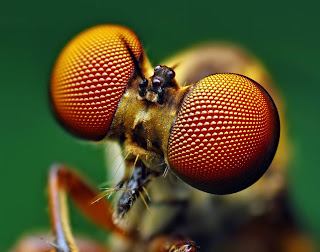
Robber fly - Nature photographer Thomas Shahan specializes in amazing portraits of tiny insects. It isn't easy. Shahan says that this Robber Fly (Holcocephala fusca), for instance, is "skittish" and doesn't like its picture taken.

Eye-popping bug photos

Nature by Numbers (Video)

"A Summary" – Apr 2, 2011 (Kryon channeled by Lee Carroll) (Subjects: Religion, Shift of Human Consciousness, 2012, Intelligent/Benevolent Design, EU, South America, 5 Currencies, Water Cycle (Heat up, Mini Ice Ace, Oceans, Fish, Earthquakes ..), Middle East, Internet, Israel, Dictators, Palestine, US, Japan (Quake/Tsunami Disasters , People, Society ...), Nuclear Power Revealed, Hydro Power, Geothermal Power, Moon, Financial Institutes (Recession, Realign integrity values ..) , China, North Korea, Global Unity,..... etc.) -
"The Quantum Factor" – Apr 10, 2011 (Kryon channeled by Lee Carroll) (Subjects: Galaxies, Universe, Intelligent design, Benevolent design, Aliens, Nikola Tesla (Quantum energy), Inter-Planetary Travel, DNA, Genes, Stem Cells, Cells, Rejuvenation, Shift of Human Consciousness, Spontaneous Remission, Religion, Dictators, Africa, China, Nuclear Power, Sustainable Development, Animals, Global Unity.. etc.) - (Text Version)


“ … Here is another one. A change in what Human nature will allow for government. "Careful, Kryon, don't talk about politics. You'll get in trouble." I won't get in trouble. I'm going to tell you to watch for leadership that cares about you. "You mean politics is going to change?" It already has. It's beginning. Watch for it. You're going to see a total phase-out of old energy dictatorships eventually. The potential is that you're going to see that before 2013.

They're going to fall over, you know, because the energy of the population will not sustain an old energy leader ..."

(Live Kryon Channelings was given 7 times within the United Nations building.)

"Update on Current Events" – Jul 23, 2011 (Kryon channelled by Lee Carroll) - (Subjects: The Humanization of God, Gaia, Shift of Human Consciousness, 2012, Benevolent Design, Financial Institutes (Recession, System to Change ...), Water Cycle (Heat up, Mini Ice Ace, Oceans, Fish, Earthquakes ..), Nuclear Power Revealed, Geothermal Power, Hydro Power, Drinking Water from Seawater, No need for Oil as Much, Middle East in Peace, Persia/Iran Uprising, Muhammad, Israel, DNA, Two Dictators to fall soon, Africa, China, (Old) Souls, Species to go, Whales to Humans, Global Unity,..... etc.)

"Recalibration of Free Choice"– Mar 3, 2012 (Kryon Channelling by Lee Caroll) - (Subjects: (Old) Souls, Midpoint on 21-12-2012, Shift of Human Consciousness, Black & White vs. Color, 1 - Spirituality (Religions) shifting, Loose a Pope “soon”, 2 - Humans will change react to drama, 3 - Civilizations/Population on Earth, 4 - Alternate energy sources (Geothermal, Tidal (Paddle wheels), Wind), 5 – Financials Institutes/concepts will change (Integrity – Ethical) , 6 - News/Media/TV to change, 7 – Big Pharmaceutical company will collapse “soon”, (Keep people sick), (Integrity – Ethical) 8 – Wars will be over on Earth, Global Unity, … etc.) - (Text version)

“… 4 - Energy (again)


The natural resources of the planet are finite and will not support the continuation of what you've been doing. We've been saying this for a decade. Watch for increased science and increased funding for alternate ways of creating electricity (finally). Watch for the very companies who have the most to lose being the ones who fund it. It is the beginning of a full realization that a change of thinking is at hand. You can take things from Gaia that are energy, instead of physical resources. We speak yet again about geothermal, about tidal, about wind. Again, we plead with you not to over-engineer this. For one of the things that Human Beings do in a technological age is to over-engineer simple things. Look at nuclear - the most over-engineered and expensive steam engine in existence!

Your current ideas of capturing energy from tidal and wave motion don't have to be technical marvels. Think paddle wheel on a pier with waves, which will create energy in both directions [waves coming and going] tied to a generator that can power dozens of neighborhoods, not full cities. Think simple and decentralize the idea of utilities. The same goes for wind and geothermal. Think of utilities for groups of homes in a cluster. You won't have a grid failure if there is no grid. This is the way of the future, and you'll be more inclined to have it sooner than later if you do this, and it won't cost as much….”


"Fast-Tracking" - Feb 8, 2014 (Kryon Channelling by Lee Carroll) - (Reference to Fukushima / H-bomb nuclear pollution and a warning about nuclear > 20 Min)

Obama unveils landmark regulations to combat climate change

Obama unveils landmark regulations to combat climate change
In a bid to combat climate change, US President Barack Obama announced the Clean Power Plan on Monday, marking the first time power plants have been targeted by mandatory regulations on carbon dioxide emissions in the US.
Google: Earthday 2013
Showing posts with label Farmers. Show all posts

Wednesday, January 25, 2023

EU eyes more help for shrinking bee populations

Yahoo – AFP, January 24, 2023 

The EU on Tuesday announced proposals to try to reverse an "alarming decline" in the number of bees -- and other insects that pollinate the bloc's crops -- including by rewarding organic farming. 

The European Commission said a review of a 2018 EU Pollinators Initiative showed there were gaps, and "significant challenges" needed to be addressed with revised measures. 

The proposal calls for promoting farming -- organic or otherwise -- that protects pollinating insects, cutting back on pesticides, better monitoring of pollinator populations, and better conservation of habitats including in urban areas. 

At stake is much of the European Union's agricultural output. 

The commission estimates that pollinators -- mostly bees, but also hoverflies, moths, and some beetles and other insects -- contribute around five billion euros ($5.5 billion) a year to the bloc's food production. 

Yet intensive farming practices, pesticides, pollution, changed land-use, other introduced species and climate change have all taken a serious toll on their populations. 

"Pollinating insects have declined dramatically in diversity and abundance in the last decades, with many of them being threatened with extinction," the commission said in a statement. 

Its proposal, made to the European Parliament and the 27 EU member states, looks to reverse pollinator decline by the end of this decade. 

It focuses on wild populations of bees and other pollinators as the EU has other tools aimed at supporting honeybee farms. 

It also is designed to work alongside the EU's farm subsidy scheme, called the Common Agricultural Policy, by rewarding farmers who implement sustainable methods. 

The EU's environment commissioner, Virginijus Sinkevicius, said that "in the case of pollinators, these small insects will define the future of nature and long-term food security". 

He said he hoped the EU's steps towards saving them "can inspire similar action in the entire world".

Wednesday, August 19, 2020

High-tech farmers sow seeds of revolution in Dubai desert

Yahoo – AFP, Shatha Yaish, August 18, 2020

Al-Badia market garden farm produces an array of vegetable crops in multi-storey format,
carefully controlling light and irrigation as well as recycling 90 percent of the water it uses

An ultra-modern vertical farm in the middle of the desert stands as a testament to Dubai's determination to spark a "green revolution" to overcome its dependence on food imports.

Al-Badia market garden farm produces an array of vegetable crops in multi-storey format, carefully controlling light and irrigation as well as recycling 90 percent of the water it uses.

"It's a green revolution in the middle of the desert," the farm's director Basel Jammal tells AFP.

"Each plant is given the amount of light, humidity, heat and water it needs. It's as if it were a guest in a five-star hotel," he says.

The COVID-19 pandemic, which disrupted global supply chains, has refocused attention on food security in the United Arab Emirates.

The UAE is rich in oil and ingenuity, but has little arable land and endures dry, baking summers.

That was not an issue decades ago when the area was sparsely inhabited by Bedouins.

The UAE's need to address its over-reliance on imports has inspired other 
strategies, including stockpiling and high-tech agriculture

But the wealth generated by oil discoveries since the 1970s sent expatriates flocking to the UAE.

Dubai now has more than 3.3 million inhabitants of 200 nationalities, relies largely on expensive desalinated water, and its food needs have grown and diversified.

'Choices for the future'

Dubai, like the other six emirates that make up the UAE, is heavily dependent on imports, which make up 90 percent of its food needs according to official statistics.

Produce arrives from all over the world by air and at Dubai's state-of-the-art port, stocking supermarkets with a range that compares favourably to those of any Western capital.

But in a region where geopolitical tensions with nearby Iran frequently threaten to boil over, long-term food security and self-sufficiency are key goals.

More than a decade ago, the UAE began buying or leasing agricultural land abroad, mainly in east Africa, to lock in supply even in times of crisis.

Abdellatif al-Banna is an independent farmer joining the innovation drive, 
growing pineapples in greenhouses using hydroponics and selling his production 
via an internet platform

Problems on the ground including political instability led it to look towards Australia and Eastern Europe.

But the need to address its over-reliance on imports has inspired other strategies including stockpiling and high-tech agriculture.

Jammal says his model farm where everything is controlled by computers, is a "choice for the future".

"We no longer want to depend on imports. We want to produce locally, all year round, without worrying about climate change, rainfall or drought," he says.

Like Al-Badia, a number of farms are springing up in Dubai and less-developed areas like Al-Ain and the mountainous emirate of Ras al-Khaimah.

Abdellatif al-Banna is another independent farmer joining the innovation drive, growing pineapples in greenhouses using hydroponics -- without soil -- and selling his production via an internet platform.

Not far from Dubai's coastline and glitzy skyscrapers, several farms raise cows 
in air-conditioned sheds that help provide the local market with dairy products

At his farm in Al-Awir, Banna also experiments with growing fruits, vegetables and even wheat in the cooler months -- producing enough grain for his family in what he hopes is a prototype.

Elsewhere, not far from Dubai's coastline and glitzy skyscrapers, several farms raise cows in air-conditioned sheds that help provide the local market with dairy products.

And in vast tanks overseen by a control room that duplicates Norway's sunrises and sunsets, salmon are being farmed in tanks, despite searing heat outside.

Free of shortages

Such farms are often private ventures but are actively encouraged by Emirati authorities, said Omar Bouchehab, who chairs Dubai's Food Security Committee.

Authorities have launched a plan to raise domestic agricultural production by 15 percent by 2021 and boost the use of agricultural technologies, he said.

A fruit and vegetable warehouse is seen in Dubai

At the beginning of the coronavirus crisis, while many developed cities saw shelves stripped of pasta, tinned goods and toilet rolls, Dubai did not experience any shortages in fresh produce or staples.

Thanks to airborne cargo services via giant carrier Emirates, which repurposed passenger seats to boost capacity, Dubai was even able to ensure the re-export of various food products to its neighbours.

At the Fresh Market, a large wholesale enterprise, workers busily transported and stored tonnes of imported fresh food. Executive director Redha al-Mansouri was upbeat about the emirate's food security.

"Dubai has an adequate infrastructure and a stock capable of meeting the needs of the United Arab Emirates, and even the needs of neighbouring countries," he said.

Thursday, January 23, 2020

More farmland goes organic, but the Netherlands still trails in Europe

DutchNews, January 22, 2020 

Organic curly cale being farmed in Noord Holland. Photo: DutchNews.nl

The amount of Dutch farmland devoted to organic fruit, cereals and vegetables grew by 4% last year, according to figures from official regulator Skal. 

In total, the amount of land used for organic farming has doubled in 10 years, and now just over 2,000 of the 50,000 Dutch farming companies are classified as organic. 

Nevertheless, despite the growth, the Netherlands is still trailing in European terms. Just 3.2% of the total amount of cultivated land in the Netherlands is farmed without pesticides and artificial fertiliser, compared with a European average of 7.5%. In Austria almost a quarter of farmland is devoted to organic farming. 

One reason for this, according to Michael Wilde, from organic farming lobby group Bionext, is that the Dutch government does not provide any subsidies for organic farming. 

And one scheme, to help farmers move from traditional to organic farming was scrapped several years ago, Wilde told the Financieele Dagblad.

Sunday, January 19, 2020

Right fire for right future: how cultural burning can protect Australia from catastrophic blazes

The Guardian, Lorena Allam, Sat 18 Jan 2020

Traditional knowledge has already reduced bushfires and emissions in the top end, so why isn’t it used more widely?

Kija Rangers conduct prescribed burning in the East Kimberley in 2019.
Photograph: Supplied/Kimberley Land Council

Indigenous fire practitioners have warned that Australia’s bush will regenerate as a “time bomb” prone to catastrophic blazes, and issued a plea to put to use traditional knowledge which is already working across the top end to reduce bushfires and greenhouse gas emissions.

“This is a time bomb ticking now because all that canopy has been wiped out,” says Oliver Costello of the national Indigenous Firesticks Alliance.

“A lot of areas will end up regenerating really strongly, but they’ll return in the wrong way. We’ll end up with the wrong species compositions and balance.

 “That’s why we need to get Indigenous fire practices out into the landscape in the coming months, to start to read the country and look at areas that need restoration burning in the short term.”

As Australia comes to terms with this season’s catastrophic fires, Indigenous practitioners like Costello are advocating a return to “cultural burning”.

What is cultural burning?

Small-scale burns at the right times of year and in the right places can minimise the risk of big wildfires in drier times, and are important for the health and regeneration of particular plants and animals.

Different species relate to fire in different ways, Costello explains. Wombats, for example, dig burrows to escape, while koalas climb into the canopy.

“When you understand the fire relationships they have, their own fire culture, then you are really applying the right fire for that culture so that you’re supporting the identity of that place.

“When you do that, you get more productive landscapes, you get healthier plants and animals, you get regeneration, you discourage invasive elements, which are sometimes native species that might belong in the system next door.

“It’s so important to apply that right fire for right country, so you can maintain the right balance.”

Aboriginal rangers and traditional owners conduct burns in the Katiti-Petermann
 Indigenous Protected Area, in the remote desert country near the Western
Australia and Northern Territory border. Photograph: Helen Davidson/The Guardian

Dr David Bowman is a professor of pyrogeography and fire science at the University of Tasmania. Bowman describes Indigenous fire management as “little fires tending the earth affectionately”.

“The affectional is the opposite of mechanical. It’s with emotion. So it can be reverence, affection, fear, a whole range of emotions, but it’s an emotional relationship you have with land using fire to create mosaics and flammable habitat mosaics, which are really good for biodiversity and a really good way of managing fuel load.”

Where is it used in Australia?

In northern Australia, Indigenous land ownership is widespread. Caring for country and ranger programs in protected areas has delivered a degree of autonomy to traditional owners to walk the country, burning according to seasonal need and cultural knowledge.

Indigenous fire management involves “cool” fires in targeted areas during the early dry season, between March and July. The fires burn slowly and in patches.

In the Kimberley, the Land council holds community fire planning meetings throughout the early dry season to ensure the correct people are burning their country.

“Traditional owners are consulted and native title holders design burn lines and fire walk routes,” the KLC acting CEO Tyronne Garstone says.

“These burn lines are approved by the group and Indigenous rangers perform the on-ground work, backed up by modern technology with rangers taking constant weather readings and recording the conditions of the day.

“They work very well at combining the old people’s fire practices with modern techniques.”

Even so, climate change is affecting their ability to do “right way” fire management, Garstone says.

“These ‘right way’ fire days are getting fewer and fire behaviour is changing along the same lines as over east. Late season conditions are also driving more fires in unusual ways due to the climatic conditions we are currently facing.”

Kija Rangers conduct prescribed or ‘cool’ burning in the East Kimberley
in the dry season, 2019. Photograph: Supplied/Kimberley Land Council

How effective is it?

The Darwin centre for bushfire research at Charles Darwin University maps bushfires weekly. Since traditional burning was reintroduced on a large scale, the centre has collected enough data to show that the area of land destroyed by wildfires has more than halved, from 26.5m hectares in 2000, to just 11.5m hectares in 2019.

“We have annual fires up here,” the centre’s research fellow Andrew Edwards says. “Forty per cent of the top end could burn every year. So we had to do something about that.”

“We were originally much more interested in biodiversity, Aboriginal employment and getting people back on country to manage it properly, but when the carbon economy came along we saw a way to manage fire to abate greenhouse gas emissions.

“It was pretty bad before that happened,” Edwards says. “It was just fires running wild across huge tracts of north Australia that nobody was doing anything about.”

Edwards says the top end cooperative model can be adapted to southern conditions.

“That’s what needs to be looked at. Obviously there’s a lot more infrastructure to set up, but it’s collaboration and education.

“If we want to manage our natural environment properly, we need to be doing prescribed burning. There’s so much cultural knowledge out there still, and it’s being totally ignored. There’s hundreds of Indigenous rangers out there now doing this work.”

The Oriners and Sefton Savannah Burning Project creates carbon credits, using
strict scientific methodologies, approved through a rigorous accreditation process
with the Department of Environment, to store carbon in the natural landscape.
Photograph: Richard Wainwright/Caritas Australia

Will these practices be widely adopted?

In southern Australia, Oliver Costello says, Aboriginal knowledge systems are far less valued but hold important solutions.

The Coag national bushfire management policy includes a commitment to “promote Indigenous Australians’ use of fire”, but Indigenous fire groups like Firesticks Alliance say they need more resources to build capacity.

“There are a lot of policy settings at a high level that support us, but there’s nothing in between. There’re no resources,” Costello says.

“There’s no investment really outside of northern Australia Indigenous fire management of any significance, and they had to build a whole new economy to support it through carbon.

“There’s always investment going into future firefighting capacity, more trucks, more helicopters, more this, more that. What we need is people getting out into the landscape now, with the knowledge to start to heal it.

A small cool burn managed by Indigenous firesticks alliance.
Photograph: Firesticks Alliance Indigenous Corporation/PA

Professor Bowman says it is possible to “blend Aboriginal with European and modern scientific approaches to create an opportunity for all land users and land owners”.

He suggests small-scale local “Green fire” groups modelled on the Landcare program.

“I would like to see a crossover between Indigenous and mainstream fire management groups, where there can be exchange and recognition.

“Because in the end there’s two things which are important to [remember]: all humans have come from a fire management background in their cultures, it’s just that some cultures ended up obliterating that knowledge because of industrialisation.

“We should really prioritise employment of Aboriginal people. But when there’s a gap we could be filling that gap with community groups. And there’s a really good opportunity for Aboriginal people to be involved in training.

“We need to encourage and promote the philosophy of Aboriginal fire practice because that’s going to be a really important pathway for sustainable fire management and also for healing because so many communities have been traumatised and shocked by the scale of the burning.”

Costello says the areas that haven’t burned this time around are now even more vulnerable.

“They are critical parts of the landscape [that need] to be able to support the animals and plants that have survived. And so those areas are going to be under increasing pressure and they’re also at risk of a future fire.

“There was an economy before settlement that supported this, a resource economy based on people looking after the land and having all that they needed.

“Now in the modern society it revolves around money. So we need to build economies that support cultural practice and acknowledge traditional custodianship.

“There’s all this canopy that’s been burnt away. We’ve got knowledge and techniques that can help heal that country in the future. It’s going to take some time. We’ve got probably two or three years before we can really be effective in some of that country because it needs to recover. But if we don’t get in there after that, then we miss our chance.”


Related Articles:


(*)  Kryon explains what is going on with the Weather/Climate Change 
(**) Kryon gives Australia fire suggestions

Thursday, August 8, 2019

Italian hydroponics farm bets on 'red gold

Yahoo – AFP, Ella IDE, August 7, 2019

Luigi Galimberti says his farm can produce a kilogramme of tomatoes using just
two litres of water, compared to 75 in the fields (AFP Photo/ALBERTO PIZZOLI)

Grosseto (Italy) (AFP) - The Italian tomato is prized around the world, but its reputation has soured in recent years over reports of mafia infiltration, slave labour and toxic fires that poison water sources.

Southern Europe's biggest hydroponics farm is out to change all that, by growing pesticide-free crops in environmentally friendly greenhouses -- and getting bees to do the hard work.

Set among organic vineyards in Tuscany, Sfera Agricola was launched in 2015 by Luigi Galimberti as a response to repeated UN warnings that food production will need to increase sharply to feed the growing global population.

"The UN reminds us every year that by 2050 there will be 10 billion of us, and we'll need double the amount of water and double the land to produce food for everyone," Galimberti told AFP.

"Along with the problems of a suddenly-changing climate, which is having an ever-greater impact on farming, it pushed me to imagine a more efficient, technological way of farming that produces more with less," he said.

Hydroponics is a method of growing plants without soil, using water fortified with mineral nutrients and oxygen instead.

Hydroponics is a method of growing plants without soil, using water fortified with 
mineral nutrients and oxygen instead (AFP Photo/ALBERTO PIZZOLI)

Galimberti's farm produces a kilogramme of tomatoes or lettuce using just two litres of water, compared to 75 in fields, he says.

Of those two litres, over 90 percent is collected rainwater.

It relies on natural organisms to control pests and disease and the few plants that need to be treated chemically are separated and their fruit destroyed.

'Insect predators'

"We use bumblebees to pollinate the flowers, and we release a series of insect predators to combat the insects we fear," Galimberti said, adding that it had led to the creation of new bee colonies in a boost for the local ecosystem.

Pickers shuttle back and forth on solar-powered platforms, delicately tying back the plants' upper branches as the fruit below ripens.

Further on, vast basins shimmer in the midday heat where styrofoam boards holding baby lettuces are floated on a nutrient-rich, oxygenated solution.

As his farm expands, Luigi Galimbert hopes to grow cabbages, spinach, courgettes, 
peppers and aubergines as well (AFP Photo/ALBERTO PIZZOLI)

As the company expands, it hopes to grow cabbages, spinach, courgettes, peppers and aubergines as well.

Galimberti tapped private investors and banks to raise the 20 million euros ($22.4 million) needed to open the 13-hectare greenhouse, which now employs 230 people and produces crops every day of the year.

Italian tomatoes -- particularly the canned variety -- have received bad press in recent years, with rights charities warning that foreign workers are effectively used as slave labour.

The fruit dubbed "red gold", destined for supermarket shelves around the world, is plucked in back-breaking conditions under a pitiless sun, for pitiful wages, largely by Africans who live in shanty towns.

The illegal dumping and burning of toxic waste particularly in southern Italy has also spooked consumers over recent decades, amid reports of contaminated farm produce and a sharp rise in cancers, malformations and birth defects.

The so-called "agro-mafia" business -- the infiltration of organised crime along the agri-food chain in Italy, from pickers to distributors -- is worth 24.5 billion euros, according to a July report by farming association Coldiretti.

Luigi Galimberti plans to build 500 hectares of hydroponic greenhouses in the
next 10 years (AFP Photo/ALBERTO PIZZOLI)

"The exploitation of workers combined with exhausting conditions make picking in the south an ignoble job," said Galimberti, who says his company's proper contracts and paid overtime are "a rare thing in the sector".

'Flavour advantage'

Sfera Agricola has bet on a return to the Italian tomato's glory days, producing three varieties that have fallen out of favour with farmers and distributors, but that the company is "bringing back to supermarket shelves".

"Over the last 50 years, the market has evolved rapidly for distribution and commercial reasons. Tomato skins have thickened so they last longer on the shelf, and the fruit no longer drops off the vine when ripe," he said.

Thanks to the cubes of rockwool -- a hydroponic growing medium that mimics soil and supports the roots -- "the plant is protected and we can use older, weaker varieties," he added.

Those have thinner skins and tend to fall off the plant when ripe, so they have to be picked and eaten relatively quickly, he said.

Sfera Agricola is betting on a return to the Italian tomato's glory days (AFP Photo/
ALBERTO PIZZOLI)

"But they do not have 'innovative' characteristics, which gives them a flavour advantage," Galimberti said.

He aims to build 500 hectares of hydroponic greenhouses in the next 10 years, to become one of the biggest players in the sector in Europe.

But his toughest competition may be much smaller, and closer to home.

"In Italy almost everyone has someone in their family who produces their own tomatoes. Or their neighbour does, or the old man next door."

Related Articles:


Wednesday, June 12, 2019

Dutchman wins prestigious prize for work with seeds and small farmers

DutchNews, June 11, 2019

Photo: Marcel Bakker via World Food Prize Foundation

This year’s World Food Prize, the most important global prize in the field of farming and food, has been awarded to Dutchman Simon Groot for his work in helping millions of smallholder farmers to use good seeds. 

This work, the organising committee says, ‘enabled them to to earn greater incomes through enhanced vegetable production, benefitting hundreds of millions of consumers with greater access to nutritious vegetables for healthy diets’. 

‘Simon Groot has dedicated his life to improving the livelihoods of millions around the world,’ Kenneth Quinn, president of the World Food Prize Foundation, said at the award announcement on Monday. 

Groot, now 84, and his partner in the Philippines, started East-West Seed in 1982. Today, the team has developed vegetable varieties with enhanced disease resistance and significantly higher yields which are now used across Asia and beyond. The company serves 19 million smallholder farmers in more than 60 tropical countries.


In an interview with the Volkskrant, Groot said he thinks it regrettable that seed production is in the hands of a few big companies such as Bayer/Monsanto and Syngenta. 

The big companies, he said, are limiting supplies because there is little money to be made from minor breeds. ‘Big companies look at the importance of shareholders,’ he said. ‘Traditional seed companies put the interests of farmers first. We are friends to farmers.’ 

The prize was founded in 1986 by Norman E. Borlaug, recipient of the 1970 Nobel Peace Prize. Groot is the first Dutch national to take the prize.

Friday, May 3, 2019

When apple trees blossom, worker bees rock

Yahoo – AFP, Isabel MALSANG and Fabien NOVIAL, May 2, 2019

The national apiculture institute estimates the value of pollinization for French
farmers at two billion euros ($2.2 billion) (AFP Photo/PHILIPPE HUGUEN)

Chèvreville (France) (AFP) - In an apple orchard outside Paris, a constant hum among the blossoming trees bears witness to thousands of worker bees pollinating millions of flowers in just three weeks.

"Without bees, no pollinization, no apples, no life," sums up farmer Alexandre Prot, who decided to deal with a decline in bee populations by becoming a beekeeper as well.

"We are not worried about the lack of bees because we have our own," he said, during a tour of his 30 hives, which are backed up by another 30 that he hires during spring months to ensure his 60 hectares (150 acres) of apples are fertilised.

Prot initially took a business degree to work as an auditor on the New York and Paris commodities markets before coming back to his family's 300-hectare apple and grain farm in Chevreville, about an hour north of the French capital.

'Autonomous'

His grandfather, who planted the first apple trees, and his father both called on professional beekeepers to ensure the orchard was properly pollinated.

"Having bees lets me be autonomous with respect to my apple crop," he said.

EU map showing apple orchards by area in 2017, by country in hectares
(AFP Photo/Vincent LEFAI)

"Each year, the hives divide in two, the young queen finds a new home, and we recover the swarms" of worker bees and drones.

"So every year we enlarge our population."

Prot recovers 500 kilos (1,100 pounds) of honey per year, which he sells in the farm's store.

But it is almost a derivative product because the pollinization is the farmer's main motivation.

The national apiculture institute, ITSAP, estimates that the value of the work done by bees in helping pollinise the fruits, cereals and vegetables from the plants and trees of French farmers is two billion euros ($2.2 billion).

The UN Food and Agriculture Organization (FAO) has made the conservation and sustainable use of pollinators an absolute priority in dealing with a pollinization crisis that threatens global food resources.

The FAO estimates that almost 35 percent of agricultural production worldwide depends on pollinators such as bees, birds and bats, which improve yields on the 87 most cultivated food plants.

Yarrow and calendula

In France, the number of farmers who have installed their own beehives to support crops is not known, said Eric Lelong, head of the recently created trade association, InterApi.

Some apple growers call on professional beekeepers to ensure orchards are 
pollinated (AFP Photo/Fred TANNEAU)

He nonetheless believes that it is "indispensable to put a value on pollinization".

In California's almond groves, output can fall sharply unless beehives are brought in, "which explains very high prices for hive rentals," he noted.

Prot looks after his worker bees closely therefore, sowing fields of flowers, yarrow, calendula, linen and white clover near the hives.

"Since they don't all bloom at the same time, they constitute a pantry for bees from May to October, when there are no more apple blossoms."

Though the average rate of bee colony collapse in France rose to 30 percent in 2017-2018 owing to humid conditions and attacks by Varroa mites according to the agriculture ministry, Prot says that he did not lose a single colony.

'Let nature do its work'

The farmer has chosen to produce apples under an "eco-responsable" label, as have 65 percent of all apple farmers in France.

The national apiculture institute estimates the value of pollinization for French 
farmers at two billion euros ($2.2 billion) (AFP Photo/PHILIPPE HUGUEN)

Situated between wholly commercial production methods and organic ones, the method provides for stable output from one year to the next, which is necessary to obtain contracts with major distributors, while it reduces the use of pesticides.

"The approach is to let nature do its work, as much as it can, while not ruling out interventions" if the crop is threatened by mould or pests, Prot said.

Use of crop protection products or chemicals such as copper or sulphur must take place while bees are asleep in their hives.

Before reaching that point, farmers who keep bees use other methods aimed at "orienting" natural processes, such as installing "insect hotels" in orchards so that wild drones passing through can help pollinate flowers.

Nests for birds that eat insects and worms are another tool, as are perches for raptors that eat mice and voles which damage apple tree roots.

To thwart night butterflies whose larva infest the apples themselves, Prot resorts to "sexual confusion" by spraying female pheromones that disorient males who cannot find the mates they expect and do not therefore reproduce.

That means no larvae, no worms in the apples and no need for pesticides.

Friday, March 8, 2019

Bulb field pesticides found in babies’ nappies: report

DutchNews, March 7, 2019

Depositphotos.com

People who live nex to bulb fields are exposed to up to ten times the concentrations of pesticides compared to people who live more than 250 metres away, according to current affairs programme Zembla

The figures come from research commissioned by the infrastructure minister after it transpired there are no specific safety measures in place for the 2.2 million people who live near agricultural fields where pesticides are used. 

Some 5.7 million kilos of chemicals were sprayed on Dutch fields in 2017, mostly by bulb growers. 

The report, by a  group of independent toxicologists, found a year-round increased presence of the chemicals, both in people’s gardens and inside the home. 

Although the research did not include the effects of the chemicals on health, the report recommends that crop treatment with chemicals should take place at least ‘a couple of hundred metres from urban areas with people with families’, Utrecht University toxicologist Martin van den Berg told Zembla. 

Head of the research group professor Roel Vermeulen confirmed children in particular would be sensitive to the effects of pesticides. 

‘The main conclusion is the presence of higher concentrations of pesticides within the 250 metre radius,’ Vermeulen said. ‘Pesticides were found in urine samples of adults and in babies’ nappies, and children in particular are extra sensitive to their effects on health.’ 

More research is need to establish how damaging the effects are but in the meantime the government should apply the prevention principle, Van den Berg said. ‘If you are not sure if the amount of poison you are exposed to actually leads to damage to health, but you can’t say it doesn’t, you must opt for less exposure,’ he told Zembla. 

Three years

It is the first time the degree of exposure to chemicals used in agriculture has been measured in such detail. 

The research, which took place over three years, looked at the concentrations of chemicals in urine, dust, air, and gardens. ‘It was unique because we could establish that over a longer period of time and at bigger distances from the fields there were still elevated concentrations of pesticides present,’ Van den Berg said. 

The final report will be presented to the relevant ministries at the end of April.