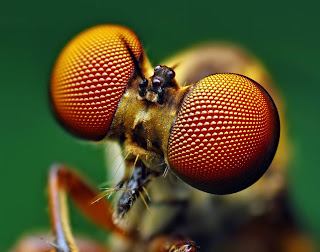
Robber fly - Nature photographer Thomas Shahan specializes in amazing portraits of tiny insects. It isn't easy. Shahan says that this Robber Fly (Holcocephala fusca), for instance, is "skittish" and doesn't like its picture taken.

Eye-popping bug photos

Nature by Numbers (Video)

"A Summary" – Apr 2, 2011 (Kryon channeled by Lee Carroll) (Subjects: Religion, Shift of Human Consciousness, 2012, Intelligent/Benevolent Design, EU, South America, 5 Currencies, Water Cycle (Heat up, Mini Ice Ace, Oceans, Fish, Earthquakes ..), Middle East, Internet, Israel, Dictators, Palestine, US, Japan (Quake/Tsunami Disasters , People, Society ...), Nuclear Power Revealed, Hydro Power, Geothermal Power, Moon, Financial Institutes (Recession, Realign integrity values ..) , China, North Korea, Global Unity,..... etc.) -
"The Quantum Factor" – Apr 10, 2011 (Kryon channeled by Lee Carroll) (Subjects: Galaxies, Universe, Intelligent design, Benevolent design, Aliens, Nikola Tesla (Quantum energy), Inter-Planetary Travel, DNA, Genes, Stem Cells, Cells, Rejuvenation, Shift of Human Consciousness, Spontaneous Remission, Religion, Dictators, Africa, China, Nuclear Power, Sustainable Development, Animals, Global Unity.. etc.) - (Text Version)


“ … Here is another one. A change in what Human nature will allow for government. "Careful, Kryon, don't talk about politics. You'll get in trouble." I won't get in trouble. I'm going to tell you to watch for leadership that cares about you. "You mean politics is going to change?" It already has. It's beginning. Watch for it. You're going to see a total phase-out of old energy dictatorships eventually. The potential is that you're going to see that before 2013.

They're going to fall over, you know, because the energy of the population will not sustain an old energy leader ..."

(Live Kryon Channelings was given 7 times within the United Nations building.)

"Update on Current Events" – Jul 23, 2011 (Kryon channelled by Lee Carroll) - (Subjects: The Humanization of God, Gaia, Shift of Human Consciousness, 2012, Benevolent Design, Financial Institutes (Recession, System to Change ...), Water Cycle (Heat up, Mini Ice Ace, Oceans, Fish, Earthquakes ..), Nuclear Power Revealed, Geothermal Power, Hydro Power, Drinking Water from Seawater, No need for Oil as Much, Middle East in Peace, Persia/Iran Uprising, Muhammad, Israel, DNA, Two Dictators to fall soon, Africa, China, (Old) Souls, Species to go, Whales to Humans, Global Unity,..... etc.)

"Recalibration of Free Choice"– Mar 3, 2012 (Kryon Channelling by Lee Caroll) - (Subjects: (Old) Souls, Midpoint on 21-12-2012, Shift of Human Consciousness, Black & White vs. Color, 1 - Spirituality (Religions) shifting, Loose a Pope “soon”, 2 - Humans will change react to drama, 3 - Civilizations/Population on Earth, 4 - Alternate energy sources (Geothermal, Tidal (Paddle wheels), Wind), 5 – Financials Institutes/concepts will change (Integrity – Ethical) , 6 - News/Media/TV to change, 7 – Big Pharmaceutical company will collapse “soon”, (Keep people sick), (Integrity – Ethical) 8 – Wars will be over on Earth, Global Unity, … etc.) - (Text version)

“… 4 - Energy (again)


The natural resources of the planet are finite and will not support the continuation of what you've been doing. We've been saying this for a decade. Watch for increased science and increased funding for alternate ways of creating electricity (finally). Watch for the very companies who have the most to lose being the ones who fund it. It is the beginning of a full realization that a change of thinking is at hand. You can take things from Gaia that are energy, instead of physical resources. We speak yet again about geothermal, about tidal, about wind. Again, we plead with you not to over-engineer this. For one of the things that Human Beings do in a technological age is to over-engineer simple things. Look at nuclear - the most over-engineered and expensive steam engine in existence!

Your current ideas of capturing energy from tidal and wave motion don't have to be technical marvels. Think paddle wheel on a pier with waves, which will create energy in both directions [waves coming and going] tied to a generator that can power dozens of neighborhoods, not full cities. Think simple and decentralize the idea of utilities. The same goes for wind and geothermal. Think of utilities for groups of homes in a cluster. You won't have a grid failure if there is no grid. This is the way of the future, and you'll be more inclined to have it sooner than later if you do this, and it won't cost as much….”


"Fast-Tracking" - Feb 8, 2014 (Kryon Channelling by Lee Carroll) - (Reference to Fukushima / H-bomb nuclear pollution and a warning about nuclear > 20 Min)

Obama unveils landmark regulations to combat climate change

Obama unveils landmark regulations to combat climate change
In a bid to combat climate change, US President Barack Obama announced the Clean Power Plan on Monday, marking the first time power plants have been targeted by mandatory regulations on carbon dioxide emissions in the US.
Google: Earthday 2013
Showing posts with label FAO. Show all posts

Friday, May 3, 2019

When apple trees blossom, worker bees rock

Yahoo – AFP, Isabel MALSANG and Fabien NOVIAL, May 2, 2019

The national apiculture institute estimates the value of pollinization for French
farmers at two billion euros ($2.2 billion) (AFP Photo/PHILIPPE HUGUEN)

Chèvreville (France) (AFP) - In an apple orchard outside Paris, a constant hum among the blossoming trees bears witness to thousands of worker bees pollinating millions of flowers in just three weeks.

"Without bees, no pollinization, no apples, no life," sums up farmer Alexandre Prot, who decided to deal with a decline in bee populations by becoming a beekeeper as well.

"We are not worried about the lack of bees because we have our own," he said, during a tour of his 30 hives, which are backed up by another 30 that he hires during spring months to ensure his 60 hectares (150 acres) of apples are fertilised.

Prot initially took a business degree to work as an auditor on the New York and Paris commodities markets before coming back to his family's 300-hectare apple and grain farm in Chevreville, about an hour north of the French capital.

'Autonomous'

His grandfather, who planted the first apple trees, and his father both called on professional beekeepers to ensure the orchard was properly pollinated.

"Having bees lets me be autonomous with respect to my apple crop," he said.

EU map showing apple orchards by area in 2017, by country in hectares
(AFP Photo/Vincent LEFAI)

"Each year, the hives divide in two, the young queen finds a new home, and we recover the swarms" of worker bees and drones.

"So every year we enlarge our population."

Prot recovers 500 kilos (1,100 pounds) of honey per year, which he sells in the farm's store.

But it is almost a derivative product because the pollinization is the farmer's main motivation.

The national apiculture institute, ITSAP, estimates that the value of the work done by bees in helping pollinise the fruits, cereals and vegetables from the plants and trees of French farmers is two billion euros ($2.2 billion).

The UN Food and Agriculture Organization (FAO) has made the conservation and sustainable use of pollinators an absolute priority in dealing with a pollinization crisis that threatens global food resources.

The FAO estimates that almost 35 percent of agricultural production worldwide depends on pollinators such as bees, birds and bats, which improve yields on the 87 most cultivated food plants.

Yarrow and calendula

In France, the number of farmers who have installed their own beehives to support crops is not known, said Eric Lelong, head of the recently created trade association, InterApi.

Some apple growers call on professional beekeepers to ensure orchards are 
pollinated (AFP Photo/Fred TANNEAU)

He nonetheless believes that it is "indispensable to put a value on pollinization".

In California's almond groves, output can fall sharply unless beehives are brought in, "which explains very high prices for hive rentals," he noted.

Prot looks after his worker bees closely therefore, sowing fields of flowers, yarrow, calendula, linen and white clover near the hives.

"Since they don't all bloom at the same time, they constitute a pantry for bees from May to October, when there are no more apple blossoms."

Though the average rate of bee colony collapse in France rose to 30 percent in 2017-2018 owing to humid conditions and attacks by Varroa mites according to the agriculture ministry, Prot says that he did not lose a single colony.

'Let nature do its work'

The farmer has chosen to produce apples under an "eco-responsable" label, as have 65 percent of all apple farmers in France.

The national apiculture institute estimates the value of pollinization for French 
farmers at two billion euros ($2.2 billion) (AFP Photo/PHILIPPE HUGUEN)

Situated between wholly commercial production methods and organic ones, the method provides for stable output from one year to the next, which is necessary to obtain contracts with major distributors, while it reduces the use of pesticides.

"The approach is to let nature do its work, as much as it can, while not ruling out interventions" if the crop is threatened by mould or pests, Prot said.

Use of crop protection products or chemicals such as copper or sulphur must take place while bees are asleep in their hives.

Before reaching that point, farmers who keep bees use other methods aimed at "orienting" natural processes, such as installing "insect hotels" in orchards so that wild drones passing through can help pollinate flowers.

Nests for birds that eat insects and worms are another tool, as are perches for raptors that eat mice and voles which damage apple tree roots.

To thwart night butterflies whose larva infest the apples themselves, Prot resorts to "sexual confusion" by spraying female pheromones that disorient males who cannot find the mates they expect and do not therefore reproduce.

That means no larvae, no worms in the apples and no need for pesticides.

Tuesday, August 27, 2013

Edible algae -- coming to a rooftop near you?

Google – AFP, William Davies (AFP), 27 August 2013

A woman prepares a spirulina shake in Bangkok on June 24, 2013
(AFP/File, Nicolas Asfouri)

BANGKOK — On a hotel rooftop in Bangkok, dozens of barrels of green liquid bubble under the sun -- the latest innovation in urban farming.

Proponents of the edible algae known as spirulina say it could help provide a sustainable source of protein as an alternative to meat.

Three times a week, Patsakorn Thaveeuchukorn harvests the green algae in the barrels.

"The algae is growing so fast, normally the doubling time is around 24 hours," said Patsakorn, whose employer EnerGaia uses Bangkok's rooftops to grow spirulina.

With its high levels of protein and nutrients, "it is beneficial to food security," he told AFP.

A worker checks a spirulina farm on the
 top of a hotel in Bangkok on June 24, 
2013 (AFP/File, Nicolas Asfouri)
"If you compare it to meat it will take six months to grow a kilogram of beef, but this we can grow in a week," said Patsakorn.

Spirulina has been described by health food experts as a super-food, and it is becoming more popular worldwide.

Rosa Rolle from the UN's food and agriculture organisation (FAO) says it has been an important food source for centuries.

"It grows naturally in Lake Texcoco in Mexico. It was eaten by the Incas," she told AFP. "It's in many countries that border Lake Chad in West Africa and is a protein source for a lot of people."

However she warns that it can lead to health problems for people suffering from gout, as it produces a lot of uric acid, and says people need to be educated about spirulina's positive and negative effects before they consume it.

"You need some nutritional information, but for people without medical conditions it would be fine," she said.

The empty space on top of Bangkok's many skyscrapers provide suitable growing conditions for spirulina as the constant high temperatures and sunlight are ideal breeding conditions.

Fresh spirulina is pictured at a spirulina
 farm on the top of a hotel in Bangkok on
June 24, 2013 (AFP/File, Nicolas Asfouri)
The algae also helps combat carbon dioxide levels through photosynthesis, its champions say, and growing it in cities means it can reach consumers the same day it is harvested.

Once the spirulina algae has been collected, it is hand rinsed and spun dry in a modified washing machine.

It then has to be hand pressed into jars, as there is no machine yet available that can work with the thick, jelly like substance it produces.

"There has been a lot of trial and error," Derek Blitz, technology director at EnerGaia, told AFP.
"It is great for vegetarians and vegans. It's also packed with anti-oxidants. It is really good for cleansing your body."

In their laboratory, lines of different sized test tubes all connected to one another act as the breeding ground for the algae. On the rooftop, barrels of different shapes are in testing, to see which will produce the highest yield.

The company says it is the only producer of fresh spirulina in the world; other companies only sell dried and processed varieties.

Jars of the algae have a shelf life of around three weeks from harvest, though Blitz plans to increase that so it can be exported abroad.

A spirulina laboratory is pictured in
Bangkok on June 24, 2013 (AFP/File,
Nicolas Asfouri)
"The advantages of having it fresh are that it has virtually no taste, so you can mix it with anything," he told AFP.

"Eating dried spirulina is like eating a cooked vegetable as opposed to a raw one, so you are getting a little bit more nutrition out of it (when fresh). The other reason to eat fresh produce is because there's a lot less energy involved in producing it."

And chefs across Bangkok are starting to experiment with the algae. Bill Marinelli, the owner of the Oyster Bar, is a convert.

"It is really good for you," he told AFP, in between mouthfuls of green pasta made with the algae. "We add it to dishes to increase the nutritional value."

The colour of the algae is so strong that anything it is mixed with instantly turns green. But despite that, and the fact it has no flavour, Bill is still keen to use it in his dishes.

"I'm looking at it as an alternative to animal protein. We can cut back on the amount of protein we serve as fish or meat, and incorporate spirulina for the additional protein source," he said.

Spirulina has been used as a food supplement for decades, and is popular among body builders. The question now is whether consumers will see it as a possible alternative to meat and fish.

Monday, August 5, 2013

Roots breakthrough for drought-resistant rice

Google – AFP, 5 Aug 2013

An Indian woman plants paddy saplings in the fields on the outskirts
of Hyderabad on July 20, 2011 (AFP/File, Noah Seelam)

PARIS — Japanese biotechnologists on Sunday said they had developed a rice plant with deeper roots that can sustain high yields in droughts that wipe out conventional rice crops.

It is the third breakthrough in new cereal strains in less than two years, boosting the quest to feed the world's spiralling population at a time of worsening climate change.

Writing in the journal Nature Genetics, a team led by Yusaku Uga of the National Institute of Agrobiological Sciences in Tsukuba describe how they found a remarkable gene in a rice plant cultivated in the dry uplands of the Philippines.

This rice strain, also called cultivar, is called Kinandang Patong. Its big characteristic is roots that are deep and grow straight downwards, delving into parched soil for water, as opposed to root systems that are shallow and grow out sideways in typical water-rich paddy fields.

The gene for this, called Deep Rooting -- dubbed DR01 -- was spliced into a cultivar called IR64, a paddy rice plant that is grown around Asia.

The team then put the new plant through its paces, planting it and standard IR64 in upland fields in three kinds of conditions -- no drought, moderate drought and severe drought.

Indian farmers carry young rice plants on
 their heads in Canning village, south of
 Kolkata on July 29, 2012 (AFP/File,
Dibyangshu Sarkar)
Moderate drought reduced yield from IR64 to just 42 percent of no-drought conditions. Severe drought destroyed it totally.

But IR64 with the DR01 gene was almost unaffected by moderate drought. In severe drought, yield fell -- but not catastrophically -- by around 30 percent.

"Based on our results, this variety can be adapted to upland (agriculture) without irrigation," Uga said in an email exchange with AFP.

"We are also evaluating the DRO1 performance under rain-fed lowland with the International Rice Research Institute," he said. "If we can get positive results in farmer's fields, we hope to release the variety for Asian countries. We are also going to introduce the DRO1 into leading varieties in Latin America with CIAT," the International Centre for Tropical Agriculture, he said.

Without genetic technology, it would have been extraordinarily hard to have pinpointed, and then inserted, the right gene, said Uga.

"Development of GM rice plants is... one of (the) useful strategies to improve drought resistance," he said.

In January 2012, scientists in Britain and Japan said they had developed a fast-track technique, called MutMat, that identifies useful genetic variants, or mutations, in rice plants. They used it to derive a strain from Japan's Hitomebore wild rice that is resistant to salinity -- a boon for farmers whose fields have high salt content through irrigation.

In March 2012, researchers in Australia said they had bred durum wheat with a salt-loving gene whose yields were up to 25 percent greater than ordinary counterparts when grown on saline fields.

The world's population is expected to reach 9.6 billion by mid-century, from 7.2 billion today, according to UN estimates. By 2100, the tally could be 10.9 billion.

To feed this rising number at a time of worsening drought and flood will require a campaign against food waste, smarter use of land, water, fertiliser and pesticides and agricultural innovation to select higher-yield or climate-resistant strains of cereals, according to the UN's Food and Agricultural Organisation (FAO) and France's National Institute for Agricultural Research (INRA).

Improvements in rice strains -- leading to a short, stubby "semi-dwarf" plant with a full head of grain -- unleashed the Green Revolution of the 1960s, boosting harvests in China and other rice-dependent countries that used to teeter perpetually on the brink of famine.


“… New ideas are things you never thought of. These ideas will be given to you so you will have answers to the most profound questions that your societies have had since you were born. Inventions will bring clean water to every Human on the planet, cheaply and everywhere. Inventions will give you power, cheaply and everywhere. These ideas will wipe out all of the reasons you now have for pollution, and when you look back on it, you'll go, "This solution was always there. Why didn't we think of that? Why didn't we do this sooner?" Because it wasn't time and you were not ready. You hadn't planted the seeds and you were still battling the old energy, deciding whether you were going to terminate yourselves before 2012. Now you didn't…. and now you didn't.

It's funny, what you ponder about, and what your sociologists consider the "great current problems of mankind", for your new ideas will simply eliminate the very concepts of the questions just as they did in the past. Do you remember? Two hundred years ago, the predictions of sociologists said that you would run out of food, since there wasn't enough land to sustain a greater population. Then you discovered crop rotation and fertilizer. Suddenly, each plot of land could produce many times what it could before. Do you remember the predictions that you would run out of wood to heat your homes? Probably not. That was before electricity. It goes on and on.

So today's puzzles are just as quaint, as you will see. (1)How do you strengthen the power grids of your great nations so that they are not vulnerable to failure or don't require massive infrastructure improvement expenditures? Because cold is coming, and you are going to need more power. (2) What can you do about pollution? (3) What about world overpopulation? Some experts will tell you that a pandemic will be the answer; nature [Gaia] will kill off about one-third of the earth's population. The best minds of the century ponder these puzzles and tell you that you are headed for real problems. You have heard these things all your life.

Let me ask you this. (1) What if you could eliminate the power grid altogether? You can and will. (2) What if pollution-creating sources simply go away, due to new ideas and invention, and the environment starts to self-correct? (3) Overpopulation? You assume that humanity will continue to have children at an exponential rate since they are stupid and can't help themselves. This, dear ones, is a consciousness and education issue, and that is going to change. Imagine a zero growth attribute of many countries - something that will be common. Did you notice that some of your children today are actually starting to ponder if they should have any children at all? What a concept! ….”

Thursday, June 2, 2011

Oxfam calls for radical rethink of world food system

Deutsche Welle, 2 June 2011

In sub-Saharan Africa, 32 percent
are undernourished
International aid organization Oxfam says world demand for food will skyrocket over the next few decades, while production capacity will decline. It has launched a campaign to change the globe's approach to food.

International aid group Oxfam has released a report on hunger around the world that paints a bleak picture of the global food supply and calls for a restructuring of a "broken" food system, which has resulted in almost one billion people going hungry.

On June 1, Oxfam launched its global GROW campaign, which aims to lobby world leaders to change policies around food subsidies, promote sustainable agricultural methods and strengthen regulations on speculation in the international food market.

The campaign also aims to make consumers in rich countries aware of the consequences of their habits on the world's poor and the environment.

Time for reflection

"Our goal is to radically change the global food system, the way we use and share and consume in order to make it sustainable," Marita Wiggerthale, an expert on trade and food security for Oxfam Germany, told Deutsche Welle.

The report offers a sobering picture of current and future world hunger levels, saying nearly 925 million people - one out of seven – now face hunger every day.

Climate change, including increased
periods of drought, will exacerbate
the hunger problem
While food prices have skyrocketed since 2007, the price for staples such as maize will continue to rise, nearly doubling in the next 20 years, which will push the number of hungry people even higher, Oxfam says.

As global population grows, so will the demand for food, the report adds. By 2050, the demand for food will have increased by 70 percent, even though the ability to increase food production is declining due to flat crop yields and weak harvests caused by a range of factors including environmental problems such as water scarcity and climate change.

"Peak food production has already been reached because there is increased competition between food, fuel and feed," Wiggerthale said, pointing to biofuel production that diverts 15 percent of the world's corn to engines and the world's growing appetite for meat, which pushes farmers to grow food for animal feed at the expense of other food crops.

Poor record on hunger

The global record for tackling hunger is not a particularly good one. In 1995, a UN food summit set a goal to reduce the number of hungry people – then at 820 million – by half. That goal has not been met.

A 2008 spike in food prices pushed an additional 100 million people into poverty. The number stabilized somewhat in the second half of that year, but has been rising again.


The largest number of the world's hungry live in Asia-Pacific region

The United Nations Food and Agriculture Organization (FAO) says food prices are higher than they have been in the last 20 years, surpassing the 2008 price spike that set off food riots in cities around the world.

Most of the world's hungry are in Asia, and particularly on the Indian subcontinent. However, Africa is the continent where the largest percentage of the population faces hunger. In 2010, some 239 million, or 30 percent, faced hunger there.

"In most African countries, there is not enough long-term investment made in the agricultural sector," Tobias Reichert, a senior advisor on trade and food at the NGO Germanwatch, told Deutsche Welle.

EU policy making it worse

That is a result, at least partly, of European Union agricultural policy, he said. In the late 1970s and early 1980s, the EU changed from a net importer to a net exporter of food, especially when it came to wheat and other grains as well as animal products such as beef, milk, pork and chicken.

"The EU focused on exporting to developing markets such as Africa, which ended up hurting local producers who couldn't compete," he said. "It gave local governments the signal that they didn't need to invest in their own agricultural sector since the products were cheaper on the world markets."

But when world food prices started going up, at first slowly, then dramatically, developing countries couldn't react quickly enough. The long neglect of their own infrastructure meant they could not increase domestic production to offset rising import prices.

The low import prices also had an impact on local food customs as people began to use imported wheat and corn for cooking instead of locally grown crops such as millet and sorghum. That hurt local farmers who saw their markets shrink.

Many of those who tried to switch to wheat or corn found that the soil or local climate wasn't suited to the cultivation of those crops, Reichert said.

Speculators

Other analysts place some blame for growing hunger on increased speculation in commodities markets, which has led to food price volatility.

In the late 1990s and early 2000s, lobbying by investment banks and hedge funds led to weaker regulations on food speculation. Key financial institutions such as Goldman Sachs and Barclays Capital created new investment products to help financial companies make money on food prices.

Oxfam's GROW program is pushing
to give women the same rights to land
as men
This speculation, betting that food prices would rise, ended up pushing the prices to much higher levels than would have been expected otherwise.

"It has had a devastating impact on people around the world," Murray Worthy, a policy officer at the World Development Movement in London, told Deutsche Welle. "It's forcing millions of people into poverty."

His group and others are calling for new regulations that would bring more transparency to financial markets and limit the amount of food that can be held and traded by banks and investment funds.

"Food is a fundamental right, it shouldn't be traded with at the whim of bankers and other financial speculators," he said.

Oxfam says that the world is actually capable of feeding all of the world's people, but that short-term thinking, failed government policies and vested interests - including 300 to 500 powerful companies who "benefit from (the current system) and lobby to maintain it" – has exacerbated the problem of hunger, which hits the world's poorest the hardest and threatens to affect millions of more men, women and children.

Oxfam's Wiggerthale said she was heartened by the fact that hunger was high on the agenda of this November's meeting of G20 leaders. There, they will decide whether and how to manage food prices and regulate markets to protect against future price volatility and food crises.

"We want to put pressure on governments so they really act," she said. "We are in an urgent situation and if we can't manage to effect change in the next few years, the situation will be much worse."

Author: Kyle James
Editor: Nathan Witkop

Related Articles:

Sunday, December 28, 2008

Food needs 'fundamental rethink'

By Mark Kinver, Science and environment reporter, BBC News

A sustainable global food system in the 21st Century needs to be built on a series of "new fundamentals", according to a leading food expert.

Tim Lang warned that the current system, designed in the 1940s, was showing "structural failures", such as "astronomic" environmental costs.

Food crops, agriculture and biodiversity cannot be separated from one another

The new approach needed to address key fundamentals like biodiversity, energy, water and urbanisation, he added.

Professor Lang is a member of the UK government's newly formed Food Council.

"Essentially, what we are dealing with at the moment is a food system that was laid down in the 1940s," he told BBC News.

"It followed on from the dust bowl in the US, the collapse of food production in Europe and starvation in Asia.

"At the time, there was clear evidence showing that there was a mismatch between producers and the need of consumers."

Professor Lang, from City University, London, added that during the post-war period, food scientists and policymakers also thought increasing production would reduce the cost of food, while improving people's diets and public health.

"But by the 1970s, evidence was beginning to emerge that the public health outcomes were not quite as expected," he explained.

"Secondly, there were a whole new set of problems associated with the environment."

Thirty years on and the world was now facing an even more complex situation, he added.

"The level of growth in food production per capita is dropping off, even dropping, and we have got huge problems ahead with an explosion in human population."

Fussy eaters

Professor Lang lists a series of "new fundamentals", which he outlined during a speech he made as the president-elect of charity Garden Organic, which will shape future food production, including:

Oil and energy: "We have an entirely oil-based food economy, and yet oil is running out. The impact of that on agriculture is one of the drivers of the volatility in the world food commodity markets."

Water scarcity: "One of the key things that I have been pushing is to get the UK government to start auditing food by water," Professor Lang said, adding that 50% of the UK's vegetables are imported, many from water-stressed nations.

Biodiversity: "Biodiversity must not just be protected, it must be replaced and enhanced; but that is going to require a very different way growing food and using the land."

Urbanisation: "Probably the most important thing within the social sphere. More people now live in towns than in the countryside. In which case, where do they get their food?"

Professor Lang said that in order to feed a projected nine billion people by 2050, policymakers and scientists face a fundamental challenge: how can food systems work with the planet and biodiversity, rather than raiding and pillaging it?

The UK's Environment Secretary, Hilary Benn, recently set up a Council of Food Policy Advisers in order to address the growing concern of food security and rising prices.

Mr Benn, speaking at the council's launch, warned: "Global food production will need to double just to meet demand.

"We have the knowledge and the technology to do this, as things stand, but the perfect storm of climate change, environmental degradation and water and oil scarcity, threatens our ability to succeed."

Professor Lang, who is a member of the council, offered a suggestion: "We are going to have to get biodiversity into gardens and fields, and then eat it.

"We have to do this rather than saying that biodiversity is what is on the edge of the field or just outside my garden."

Michelin-starred chef and long-time food campaigner Raymond Blanc agrees with Professor Lang, adding that there is a need for people, especially in the UK, to reconnect with their food.

He is heading a campaign called Dig for Your Dinner, which he hopes will help people reconnect with their food and how, where and when it is grown.

"Food culture is a whole series of steps," he told BBC News.

"Whatever amount of space you have in your backyard, it is possible to create a fantastic little garden that will allow you to reconnect with the real value of gardening, which is knowing how to grow food.

"And once you know how to grow food, it would be very nice to be able to cook it. If you are growing food, then it only makes sense that you know how to cook it as well.

"And cooking food will introduce you to the basic knowledge of nutrition. So you can see how this can slowly reintroduce food back into our culture."

Waste not...

Mr Blanc warned that food prices were likely to continue to rise in the future, which was likely to prompt more people to start growing their own food.

He was also hopeful that the food sector would become less wasteful.

"We all know that waste is everywhere; it is immoral what is happening in the world of food.

"In Europe, 30% of the food grown did not appear on the shelves of the retailers because it was a funny shape or odd colour.

"At least the amendment to European rules means that we can now have some odd-shaped carrots on our shelves. This is fantastic news, but why was it not done before?"

He suggested that the problem was down to people choosing food based on sight alone, not smell and touch.

"The way that seeds are selected is about immunity to any known disease; they have also got to grow big and fast, and have a fantastic shelf life.

"Never mind taste, texture or nutrition, it is all about how it looks.

"The British consumer today has got to understand that when they make a choice, let's say an apple - either Chinese, French or English one - they are making a political choice, a socio-economic choice, as well as an environmental one.

"They are making a statement about what sort of society and farming they are supporting."

Growing appetite

The latest estimates from the UN Food and Agriculture Organization (FAO) show that another 40 million people have been pushed into hunger in 2008 as a result of higher food prices.

This brings the overall number of undernourished people in the world to 963 million, compared to 923 million in 2007.

The FAO warned that the ongoing financial and economic crisis could tip even more people into hunger and poverty.

"World food prices have dropped since early 2008, but lower prices have not ended the food crisis in many poor countries," said FAO assistant director-general Hafez Ghanem at the launch of the agency's State of Food Insecurity in the World 2008 report.

"The structural problems of hunger, like the lack of access to land, credit and employment, combined with high food prices remain a dire reality," he added.

Professor Lang outlined the challenges facing the global food supply system: "The 21st Century is going to have to produce a new diet for people, more sustainably, and in a way that feeds more people more equitably using less land."

Related Articles:

Study finds marine conservation cuts poverty

Winning kampung leads with green thumbs

Building up people’s skills, cutting down their waste


Friday, February 8, 2008

World market fuels deforestation

Adianto P. Simamora, The Jakarta Post, Jakarta

Efforts to curb deforestation will not work if rich nations fail to control their wood consumption, forest watchdog Greenomics Indonesia has warned.

Greenomics director Elfian Effendi said Thursday that high demand for wood products mostly from the United States, European Union and Japan had given a boost to deforestation in the world's tropical nations, including Indonesia.

"The rich nations often blame us for the speedy deforestation rate. They seem unaware that their consumption contributes much to the deforestation," Elfian said.

Greenomics was commenting on the latest report on the wood market between 2004 and 2007 from the United Nations Food and Agriculture Organization (FAO). The report said the U.S., the EU and Japan were the world's three largest importers of wood products, amounting to US$71.2 billion per year. The U.S. alone spent $23.3 billion per year on wood products, while the EU $13.2 billion and Japan $11.8 billion.

According to Elfian, China and Malaysia are the world's biggest exporters of wood products, with material coming mainly from Indonesia in the form of illegally cut logs.

"It means deforestation in our country is linked to export-import transactions of wood products to rich nations," he said.

Indonesia is home to 120 million hectares of tropical forest, the world's third largest after Brazil and the Democratic Republic of Congo.

Between 1985 and 1997, deforestation occurred at a rate of 1.8 million hectares per year. It rose to 2.8 million hectares per year until 2000, but slowed between 2000 and 2006 to 1.08 million hectares per year.

The government has said that carbon trading and the reduction of emissions from deforestation in developing countries will significantly reduce the deforestation rate.

Elfian said, however, the schemes would not work unless rich countries tightened their control over the sources of wood products.

According to FAO data, Malaysia is the biggest exporter of logs with 5 million cubic meters per year.

"Malaysia exported about 20 million cubic meters in the period of 2004 to 2007. It meant denuded forests reached 303,000 hectares," he said.

Malaysia is also the second biggest exporter of sawn wood, with 3 million cubic meters annually.

"In line with the UN data, deforestation in Malaysia should cover 730,000 ha from 2004 to 2007, which is 11 times Singapore's area," he said.

He said Malaysia was the main exporter of wood products, including logs, to China. The world's most populous country is the world's top importer of logs from tropical countries with 7 million cubic meters per year.

China also imported 2.5 millions cubic meters of sawn wood between 2004 and 2007.

Japan and the United State are the top importers of plywood, reaching 3.5 million cubic meters and 1.5 million respectively.

"The two countries imported about 10 million cubic meters of tropical plywood from 2004 to 2007. Indonesia must learn from the export-import data," he said.