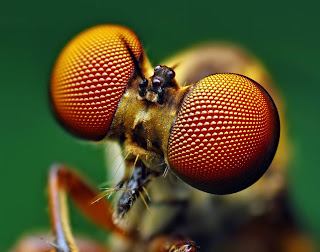
Robber fly - Nature photographer Thomas Shahan specializes in amazing portraits of tiny insects. It isn't easy. Shahan says that this Robber Fly (Holcocephala fusca), for instance, is "skittish" and doesn't like its picture taken.

Eye-popping bug photos

Nature by Numbers (Video)

"A Summary" – Apr 2, 2011 (Kryon channeled by Lee Carroll) (Subjects: Religion, Shift of Human Consciousness, 2012, Intelligent/Benevolent Design, EU, South America, 5 Currencies, Water Cycle (Heat up, Mini Ice Ace, Oceans, Fish, Earthquakes ..), Middle East, Internet, Israel, Dictators, Palestine, US, Japan (Quake/Tsunami Disasters , People, Society ...), Nuclear Power Revealed, Hydro Power, Geothermal Power, Moon, Financial Institutes (Recession, Realign integrity values ..) , China, North Korea, Global Unity,..... etc.) -
"The Quantum Factor" – Apr 10, 2011 (Kryon channeled by Lee Carroll) (Subjects: Galaxies, Universe, Intelligent design, Benevolent design, Aliens, Nikola Tesla (Quantum energy), Inter-Planetary Travel, DNA, Genes, Stem Cells, Cells, Rejuvenation, Shift of Human Consciousness, Spontaneous Remission, Religion, Dictators, Africa, China, Nuclear Power, Sustainable Development, Animals, Global Unity.. etc.) - (Text Version)


“ … Here is another one. A change in what Human nature will allow for government. "Careful, Kryon, don't talk about politics. You'll get in trouble." I won't get in trouble. I'm going to tell you to watch for leadership that cares about you. "You mean politics is going to change?" It already has. It's beginning. Watch for it. You're going to see a total phase-out of old energy dictatorships eventually. The potential is that you're going to see that before 2013.

They're going to fall over, you know, because the energy of the population will not sustain an old energy leader ..."

(Live Kryon Channelings was given 7 times within the United Nations building.)

"Update on Current Events" – Jul 23, 2011 (Kryon channelled by Lee Carroll) - (Subjects: The Humanization of God, Gaia, Shift of Human Consciousness, 2012, Benevolent Design, Financial Institutes (Recession, System to Change ...), Water Cycle (Heat up, Mini Ice Ace, Oceans, Fish, Earthquakes ..), Nuclear Power Revealed, Geothermal Power, Hydro Power, Drinking Water from Seawater, No need for Oil as Much, Middle East in Peace, Persia/Iran Uprising, Muhammad, Israel, DNA, Two Dictators to fall soon, Africa, China, (Old) Souls, Species to go, Whales to Humans, Global Unity,..... etc.)

"Recalibration of Free Choice"– Mar 3, 2012 (Kryon Channelling by Lee Caroll) - (Subjects: (Old) Souls, Midpoint on 21-12-2012, Shift of Human Consciousness, Black & White vs. Color, 1 - Spirituality (Religions) shifting, Loose a Pope “soon”, 2 - Humans will change react to drama, 3 - Civilizations/Population on Earth, 4 - Alternate energy sources (Geothermal, Tidal (Paddle wheels), Wind), 5 – Financials Institutes/concepts will change (Integrity – Ethical) , 6 - News/Media/TV to change, 7 – Big Pharmaceutical company will collapse “soon”, (Keep people sick), (Integrity – Ethical) 8 – Wars will be over on Earth, Global Unity, … etc.) - (Text version)

“… 4 - Energy (again)


The natural resources of the planet are finite and will not support the continuation of what you've been doing. We've been saying this for a decade. Watch for increased science and increased funding for alternate ways of creating electricity (finally). Watch for the very companies who have the most to lose being the ones who fund it. It is the beginning of a full realization that a change of thinking is at hand. You can take things from Gaia that are energy, instead of physical resources. We speak yet again about geothermal, about tidal, about wind. Again, we plead with you not to over-engineer this. For one of the things that Human Beings do in a technological age is to over-engineer simple things. Look at nuclear - the most over-engineered and expensive steam engine in existence!

Your current ideas of capturing energy from tidal and wave motion don't have to be technical marvels. Think paddle wheel on a pier with waves, which will create energy in both directions [waves coming and going] tied to a generator that can power dozens of neighborhoods, not full cities. Think simple and decentralize the idea of utilities. The same goes for wind and geothermal. Think of utilities for groups of homes in a cluster. You won't have a grid failure if there is no grid. This is the way of the future, and you'll be more inclined to have it sooner than later if you do this, and it won't cost as much….”


"Fast-Tracking" - Feb 8, 2014 (Kryon Channelling by Lee Carroll) - (Reference to Fukushima / H-bomb nuclear pollution and a warning about nuclear > 20 Min)

Obama unveils landmark regulations to combat climate change

Obama unveils landmark regulations to combat climate change
In a bid to combat climate change, US President Barack Obama announced the Clean Power Plan on Monday, marking the first time power plants have been targeted by mandatory regulations on carbon dioxide emissions in the US.
Google: Earthday 2013
Showing posts with label Poaching. Show all posts

Monday, September 12, 2016

World governments urge end to domestic ivory markets

Yahoo – AFP, Kerry Sheridan, September 11, 2016

After fierce debate, including opposition from Namibia and Japan, a motion was 
adopted at the IUCN World Conservation Congress to urge closure of all 
domestic ivory markets (AFP Photo/Tony Karumba)

Miami (AFP) - In a bid to stop the killing of elephants for their tusks, world governments voted at a major conservation conference to urge the closure of all domestic ivory markets.

After fierce debate -- including opposition from governments like Namibia and Japan -- the motion was adopted on the final day of the International Union for Conservation of Nature World Conservation Congress, a 10-day meeting that drew 9,000 people to Honolulu, Hawaii this month.

"Today's vote by IUCN members is the first time that a major international body has called on every country in the world to close its legal markets for elephant ivory," said Andrew Wetzler, deputy chief program officer at the Natural Resources Defense Council.

"It's truly a landmark moment, and a victory for elephants that will hopefully be repeated later this month at the next meeting of Convention on International Trade in Endangered Species (CITES) in Johannesburg."

Although the motion is non-binding, it "urges the governments of countries with domestic ivory markets to take all necessary legislative and regulatory efforts to close them," according to the IUCN.

Experts say that domestic ivory markets help fuel poaching by allowing traffickers a cover for their illegal imports and exports.

The United States and China, among the biggest consumers of ivory, have already agreed to enact near-total bans on their domestic markets.

Kenya Wildlife Services (KWS) rangers prepare a pyre in preparation for a burning 
of tonnes of ivory, rhino-horn and other confiscated wildlife trophies (AFP Photo/
Tony Karumba)

At the IUCN meeting, Japan and Namibia -- which also have thriving domestic ivory markets -- sought to soften the language of the motion by making 20 different amendments, but those efforts were rejected.

"The global conservation community is stepping up," said Wildlife Conservation Society President and CEO Cristian Samper.

"No more domestic ivory sales. Elephants have had enough of the ivory trade and so has the world."

Poaching persists

CITES banned the international commercial trade in African elephant ivory in 1989.

But illegal poaching of endangered elephants for their tusks persists at dangerous levels, according to research released at the start of the September 1-10 conference, the largest of its kind in the conservation community.

Savanna elephants have declined at a rate of 27,000 -- or eight percent -- per year, with a total of 144,000 lost in less than a decade, said the findings.

Poaching hotspots identified include Angola, Mozambique and Tanzania, where "staggering population declines" were found, said the study funded by Microsoft co-founder and billionaire philanthropist Paul Allen.

The US and China, among the biggest consumers of ivory, have already agreed
to enact near-total bans on their domestic markets (AFP Photo/Tony Karumba)

Other populations face "local extinction" in northeast Democratic Republic of Congo, northern Cameroon and southwest Zambia.

Wildlife groups hailed the IUCN move and called for more action at the CITES talks in Johannesburg later this month.

"There, we remain hopeful the delegates will be emboldened by the IUCN vote to adopt a resolution submitted by African governments that also calls for closure of domestic ivory markets," said Samper.

"The shutting down of domestic ivory markets will send a clear signal to traffickers and organized criminal syndicates that ivory is worthless and will no longer support their criminal activities causing security problems in local communities and wiping out wildlife."

Related Article:


Wednesday, February 12, 2014

US bans commercial ivory trade

Google – AFP, 12 February 2014

File picture shows an ivory Buddha carving on display at an ivory shop in
Beijing (AFP/File, Wang Zhao)

Washington — The United States banned the domestic trade of elephant ivory as part of a new drive to help African countries stem the rising threat to wildlife from poachers.

The White House administrative action prohibits all commercial imports of African elephant ivory, including antiques, and all commercial exports, -- except for bona fide antiques and certain other items.

The outlawed ivory trade is mostly fueled by demand in Asia and the Middle East, where elephant tusks and rhinoceros horns are used in traditional medicine and to make ornaments.

Poaching has risen sharply in Africa in recent years where, besides targeting rhinos, gangs have slaughtered whole herds of elephants for their tusks.

File picture shows a Kenya Wildlife Services
 (KWS) ranger standing guard over an ivory
 haul seized as it transited through Jomo
 Kenyatta Airport in Nairobi (AFP/File,
Tony Karumba)
"This ban is the best way to help ensure that US markets do not contribute to the further decline of African elephants in the wild," the White House said in a statement.

It said federal departments and agencies would immediately take actions to, among other things, clarify what constitutes an antique.

"To qualify as an antique, an item must be more than 100 years old and meet other requirements under the Endangered Species Act."

"The onus will now fall on the importer, exporter, or seller to demonstrate that an item meets these criteria."

Other measures include limiting to two the number of African elephant sport-hunted trophies that can be imported by an individual each year.

The crackdown on ivory is a key aspect of a new national strategy for combating wildlife trafficking, also unveiled Tuesday, that has been in the works for some time.

During a trip to Tanzania last year, President Barack Obama signed an executive order for a $10 million program to reduce the practice in Africa.

That led to the setting up of a task force to develop the strategy to crack down on the lucrative trade -- estimated to be worth between $7 and $10 billion a year.

"The United States will continue to lead global efforts to protect the world's iconic animals and preserve our planet's natural beauty for future generations," the White House said.

Senior administration officials said the United States is one of the world's largest markets for wildlife products, both legal and illegal.

"Much of the trafficking in ivory and other wildlife products either passes through or ends up in the United States and so we are committed to putting an end to the illegal trade in elephant ivory and also other wildlife products," one official told reporters on a conference all.

Three tonnes of illegal ivory are displayed
 on February 6, 2014 in front of the Eiffel
tower in Paris (AFP/File, Bertrand Guay)
Another said that, under the ban, it would be legal to own items made from ivory and gift these to your children or children -- but it would not be legal to sell them.

"We are facing a situation where rhino horn is worth more than its weight in gold. Elephant ivory is going for as much as $1,500 a pound," the official said.

"So we believe that an outright ban on domestic trade in ivory and rhino horn is appropriate because it will help us be more effective in law enforcement and it will demonstrate a US leadership worldwide."

"We can't ask other consumer nations to crack down on their domestic trade and markets unless we're prepared to the same here at home."

The official said there are less than half a million elephants on the African continent today and "estimates are that we are losing as many as 35,000 elephants per year."

Related Articles:


Monday, February 3, 2014

UN Security Council declares war on ivory poachers, traffickers

Google – AFP, André Viollaz (AFP), 3 February 2014

Seized ivory tusks are displayed during a Hong Kong Customs press
conference on January 4, 2013 (AFP/File, Dale de la Rey)

United Nations (United States) — The United Nations Security Council is cracking down on ivory hunters and traffickers who finance armed groups in Africa in a new initiative that has been welcomed by conservationists.

Two resolutions adopted by the council last week -- one relating to the Central African Republic, the other to the Democratic Republic of Congo -- stated that the trade in illegal wildlife was fueling conflicts in the region and bankrolling organized crime.

Under the resolutions, the council can slap sanctions, such as freezing assets or restricting travel, on any individual found to be involved in wildlife trafficking.

Game rangers look at the large bloated
 carcass of an adult elephant killed for
 its tusks in the Ishasha Valley, Virunga
 National Park on March 5, 2012 (Virunga
National Park/AFP/File)
The resolutions were primarily designed to target a number of armed rebel groups operating in the eastern region of the Democratic Republic of Congo.

The UN also suspects the Lord's Resistance Army run by the ruthless warlord Joseph Kony uses the illegal ivory trade as a source of generating finances.

Other groups believed to benefit from the illegal wildlife trade include Somalia's Al-Shabaab Islamist militant group and Sudan's fearsome Janjaweed militia.

"This is the first time that a United nations Security Council sanctions regime has targeted wildlife poachers and traffickers," said Wendy Elliott, species programme manager at the World Wildlife Fund told AFP. "It should act as a deterrent."

"There is no silver bullet to end this traffic, this is not going to solve the problem instantly but a year ago wildlife trafficking was not seen as a criminal issue, just an environmental one," Elliott added.

The resolution means that traffickers can now be targeted by officials from different government agencies such as interior and finance ministries, as well as customs.

Since 2009, the trade in poaching has escalated to near industrial levels, with more than 500 kilograms of ivory seized worldwide, threatening elephants and rhinos with extinction despite the existence of CITES (The Convention on International Trade in Endangered Species of Wild Fauna and Flora).

An estimated 60 elephants are slain each day in Africa, where the total
numbers of the animals has plummeted by half since 1980 to just 500,000 (AFP)

An estimated 60 elephants are slain each day in Africa, where the total numbers of the animals has plummeted by half since 1980 to just 500,000.

Lucrative criminal trade

In February 2012, traffickers from South Sudan massacred more than 300 elephants in the Bouba N'Djidda National Park in northern Cameroon.

In May last year, taking advantage of the chaos embroiling the Central African Republic, poachers armed with Kalashnikov assault weapons killed at least 26 animals in the fabled "village of elephants" the WWF said, a reserve set up Dzanga Bai World Heritage Site.


If the slaughter continues at the same rate, Africa will lose 20 percent of its elephant population over the next decade, according to projected estimates from the International Union for Conservation of Nature.

A policeman stands in front of a pile of
ivory before being crushed during a public
event in Dongguan, south China's
Guangdong province on January 6, 2014
(AFP/File)
The illegal trade in ivory and other wildlife is the fourth most lucrative revenue stream for criminal gangs in Africa after drugs, counterfeiting and human trafficking. Ivory can fetch up to $2,000 per kilo on the black market in Asia, it's most common destination.

The UN and conservationists want a twin-pronged approach, targeting both producers of ivory in Africa -- including countries such as Gabon, Kenya, Zambia, Democratic Republic of Congo, Central African Republic and Uganda -- and consumer countries such as China and Thailand. Transit countries on ivory smuggling routes, such as Kenya, Tanzania, Malaysia and Vietnam, would also be targeted.

"It's a simmering issue," a UN diplomat told AFP. Two international conferences to address the subject had already taken place in Botswana and France last December, the diplomat noted.

British Prime Minister David Cameron meanwhile has convened a summit on the trafficking of endangered species from February 12 and 13.

"The idea is to get the highest level of political commitment from the countries involved (in the London conference)," Elliott said.

Related Articles:


Wednesday, December 4, 2013

African and Asian states vow to crack down on illegal ivory trade

Yahoo – AFP, 3 December 2013

A Kenya Wildlife Services ranger stands guard over an ivory haul seized overnight
 as it transited through Jomo Kenyatta Airport in Nairobi on August 23, 2013. (AFP
 Photo/Tony Karumba)

Gaborone (Botswana) (AFP) - African and Asian nations on Tuesday agreed on urgent measures to tackle the illegal ivory trade, from the slaughter of elephants to the trafficking of their valuable tusks to the Far East.

The deal comes after top officials and experts from 30 states met in Botswana this week to tackle an upsurge in elephant poaching as demand for ivory soars from countries such as China and Thailand.

Countries that are home to elephants, and those where their ivory ends up, agreed to "urgent measures to halt the illegal trade and secure elephant populations across Africa," the International Union for Conservation of Nature (IUCN) and Botswanan government said in a statement.

The measures include a "zero tolerance approach", which includes maximum sentences for wildlife crimes and boosting the ability of national agencies to deal with highly-organised poaching syndicates.

The meeting also agreed that ivory trafficking should be classified as a "serious crime", paving the way for international cooperation such as mutual legal assistance, asset seizure and forfeiture, and extradition.

"The summit is the first-ever meeting focusing on the dynamics of the entire ivory value chain," the statement said.

Conservation groups at the African Elephant Summit warned this week Africa could lose 20 percent of its elephant population within a decade.

Africa and Asia must 'join forces'

The large animals, a key tourist attraction in Africa, are increasingly hunted by criminal gangs and militias using sophisticated equipment, while high-level corruption helps move the ivory off the continent, summit organisers said.

Proceeds are in some cases used to "fund armed militias and rebel groups engaged in internal and cross border conflicts," according to the IUCN.

Six countries signed the pact but all 30 states attending the summit agreed on the measures and committed to inking the deal, Simon Stuart, chair of the IUCN Species Survival Commission, told AFP.

"We have consensus, it's good news."

Data on elephant poaching and the ivory traffic (AFP Photo)

Among those who agreed to the measures were key elephant nations such as Gabon, Kenya, Niger and Zambia, transit countries Vietnam, Philippines and Malaysia and ivory destination states, including China and Thailand.

These countries will strengthen co-operation between their law enforcement agencies and create mechanisms at home to "allow immediate action" against anyone involved in poaching or the illegal ivory trade.

According to a report by CITES, TRAFFIC and IUCN, an estimated 22,000 elephants were illegally killed across the continent last year, as poaching reached "unacceptably elevated levels."

"We are very pleased with the result of the summit, especially as it involves some of the most important countries along the illegal ivory value chain,” said Julia Marton-Lefevre, IUCN director general.

It was hoped that the outcomes would help boost wider efforts to tackle trade in other hard-hit species such as rhinos and pangolins, she added.

Africa's elephant population is estimated at 500,000 animals, compared with 1.2 million in 1980 and 10 million in 1900, and they are listed as vulnerable.

"Our window of opportunity to tackle the growing illegal ivory trade is closing and if we do not stem the tide, future generations will condemn our unwillingness to act," said Botswana President Ian Khama whose country holds Africa's largest elephant population.

"Now is the time for Africa and Asia to join forces to protect this universally valued and much needed species."

Researchers believe that poverty and weak governance in African countries where elephants live are driving forces behind a spike in poaching.

Elephant tusks and other body parts are prized in Asia and the Middle East for ornaments, as talismans, and for use in traditional medicine.

Ivory trade is banned under the CITES, yet the illegal trade is estimated to be worth up to $10 billion (7.4 billion euros) a year.

The price of ivory on the black market shot up tenfold in the past decade to more than $2,000 per kilogramme. On average, an adult elephant tusk can weigh 20 kg (44 pounds), according to experts.

Wednesday, December 26, 2012

Saving the rhino with surveillance drones

South African farmer plans to put 30 drones in the air to help combat poachers

The Guardian, David Smith in Johannesburg, Tuesday 25 December 2012

A white rhino. Photograph: Thomas Hall /Getty Images/Flickr RF

A rhino farmer in South Africa is planning to use surveillance drones designed for the US military to combat poachers who are driving the animals towards extinction.

Clive Vivier, cofounder of the Zululand rhino reserve in KwaZulu-Natal province, said he has been granted permission by the US state department to buy the state-of-the-art Arcturus T-20 drone.

He is now seeking clearance from local civil aviation authorities to put 30 of the drones in South African skies.

Radical solutions are needed, he argues, at the end of a year which has seen a record of more than 650 rhinos slaughtered for their horns to meet demand from the Far East.

Vivier believes the true figure may be closer to 1,000, a significant dent in a population of around 20,000. "We're now eating into our capital of rhino," he said. "From here they are heading rapidly towards extinction. Despite all our efforts, we're just historians recording the demise of a species. We don't have the numbers on the ground to see people and stop them killing the animals."

Around 400 rhinos have been killed this year in the world-famous Kruger national park, which spans 2m hectares – impossible for a limited number of rangers to guard effectively. Vivier estimates it as the equivalent of a town with one policeman for every 100,000 houses, "all with the doors and windows and open and rhino horn inside".

He continued: "We need to change the rules of the game. We need technology. The only thing that can see these people before they do the dirty deed is surveillance drones."

The answer, he believes, is the unmanned Arcturus T-20, which, with a 17ft wingspan, can fly for 16 hours without refuelling at a height of 15,000 feet. Its lack of noise and infrared camera would be invaluable for spotting poachers at night. "It can tell whether a man is carrying a shovel or firearm and whether he has his finger on the trigger or not," said Vivier, 65. "We can see the poacher but he can't see us. We're good at arresting them when we know where they are. Otherwise it's a needle in a haystack."

Vivier has spent two years in talks with civil aviation officials and is hopeful that he will soon get the green light for a six-month trial. He proposes 10 of the drones for Kruger park, and a further 20 for other vulnerable reserves in South Africa.

He estimates that each drone would cost roughly $300,000 (£184,445) to keep in the air for two years, making a total of around $9m (£5.53m).

"The drones are economical to fly and will get us information at a very low cost. We need this technology to put us in a position to catch the guys. We need to do it before they kill rhino. The drone is, in my opinion, the only solution. It is highly sophisticated and can see things no other technology can."

After the worst rhino poaching year on record in South Africa, air technology is seen as a crucial preventative step. Earlier this month, a reconnaissance plane with surveillance equipment including thermal imaging began patrolling over Kruger park.

But Vivier believes such alternatives lack the Calfornia-built Arcturus T-20's capability. "The smaller ones are like using a bucket to put out a fire at the Empire State building. We need fire engines. We're now an inferno. If we don't wake up and do something, the world will lose the rhino."

He appealed for the US, UK or other countries to help raise the necessary funds. "The company making the drone has to be paid and we don't have the money. We need the best technology because the criminals are sharp. We've had approval from the US state department and we're trying to work with them. It's a world problem and the rest of the world needs to help us."

Vivier is among a group of rhino farmers who believe that legalising the trade in horn would thwart the black market and reduce poaching. Several conservation groups disagree and call for measures that will reduce demand in countries such as Vietnam, where horn is seen as a delicacy with health benefits.

Ike Phaahla, a spokesman for South African National Parks, welcomed moves to put eyes in the sky. "In the past three months that is a strategy we have decided to use," he said. "We are able to use the intelligence to intercept the poachers, although you can't have a silver bullet for this kind of thing."


Sunday, December 16, 2012

Ivory sales must stop or Africa's elephants could soon be extinct, says Jane Goodall

The conservationist accuses China of fuelling poaching, as tusks are smuggled out in diplomatic bags

Guardian, John Vidal, The Observer, Sunday 16 December 2012

Elephants in the Masai Maara reserve in Kenya. Photograph: Anup Shah/
Anup Shah/Corbis

Jane Goodall, one of the world's greatest conservationists, has made an impassioned plea for a worldwide ban on the sale of ivory to prevent the extinction of the African elephant.

Her call follows the seizure in Malaysia last week of 24 tonnes of illegal ivory and a report by conservationists warning that the illegal ivory trade now threatens governments as rebel groups use the sale of tusks to fund their wars.

"A massive tragedy is unfolding in some parts of Africa. This is desperately serious, unprecedented," she said. "We believe that Tanzania has lost half its elephants in the last three years. Ugandan military planes have been seen over the Democratic Republic of the Congo shooting elephants from the air. Armed militia are now shooting the elephants."

She accused China of being ultimately responsible, because most of the ivory is sent there to be made into ornaments. "The main market is China and the east. The ivory appears to be smuggled out in the Chinese diplomatic pouches or in unmarked planes, or it is smuggled over the border to DR Congo. Armed gangs and rangers are joining in the smuggling or are getting killed. I fear we are losing the battle in some countries. It's shocking," she said.

China's growing presence in Africa has been blamed for an unprecedented surge in poaching. The discovery last week by Malaysian customs of 1,500 tusks hidden in secret chambers in 10 containers supposedly carrying wooden floor tiles was the largest illegal ivory haul ever, roughly equivalent to all the illegal ivory seized last year.

The containers were reportedly on their way to China via Spain from Togo, a popular destination for armed gangs to smuggle ivory. It follows the discovery in Hong Kong in October of nearly 1,000 pieces of ivory tusks from Tanzania and the discovery of more than 200 tusks in Tanzania itself.

Goodall, who became famous for her work as a primatologist working with chimpanzees in Africa, compared the deteriorating situation with elephants to the drastic decline of primate populations in the past 40 years. "We are seeing the devastation of populations of elephants in many countries. It's a similar situation to the great apes. Everyone should be concerned. We are fighting for a total worldwide ban on the sale of all ivory."

She said that she would be campaigning with David Attenborough to persuade the UN to ban ivory sales. "The world must wake up. Governments need to tighten up. No one anywhere should buy any ivory. Countries must be helped to reinforce controls on poaching," said Goodall.

A report submitted to the UN last week by WWF International warned that the illegal ivory trade threatened Africa's governments as rebel groups used the sale of tusks to fund their wars. "This is about much more than wildlife. This crisis is threatening the very stability of governments. It has become a profound threat to national security," said Jim Leape, director-general of WWF International.

Poaching in some countries is said to be out of control. In southern Sudan the elephant population, estimated at 130,000 in 1986, has crashed to 5,000, said World Conservation Society director Paul Elkan. "Within the next five years, they could completely be gone with the current rates of poaching. Even security forces are involved in trafficking," he said.

Conservationists blamed the Tanzanian authorities for not controlling ivory poaching and trafficking. "There's an enormous slaughter of elephants going on in Tanzania right now. Things are out of hand," said the veteran conservationist Iain Douglas-Hamilton. "There's no protection in numbers for elephants, any more than there was for bison in the last century when they were all wiped out in America. So people shouldn't kid themselves."

Tanzania, with 70,000-80,000 elephants in 2009, is thought to have nearly a quarter of all African elephants. But Peter Msigwa, a Tanzanian MP, said last week that poaching was "out of control" with an average of 30 elephants being slaughtered for their ivory every day.

"At the end of the year, you're talking about 10,000 elephants killed," said James Lembeli, chairman of Tanzania's natural resources committee. "Move around this country where you have populations of elephants and [you see] carcasses everywhere," he said.

Last year Tanzanian police seized more than 1,000 elephant tusks hidden in sacks of dried fish at Zanzibar port.

In June the Convention on International Trade in Endangered Species described the plight of Africa's elephants as "critical" and said that elephant poaching had reached its highest level for a decade, with tens of thousands killed for their tusks each year.


Malaysian customs officers display elephant tusks that were
recently seized in Port Klang, outside Kuala Lumpur, Malaysia.
Photograph: AP

Related Articles:

Malaysia seizes 1,500 elephant tusks headed for China

Illegal wildlife trade 'threatening national security', says WWF

In pictures: Wildlife crime