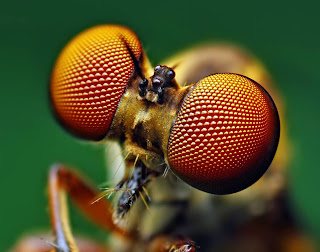
Robber fly - Nature photographer Thomas Shahan specializes in amazing portraits of tiny insects. It isn't easy. Shahan says that this Robber Fly (Holcocephala fusca), for instance, is "skittish" and doesn't like its picture taken.

Eye-popping bug photos

Nature by Numbers (Video)

"A Summary" – Apr 2, 2011 (Kryon channeled by Lee Carroll) (Subjects: Religion, Shift of Human Consciousness, 2012, Intelligent/Benevolent Design, EU, South America, 5 Currencies, Water Cycle (Heat up, Mini Ice Ace, Oceans, Fish, Earthquakes ..), Middle East, Internet, Israel, Dictators, Palestine, US, Japan (Quake/Tsunami Disasters , People, Society ...), Nuclear Power Revealed, Hydro Power, Geothermal Power, Moon, Financial Institutes (Recession, Realign integrity values ..) , China, North Korea, Global Unity,..... etc.) -
"The Quantum Factor" – Apr 10, 2011 (Kryon channeled by Lee Carroll) (Subjects: Galaxies, Universe, Intelligent design, Benevolent design, Aliens, Nikola Tesla (Quantum energy), Inter-Planetary Travel, DNA, Genes, Stem Cells, Cells, Rejuvenation, Shift of Human Consciousness, Spontaneous Remission, Religion, Dictators, Africa, China, Nuclear Power, Sustainable Development, Animals, Global Unity.. etc.) - (Text Version)

“ … Here is another one. A change in what Human nature will allow for government. "Careful, Kryon, don't talk about politics. You'll get in trouble." I won't get in trouble. I'm going to tell you to watch for leadership that cares about you. "You mean politics is going to change?" It already has. It's beginning. Watch for it. You're going to see a total phase-out of old energy dictatorships eventually. The potential is that you're going to see that before 2013.

They're going to fall over, you know, because the energy of the population will not sustain an old energy leader ..."
"Update on Current Events" – Jul 23, 2011 (Kryon channelled by Lee Carroll) - (Subjects: The Humanization of God, Gaia, Shift of Human Consciousness, 2012, Benevolent Design, Financial Institutes (Recession, System to Change ...), Water Cycle (Heat up, Mini Ice Ace, Oceans, Fish, Earthquakes ..), Nuclear Power Revealed, Geothermal Power, Hydro Power, Drinking Water from Seawater, No need for Oil as Much, Middle East in Peace, Persia/Iran Uprising, Muhammad, Israel, DNA, Two Dictators to fall soon, Africa, China, (Old) Souls, Species to go, Whales to Humans, Global Unity,..... etc.)
"Recalibration of Free Choice"– Mar 3, 2012 (Kryon Channelling by Lee Caroll) - (Subjects: (Old) Souls, Midpoint on 21-12-2012, Shift of Human Consciousness, Black & White vs. Color, 1 - Spirituality (Religions) shifting, Loose a Pope “soon”, 2 - Humans will change react to drama, 3 - Civilizations/Population on Earth, 4 - Alternate energy sources (Geothermal, Tidal (Paddle wheels), Wind), 5 – Financials Institutes/concepts will change (Integrity – Ethical) , 6 - News/Media/TV to change, 7 – Big Pharmaceutical company will collapse “soon”, (Keep people sick), (Integrity – Ethical) 8 – Wars will be over on Earth, Global Unity, … etc.) - (Text version)

“… 4 - Energy (again)


The natural resources of the planet are finite and will not support the continuation of what you've been doing. We've been saying this for a decade. Watch for increased science and increased funding for alternate ways of creating electricity (finally). Watch for the very companies who have the most to lose being the ones who fund it. It is the beginning of a full realization that a change of thinking is at hand. You can take things from Gaia that are energy, instead of physical resources. We speak yet again about geothermal, about tidal, about wind. Again, we plead with you not to over-engineer this. For one of the things that Human Beings do in a technological age is to over-engineer simple things. Look at nuclear - the most over-engineered and expensive steam engine in existence!

Your current ideas of capturing energy from tidal and wave motion don't have to be technical marvels. Think paddle wheel on a pier with waves, which will create energy in both directions [waves coming and going] tied to a generator that can power dozens of neighborhoods, not full cities. Think simple and decentralize the idea of utilities. The same goes for wind and geothermal. Think of utilities for groups of homes in a cluster. You won't have a grid failure if there is no grid. This is the way of the future, and you'll be more inclined to have it sooner than later if you do this, and it won't cost as much….”


"Fast-Tracking" - Feb 8, 2014 (Kryon Channelling by Lee Carroll) - (Reference to Fukushima / H-bomb nuclear pollution and a warning about nuclear > 20 Min)

Obama unveils landmark regulations to combat climate change

Obama unveils landmark regulations to combat climate change
In a bid to combat climate change, US President Barack Obama announced the Clean Power Plan on Monday, marking the first time power plants have been targeted by mandatory regulations on carbon dioxide emissions in the US.
Google: Earthday 2013
Showing posts with label Animal Rights. Show all posts

Sunday, July 23, 2017

Researchers mourn killing of Cecil the lion's cub

Yahoo – AFP, July 21, 2017

Cecil was killed by American dentist and trophy hunter Walter Palmer. Researchers
now confirm that a trophy hunter has shot dead one of his cubs (AFP Photo)

Johannesburg (AFP) - A trophy hunter in Zimbabwe has shot dead a cub of Cecil the lion whose death in 2015 caused worldwide outrage, researchers tracking the pride confirmed Friday.

Xanda, a six-year-old lion fitted with a radio collar, was killed on July 7 in northwest Zimbabwe, close to where US dentist Walter Palmer shot Cecil with a high-powered bow and arrow two years ago.

"Xanda was shot by a trophy hunter on a legally sanctioned hunt in a hunting area outside Hwange National Park," Andrew Loveridge from Oxford University's zoology department told AFP.

"As researchers we are saddened to lose a well-known study animal we have monitored since birth."

In 2015, Cecil's killing triggered fierce controversy as he was a popular attraction for visitors to the famed Hwange National Park.

Both Cecil and Xanda wore electronic GPS tracking collars in a project run by Oxford University's wildlife conservation research unit.

But they had strayed out of the park boundaries and into a legal hunting area.

The trophy hunter has not been named, but many hunters are from the United States or South Africa, paying tens of thousands of dollars for the opportunity to kill lions and other wild animals.

Pro-hunt groups say hunting provides an essential economic incentive to promote long-term conservation and that the income pays to safeguard wildlife and catch poachers.

Britain's Daily Telegraph newspaper named the hunt's professional expedition leader as Zimbabwean Richard Cooke, and said that the hunt was legal as Xanda was six years old.

It added that Cooke had handed in the collar after discovering it on the dead animal, who was the head of the pride with two lionesses and several cubs.

Palmer, who shot Cecil, a 13-year-old male, was hounded on social media and went into hiding after demonstrations outside his dental practice.

He was reported to have paid $55,000 for the hunt.

No charges were brought against Palmer or the local guide as the hunt was also found to be legal.

Scientists, who say that Hwange has a healthy population of about 550 lions, are pushing for a 5-km (3-mile) hunting exclusion zone to protect lions who wander outside the park's boundaries.

Cecil had at least 12 surviving cubs last year, according to the Oxford research project.

Related Articles:

Hunt: Fahd bin Sultan is said to have killed
1,977 houbara bustards in just 21 days while
on holiday


Spain's King Juan Carlos poses in front of a dead elephant
on a hunting trip in Botswana, Africa. Photograph: Target
Press/Barcroft Media


Spain's king ousted as WWF honorary president
Spain's King Juan Carlos under fire over elephant hunting trip


Question: Dear Kryon: I live in Spain. I am sorry if I will ask you a question you might have already answered, but the translations of your books are very slow and I might not have gathered all information you have already given. I am quite concerned about abandoned animals. It seems that many people buy animals for their children and as soon as they grow, they set them out somewhere. Recently I had the occasion to see a small kitten in the middle of the street. I did not immediately react, since I could have stopped and taken it, without getting out of the car. So, I went on and at the first occasion I could turn, I went back to see if I could take the kitten, but it was to late, somebody had already killed it. This happened some month ago, but I still feel very sorry for that kitten. I just would like to know, what kind of entity are these animals and how does this fit in our world. Are these entities which choose this kind of life, like we do choose our kind of Human life? I see so many abandoned animals and every time I see one, my heart aches... I would like to know more about them.

Answer: Dear one, indeed the answer has been given, but let us give it again so you all understand. Animals are here on earth for three (3) reasons.

(1) The balance of biological life. . . the circle of energy that is needed for you to exist in what you call "nature."

(2) To be harvested. Yes, it's true. Many exist for your sustenance, and this is appropriate. It is a harmony between Human and animal, and always has. Remember the buffalo that willingly came into the indigenous tribes to be sacrificed when called? These are stories that you should examine again. The inappropriateness of today's culture is how these precious creatures are treated. Did you know that if there was an honoring ceremony at their death, they would nourish you better? Did you know that there is ceremony that could benefit all of humanity in this way. Perhaps it's time you saw it.

(3) To be loved and to love. For many cultures, animals serve as surrogate children, loved and taken care of. It gives Humans a chance to show compassion when they need it, and to have unconditional love when they need it. This is extremely important to many, and provides balance and centering for many.

Do animals know all this? At a basic level, they do. Not in the way you "know," but in a cellular awareness they understand that they are here in service to planet earth. If you honor them in all three instances, then balance will be the result. Your feelings about their treatment is important. Temper your reactions with the spiritual logic of their appropriateness and their service to humanity. Honor them in all three cases.

Saturday, October 29, 2016

Deal struck for world's biggest marine reserve in Antarctica

Yahoo – AFP, Martin Parry, October 28, 2016

Antartica is considered critical for scientists to study how marine ecosystems
function and to understand the impacts of climate change on the ocean
(AFP Photo/Rodrigo Arangua)

Sydney (AFP) - The world's largest marine reserve aimed at protecting the pristine wilderness of Antarctica will be created after a "momentous" agreement was finally reached Friday, with Russia dropping its long-held opposition.

The deal, sealed by the Conservation of Antarctic Marine Living Resources (CCAMLR) at an annual meeting in Hobart after years of negotiations, will see a massive US and New Zealand-backed marine protected area established in the Ross Sea.

It will cover more than 1.55 million square kilometres (600,000 square miles) -- roughly the size of Britain, Germany and France combined -- of which 1.12 million square kilometres will be a no fishing zone.

"The proposal required some changes in order to gain the unanimous support of all 25 CCAMLR members and the final agreement balances marine protection, sustainable fishing and science interests," New Zealand Foreign Minister Murray McCully said.

"The boundaries of the MPA, however, remain unchanged."

'Just the start'

The Ross Sea is one of the last intact marine ecosystems in the world, home to penguins, seals, Antarctic toothfish, whales and huge numbers of krill, a staple food for many species.

It is considered critical for scientists to study how marine ecosystems function and to understand the impacts of climate change on the ocean.

Antarctic sanctuaries (AFP Photo/Laurence CHU, Gal ROMA)

Moscow was the last government opposing the move, largely due to concerns over fishing rights, after China offered its support last year.

"We had a lot of talks with them. Secretary (John) Kerry reached out to Russian President (Vladimir) Putin and (Foreign Minister Sergei) Lavrov and I think that helped a great deal to convince Russia to come on board," Evan Bloom, head of the US delegation at the meeting, told AFP.

"This decision is very important not just for the Antarctic but for efforts to promote world marine conservation."

Moscow has signalled more commitment to conservation in recent times, designating 2017 as the Year of Ecology. It moved in August to significantly increase the size of a protected zone around Franz Josef Land in the Arctic.

While the Ross Sea plan got the go-ahead, time ran out at the meeting to reach agreement on a second proposed protected area -- the Australia and France-led East Antarctica sanctuary covering another one million square kilometre zone.

Antarctica is home to penguins, seals, Antarctic toothfish, and whales
(AFP Photo/Eitan Abramovich)

Both reserve proposals have been on the table since 2012 with CCAMLR -- a treaty tasked with overseeing conservation and sustainable exploitation of the Antarctic Ocean, also known as the Southern Ocean.

Consensus is needed from all 24 member countries and the European Union.

A third German-proposed plan is also in the works to protect the Weddell Sea, which extends from the southeast of South America over an area of some 2.8 million square kilometres.

"For the first time, countries have put aside their differences to protect a large area of the Southern Ocean and international waters," said Mike Walker, project director of the Antarctic Ocean Alliance, calling the outcome "momentous".

"Although there was not a decision on the proposed protection of the Weddell Sea and the East Antarctic this year, we are confident that these areas will be protected in the coming years, adding to the system of marine protected areas in the Southern Ocean."

A humpback whale jumps out of the water in the western Antarctic peninsula
(AFP Photo/Eitan Abramovich)

The Ross Sea is named after British explorer Sir James Ross and his great, great, great granddaughter Phillipa Ross said the family was thrilled it was safeguarded.

"The Ross family are euphoric that our family legacy has been honoured in the 175th anniversary year since James first discovered the Ross Sea, thanks to the individuals and organisations who have poured their hearts and souls into campaigning for its protection," she said.

It culminates years of pressure by conservationists, including a campaign by the global civic movement Avaaz which was kickstarted by Hollywood superstar Leonardo DiCaprio.

"There’s massive momentum in the world right now to protect our oceans," said Avaaz campaign director Luis Morago. "The Ross Sea is just the start."


Related Articles:


The existing boundaries of the Pacific Remote Islands Marine National Monument
 are outlined in light blue. The other Monuments, outlined in purple and green, are
not being changed. Photograph: Noaa


“… Now, in the process of all of this, there's going to be renewed interest in Antarctica, and you're going to find some interesting things about the land under the ice. The topography of the land under the ice does not match the topography of the ice above. Some astonishing shapes will be revealed when you map the actual land under the ice. Points of mountains are going to be revealed, giving an entire different idea of what Antarctica might have been and what its purpose really is. The continent that is uninhabitable by Human Beings may very well be the engine of life for Human Beings. And I will leave it at that. …”

Monday, September 12, 2016

World governments urge end to domestic ivory markets

Yahoo – AFP, Kerry Sheridan, September 11, 2016

After fierce debate, including opposition from Namibia and Japan, a motion was 
adopted at the IUCN World Conservation Congress to urge closure of all 
domestic ivory markets (AFP Photo/Tony Karumba)

Miami (AFP) - In a bid to stop the killing of elephants for their tusks, world governments voted at a major conservation conference to urge the closure of all domestic ivory markets.

After fierce debate -- including opposition from governments like Namibia and Japan -- the motion was adopted on the final day of the International Union for Conservation of Nature World Conservation Congress, a 10-day meeting that drew 9,000 people to Honolulu, Hawaii this month.

"Today's vote by IUCN members is the first time that a major international body has called on every country in the world to close its legal markets for elephant ivory," said Andrew Wetzler, deputy chief program officer at the Natural Resources Defense Council.

"It's truly a landmark moment, and a victory for elephants that will hopefully be repeated later this month at the next meeting of Convention on International Trade in Endangered Species (CITES) in Johannesburg."

Although the motion is non-binding, it "urges the governments of countries with domestic ivory markets to take all necessary legislative and regulatory efforts to close them," according to the IUCN.

Experts say that domestic ivory markets help fuel poaching by allowing traffickers a cover for their illegal imports and exports.

The United States and China, among the biggest consumers of ivory, have already agreed to enact near-total bans on their domestic markets.

Kenya Wildlife Services (KWS) rangers prepare a pyre in preparation for a burning 
of tonnes of ivory, rhino-horn and other confiscated wildlife trophies (AFP Photo/
Tony Karumba)

At the IUCN meeting, Japan and Namibia -- which also have thriving domestic ivory markets -- sought to soften the language of the motion by making 20 different amendments, but those efforts were rejected.

"The global conservation community is stepping up," said Wildlife Conservation Society President and CEO Cristian Samper.

"No more domestic ivory sales. Elephants have had enough of the ivory trade and so has the world."

Poaching persists

CITES banned the international commercial trade in African elephant ivory in 1989.

But illegal poaching of endangered elephants for their tusks persists at dangerous levels, according to research released at the start of the September 1-10 conference, the largest of its kind in the conservation community.

Savanna elephants have declined at a rate of 27,000 -- or eight percent -- per year, with a total of 144,000 lost in less than a decade, said the findings.

Poaching hotspots identified include Angola, Mozambique and Tanzania, where "staggering population declines" were found, said the study funded by Microsoft co-founder and billionaire philanthropist Paul Allen.

The US and China, among the biggest consumers of ivory, have already agreed
to enact near-total bans on their domestic markets (AFP Photo/Tony Karumba)

Other populations face "local extinction" in northeast Democratic Republic of Congo, northern Cameroon and southwest Zambia.

Wildlife groups hailed the IUCN move and called for more action at the CITES talks in Johannesburg later this month.

"There, we remain hopeful the delegates will be emboldened by the IUCN vote to adopt a resolution submitted by African governments that also calls for closure of domestic ivory markets," said Samper.

"The shutting down of domestic ivory markets will send a clear signal to traffickers and organized criminal syndicates that ivory is worthless and will no longer support their criminal activities causing security problems in local communities and wiping out wildlife."

Related Article:


Thursday, September 17, 2015

Eyes on elephants as Google cameras snap Kenya reserve

Yahoo - AFP, September 15, 2015

A Google Street View vehicle collects imagery for Google Maps while driving down
a street in Calais, northern France, on July 29, 2015 (AFP Photo/Philippe Huguen)

Samburu (Kenya) (AFP) - For once, Google was unlikely to face privacy complaints as the US Internet giant on Tuesday launched its Street View service in Kenya's Samburu park, in a move conservationists said could help protect endangered elephants.

Special cameras have taken panoramic images of the reserve while driving down dusty tracks -- and have also been fixed to a backpack to penetrate deep into the bush.

Some of Google's previous Street View forays have brought complaints on privacy grounds.

A lioness stands near an oryx at the Samburu
National Park in Kenya (AFP Photo/
Pedro Ugarte)
But this time there were no demands to blur out faces -- the main residents of the 165 square kilometre (65 square mile) reserve are 900 elephants.

The idea is to allow viewers to click and view the elephant herds close up.

"We hope that by bringing Street View to Samburu, we will inspire people around the world to gain a deeper appreciation for elephants," said Farzana Khubchandani of Google Kenya.

Slightly larger than a basketball, Google's camera contains 15 individual fixed-focus lenses that simultaneously capture a 360 degree image roughly every three metres.

The Kenya project was launched in collaboration with conservation group Save the Elephants.

"It's exciting to open a window onto Samburu, and to help us better protect its elephants," said Save the Elephants chief Iain Douglas-Hamilton, speaking in Samburu, some 300 kilometres (185 miles) north of the Kenyan capital Nairobi.

Kenya is struggling to stem poaching to protect its remaining elephant population -- currently estimated at 30,000 -- and just over a thousand rhinos.

With ivory raking in thousands of dollars a kilo in Asia, conservationists have warned that African elephants could be extinct in the wild within a generation.

"Giving people a virtual tour will bring Samburu to the world, and inspire the world to come to Samburu," county governor Moses Lenolkulal said.

"The more people experience our culture, our people and the majestic elephants and other wildlife with which we co-exist, the more we are able to conserve and sustain the Samburu culture and its fragile ecosystem for generations to come."

Wednesday, July 29, 2015

Killer of Cecil the lion was dentist from Minnesota, claim Zimbabwe officials

Zimbabwe Conservation Task Force alleges trophy hunter shot one of Africa’s most famous lions near Hwange national park


Conservationists in Zimbabwe have accused an American man of being the alleged killer of Cecil, one of Africa’s most famous lions and the star attraction at the Hwange national park.

On Tuesday, the Zimbabwe Conservation Task Force said the man thought to have paid $50,000 (£32,000) for the chance to kill Cecil was not a Spaniard as originally believed, but US citizen Walter Palmer, from a small town near Minneapolis. The man left the lion skinned and headless on the outskirts of the park, the ZCTF’s Johnny Rodrigues said in a statement.

The hunt took place around 6 July. “They went hunting at night with a spotlight and they spotted Cecil,” Rodrigues said. “They tied a dead animal to their vehicle to lure Cecil out of the park and they scented an area about half a kilometre from the park.”

Walt Palmer, left, and one of his many trophies.

The hunter first shot at Cecil with a bow and arrow but failed to kill the lion. “They tracked him down and found him 40 hours later when they shot him with a gun,” Rodrigues said.

A spokesman for Palmer told the Guardian that the hunter was “obviously quite upset over everything”.

“As far as I understand, Walter believes that he might have shot that lion that has been referred to as Cecil,” the spokesman said. “What he’ll tell you is that he had the proper legal permits and he had hired several professional guides, so he’s not denying that he may be the person who shot this lion. He is a big-game hunter; he hunts the world over.”

On Tuesday, Palmer - a dentist and married father of two - became a target as the Facebook page of his dental clinic was flooded with angry comments and threats. An online petition demanding justice for Cecil had gathered more than 12,000 signatures.

Palmer’s love of hunting is well-documented online. In 2009, he was interviewed by the New York Times about his slaying of an elk that was touted as a kill for the archery record books.

Noting that Palmer had learned to shoot at age five and was “capable of skewering a playing card from 100 yards with his compound bow,” the article said Palmer had paid $45,000 at auction to take part in the hunt, with the proceeds being used to help fund the elk habitat. As the hunting season began, Palmer was on probation for lying to authorities over the exact location where he had killed a black bear in northern Wisconsin in 2006.

A 2008 Flickr photo album by Trophy Hunt America and Porcupine Creek Outfitters, a company that leads hunting expeditions, shows Walter Palmer posing next to avariety of slain animals, including a wood bison and a lion. In another online photo Palmer and his bow and arrow sit next to a slain rhino, the captionstating that the photo was taken in South Africa.

The same company advertises trips to Africa, under the name Safari Connection. Photographs to advertise the company’s services show hunters posed next to elephants. Other expeditions show hunters posed next to polar bears amid snowy backdrops.

Two people who accompanied the hunter on his Zimbabwe trip were identified by authorities and arrested earlier this month, including Theo Bronkhorst, the founder of Bushman Safaris Zimbabwe which is believed to have organised the hunt. Both are facing poaching charges and due to appear in court in early August.

Zimbabwe National Parks confirmed the charges. “In this case, both the professional hunter and land owner had no permit or quota to justify the offtake of the lion and therefore are liable for the illegal hunt,” it said in a statement. Bronkhorst’s hunting license has been suspended and efforts were being made to interview another employee of Bushman Safaris who was believed to have also taken part in the hunt.

The 13-year-old lion was wearing a GPS collar as part of an Oxford University research project that had been running since 1999, making it possible to trace his last movements. Rodrigues said the hunters tried to destroy the collar, but failed.

Walt Palmer and a Nevada California Bighorn.

The death of Cecil comes as Zimbabwe, like many countries in Africa, attempts to crack down on illegal hunting and poaching, said Rodrigues. “This has been going on too long. Cecil is the 23 or 24th lion that has been collared and then killed in Hwange. We have to try and stop it.”

Initially his organisation had said the whereabouts of Cecil’s head was unknown, sparking concerns that it would be sent abroad as a trophy. The fear brought conservationists and politicians together this week to call on the European Union to ban the import of lion heads, paws and skins as hunters’ trophies from African countries that cannot prove their lion populations are sustainable.

On Tuesday, Rodrigues said the head of the lion had been located in Zimbabwe and had been impounded to be used as evidence in the investigation.

The ZCTF said on Tuesday that it continued to mourn Cecil. Rodrigues pointed out that the hunter was believed to have paid just $50,000 to kill a creature that would have brought millions of dollars worth of tourism to the reserve.

Conservation authorities said they were also dealing with the likely consequences of Cecil’s death for his six cubs. “The saddest part of all is that now that Cecil is dead, the next lion in the hierarchy, Jericho, will most likely kill all Cecil’s cubs so that he can insert his own bloodline into the females.”


Cecil was a major tourist attraction at Zimbabwe's largest game reserve in
Hwange National Park, due to his distinctive black mane (AFP Photo)


Hunt: Fahd bin Sultan is said to have killed
1,977 houbara bustards in just 21 days while
on holiday


Spain's King Juan Carlos poses in front of a dead elephant
on a hunting trip in Botswana, Africa. Photograph: Target
Press/Barcroft Media

Spain's king ousted as WWF honorary president
Spain's King Juan Carlos under fire over elephant hunting trip


Question: Dear Kryon: I live in Spain. I am sorry if I will ask you a question you might have already answered, but the translations of your books are very slow and I might not have gathered all information you have already given. I am quite concerned about abandoned animals. It seems that many people buy animals for their children and as soon as they grow, they set them out somewhere. Recently I had the occasion to see a small kitten in the middle of the street. I did not immediately react, since I could have stopped and taken it, without getting out of the car. So, I went on and at the first occasion I could turn, I went back to see if I could take the kitten, but it was to late, somebody had already killed it. This happened some month ago, but I still feel very sorry for that kitten. I just would like to know, what kind of entity are these animals and how does this fit in our world. Are these entities which choose this kind of life, like we do choose our kind of Human life? I see so many abandoned animals and every time I see one, my heart aches... I would like to know more about them.

Answer: Dear one, indeed the answer has been given, but let us give it again so you all understand. Animals are here on earth for three (3) reasons.

(1) The balance of biological life. . . the circle of energy that is needed for you to exist in what you call "nature."

(2) To be harvested. Yes, it's true. Many exist for your sustenance, and this is appropriate. It is a harmony between Human and animal, and always has. Remember the buffalo that willingly came into the indigenous tribes to be sacrificed when called? These are stories that you should examine again. The inappropriateness of today's culture is how these precious creatures are treated. Did you know that if there was an honoring ceremony at their death, they would nourish you better? Did you know that there is ceremony that could benefit all of humanity in this way. Perhaps it's time you saw it.

(3) To be loved and to love. For many cultures, animals serve as surrogate children, loved and taken care of. It gives Humans a chance to show compassion when they need it, and to have unconditional love when they need it. This is extremely important to many, and provides balance and centering for many.

Do animals know all this? At a basic level, they do. Not in the way you "know," but in a cellular awareness they understand that they are here in service to planet earth. If you honor them in all three instances, then balance will be the result. Your feelings about their treatment is important. Temper your reactions with the spiritual logic of their appropriateness and their service to humanity. Honor them in all three cases.

Saturday, March 21, 2015

US lawyer argues chimps are people too

Yahoo – AFP, Glenn Chapman, 21 March 2015

Attorney Steven Wise argues that apes, chimpanzees, elephants and orcas
 are as entitled to the rights of "persons" under law as are people or corporations 
(AFP Photo/Sia Kambou)

Vancouver (AFP) - Attorney Steven Wise is on a crusade to prove that, as a matter of law, chimps are people too.

For that matter, so are dolphins, elephants, gorillas and orcas.

Wise made his argument at the TED Conference that wrapped up in Vancouver, Canada on Friday.

"I had to invent the field of animal juris prudence," Wise told AFP at TED.

Nonhuman Rights Project president and
 attorney Steven Wise pictured in 
Vancouver, Canada on March 20, 2015,
 where he spoke at a TED conference
(AFP Photo/Glenn Chapman)
"Coming here is implicit affirmation that people are interested in what we have to say."

Wise argued that apes, chimps, elephants and orcas are as entitled to the rights of "persons" under law as are people or corporations.

Legal systems around the world have granted rights of personhood to holy scripts, mosques, companies, and even a river.

"Personhood is not a biological concept, it is a public policy concept," Wise said.

"The legal system decides it; human being is not synonymous with person."

He has devoted decades to the cause, which is now making its way through courts in the US state of New York.

Seeing animals as slaves

Wise, president of the Nonhuman Rights Project, is hoping a legal tactic successful in getting a slave legally transformed from property to person in a historic case in Britain will do the same for chimpanzees and other animals.

He will use the writ of habeas corpus, in which judges order prisoners or detainees brought before the court. Such writs, by definition, assign rights of personhood to those targeted.

Members of the project found chimpanzees in abysmal conditions in several parts of the state of New York, then filed for writs of habeas corpus in respective courts to get the animals moved to a refuge.

Reactions from judges have been mixed, with even sympathetic members of the bench averse to breaching the legal wall separating people from animals, according to Wise.

"Even in America, no judge wants to be the first to make this leap of faith," the animal rights champion said.

Wise, author of "Rattling the Cage" and other works defending animal rights, has been waging this legal battle since the early 1980s.

"They truly are slaves," Wise said of chimps, bonobos and other animals proven to have feelings, memories, language, foresight and other traits considered human.

"I realized there was no one looking out for their interests and they were just being exploited."

He recalled being met with hostility and ridicule early in the battle. Rival lawyers would bark when he walked into courtrooms.

After decades of laying groundwork and gathering allies, Wise and his team filed an opening salvo of lawsuits in New York about two years ago.

"We are going state by state, animal by animal and we are going to lose a lot before we start to win," he said.

"I expect to win, and not all that far into the future."

An orca swims with its baby at the Marineland animal exhibition park in
 the French Riviera city of Antibes, southeastern France on December 10, 2013
(AFP Photo/Valery Hache)

Tide of history

Victory would come in the form of a non-human animal being legally recognized as a person for some purpose, no matter how limited.

"Once that wall is pierced, judges will realize that they have to make more nuanced, rational decisions," Wise said of establishing that some animals have a right to be treated better than mere property.

Wise is working with lawyers in Europe, Argentina and other parts of the world.

"I think there is a tide of history and judges need to swim with it and not against it," Wise said.

"Orcas, apes, chimps and elephants should at least have the right to bodily liberty. I am not talking the entire animal kingdom, but lines have to be drawn."

The Nonhuman Rights Project is looking to hit US courts with its next case, on behalf of circus elephants, late this year.

"I think it may change the way people view entities that aren't human," Wise said of his quest.

"They may not have the knee-jerk reaction that we can exploit them."


Killer whales have been thrilling whale watchers this week in Puget Sound. But
they were especially exciting Tuesday when nearly three dozen orcas surrounded
 the ferry from Seattle as it approached the terminal on Bainbridge Island. NOAA
Fisheries Service photo by Candice Emmons

Related Articles:


Question: Dear Kryon: I live in Spain. I am sorry if I will ask you a question you might have already answered, but the translations of your books are very slow and I might not have gathered all information you have already given. I am quite concerned about abandoned animals. It seems that many people buy animals for their children and as soon as they grow, they set them out somewhere. Recently I had the occasion to see a small kitten in the middle of the street. I did not immediately react, since I could have stopped and taken it, without getting out of the car. So, I went on and at the first occasion I could turn, I went back to see if I could take the kitten, but it was to late, somebody had already killed it. This happened some month ago, but I still feel very sorry for that kitten. I just would like to know, what kind of entity are these animals and how does this fit in our world. Are these entities which choose this kind of life, like we do choose our kind of Human life? I see so many abandoned animals and every time I see one, my heart aches... I would like to know more about them.

Answer: Dear one, indeed the answer has been given, but let us give it again so you all understand. Animals are here on earth for three (3) reasons.

(1) The balance of biological life. . . the circle of energy that is needed for you to exist in what you call "nature."

(2) To be harvested. Yes, it's true. Many exist for your sustenance, and this is appropriate. It is a harmony between Human and animal, and always has. Remember the buffalo that willingly came into the indigenous tribes to be sacrificed when called? These are stories that you should examine again. The inappropriateness of today's culture is how these precious creatures are treated. Did you know that if there was an honoring ceremony at their death, they would nourish you better? Did you know that there is ceremony that could benefit all of humanity in this way. Perhaps it's time you saw it.

(3) To be loved and to love. For many cultures, animals serve as surrogate children, loved and taken care of. It gives Humans a chance to show compassion when they need it, and to have unconditional love when they need it. This is extremely important to many, and provides balance and centering for many.

Do animals know all this? At a basic level, they do. Not in the way you "know," but in a cellular awareness they understand that they are here in service to planet earth. If you honor them in all three instances, then balance will be the result. Your feelings about their treatment is important. Temper your reactions with the spiritual logic of their appropriateness and their service to humanity. Honor them in all three cases.


Question: Dear Kryon: I was wondering about the way I feel about whales and dolphins. I've had a feeling that I have to go to them sometime, but I don't know how or what I'm to do when I get there. Please help.

Question: Dear Kryon: I'm a Turkish/Islam woman of 57. I live in Ankara and work for the European Commission's project in Turkey. I've read almost all of the Kryon books twice, and I'm planning to read them once more. My question is about the whales. Why do they commit mass suicide? What is the reason for this very sad event? Is it a kind of protest against Human Beings?

Answer: Dear ones, we've channelled many times about the whales of this planet. In review, they're the living portions of an actual grid-system! They contain the "history of Earth" within their beings, and they're sacred for that reason. They coordinate and cooperate with the crystalline grid of your planet, which is currently being rewritten (see Kryon channelling on the Website: "What's Next?" December 8, 2002). Doesn't it strike you odd that these mammals are the only ones protected against hunting by more than 90 percent of the countries of Earth... even the places without oceans? Do you think that this is an accident or a coincidence? No. It's cellular information for all humanity to protect the whales and keep them safe. Dolphins are their cousins and support group, and they play a role in the whales' development. This is why you're so attracted to them.

Whales do not commit mass suicide. They have no consciousness to allow for this, and it has never happened. Instead, you see whales often beaching themselves and then being saved by Humans, only to re-beach themselves and die. This takes place mostly on the coastlines of your continents, and often on those areas of topography that "stick out," such as a peninsula or isthmus. Your Cape Cod is a good example in America, and is also a place where this has recently happened (up to 47 whales on a beach).

The reason is that whales, dolphins, amphibians, birds, and even insects all navigate to their breeding ground or migration areas each year via the magnetic grid of the planet! Each group follows the ley lines of magnetic influence, almost as if they had a built-in compass. In fact, they actually do!

The magnetic grid of this planet has changed so much, so quickly, as we told you it would in 1989, that there hasn't been time for the pods of whales to adjust with time to these changes. Instead, many simply follow the old magnetic lines of migration, only to find themselves on a beach instead of the open ocean, as the old magnetic direction used to take them. They're confused, and they simply line up and try again, just as they have for years. These things are temporary, and as tragic as you might see them, it's all part of "pruning" the system, and the calves will go around in the future, establishing new instinctive information for the new whales regarding the grid changes. This information has even now been validated this year (2003) by your scientists.