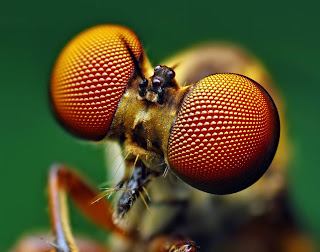
Robber fly - Nature photographer Thomas Shahan specializes in amazing portraits of tiny insects. It isn't easy. Shahan says that this Robber Fly (Holcocephala fusca), for instance, is "skittish" and doesn't like its picture taken.

Eye-popping bug photos

Nature by Numbers (Video)

"A Summary" – Apr 2, 2011 (Kryon channeled by Lee Carroll) (Subjects: Religion, Shift of Human Consciousness, 2012, Intelligent/Benevolent Design, EU, South America, 5 Currencies, Water Cycle (Heat up, Mini Ice Ace, Oceans, Fish, Earthquakes ..), Middle East, Internet, Israel, Dictators, Palestine, US, Japan (Quake/Tsunami Disasters , People, Society ...), Nuclear Power Revealed, Hydro Power, Geothermal Power, Moon, Financial Institutes (Recession, Realign integrity values ..) , China, North Korea, Global Unity,..... etc.) -
"The Quantum Factor" – Apr 10, 2011 (Kryon channeled by Lee Carroll) (Subjects: Galaxies, Universe, Intelligent design, Benevolent design, Aliens, Nikola Tesla (Quantum energy), Inter-Planetary Travel, DNA, Genes, Stem Cells, Cells, Rejuvenation, Shift of Human Consciousness, Spontaneous Remission, Religion, Dictators, Africa, China, Nuclear Power, Sustainable Development, Animals, Global Unity.. etc.) - (Text Version)


“ … Here is another one. A change in what Human nature will allow for government. "Careful, Kryon, don't talk about politics. You'll get in trouble." I won't get in trouble. I'm going to tell you to watch for leadership that cares about you. "You mean politics is going to change?" It already has. It's beginning. Watch for it. You're going to see a total phase-out of old energy dictatorships eventually. The potential is that you're going to see that before 2013.

They're going to fall over, you know, because the energy of the population will not sustain an old energy leader ..."

(Live Kryon Channelings was given 7 times within the United Nations building.)

"Update on Current Events" – Jul 23, 2011 (Kryon channelled by Lee Carroll) - (Subjects: The Humanization of God, Gaia, Shift of Human Consciousness, 2012, Benevolent Design, Financial Institutes (Recession, System to Change ...), Water Cycle (Heat up, Mini Ice Ace, Oceans, Fish, Earthquakes ..), Nuclear Power Revealed, Geothermal Power, Hydro Power, Drinking Water from Seawater, No need for Oil as Much, Middle East in Peace, Persia/Iran Uprising, Muhammad, Israel, DNA, Two Dictators to fall soon, Africa, China, (Old) Souls, Species to go, Whales to Humans, Global Unity,..... etc.)

"Recalibration of Free Choice"– Mar 3, 2012 (Kryon Channelling by Lee Caroll) - (Subjects: (Old) Souls, Midpoint on 21-12-2012, Shift of Human Consciousness, Black & White vs. Color, 1 - Spirituality (Religions) shifting, Loose a Pope “soon”, 2 - Humans will change react to drama, 3 - Civilizations/Population on Earth, 4 - Alternate energy sources (Geothermal, Tidal (Paddle wheels), Wind), 5 – Financials Institutes/concepts will change (Integrity – Ethical) , 6 - News/Media/TV to change, 7 – Big Pharmaceutical company will collapse “soon”, (Keep people sick), (Integrity – Ethical) 8 – Wars will be over on Earth, Global Unity, … etc.) - (Text version)

“… 4 - Energy (again)


The natural resources of the planet are finite and will not support the continuation of what you've been doing. We've been saying this for a decade. Watch for increased science and increased funding for alternate ways of creating electricity (finally). Watch for the very companies who have the most to lose being the ones who fund it. It is the beginning of a full realization that a change of thinking is at hand. You can take things from Gaia that are energy, instead of physical resources. We speak yet again about geothermal, about tidal, about wind. Again, we plead with you not to over-engineer this. For one of the things that Human Beings do in a technological age is to over-engineer simple things. Look at nuclear - the most over-engineered and expensive steam engine in existence!

Your current ideas of capturing energy from tidal and wave motion don't have to be technical marvels. Think paddle wheel on a pier with waves, which will create energy in both directions [waves coming and going] tied to a generator that can power dozens of neighborhoods, not full cities. Think simple and decentralize the idea of utilities. The same goes for wind and geothermal. Think of utilities for groups of homes in a cluster. You won't have a grid failure if there is no grid. This is the way of the future, and you'll be more inclined to have it sooner than later if you do this, and it won't cost as much….”


"Fast-Tracking" - Feb 8, 2014 (Kryon Channelling by Lee Carroll) - (Reference to Fukushima / H-bomb nuclear pollution and a warning about nuclear > 20 Min)

Obama unveils landmark regulations to combat climate change

Obama unveils landmark regulations to combat climate change
In a bid to combat climate change, US President Barack Obama announced the Clean Power Plan on Monday, marking the first time power plants have been targeted by mandatory regulations on carbon dioxide emissions in the US.
Google: Earthday 2013
Showing posts with label Biodiversity. Show all posts

Friday, August 5, 2022

Great Barrier Reef sees fragile coral comeback

 Yahoo – AFP, Andrew BEATTY, August 4, 2022 

Parts of Australia's beleaguered Great Barrier Reef now have the highest levels of coral cover seen in decades, a government report said Thursday, suggesting the aquatic wonder could survive given the chance. 

Portions of the vast UNESCO heritage site showed a marked increase in coral cover in the last year, reaching levels not seen in 36 years of monitoring, the Australian Institute of Marine Science said. 

Scientists surveying 87 sites said northern and central parts of the reef had bounced back from damage more quickly than some had expected, thanks mainly to fast-growing Acropora -- a branching coral that supports thousands of marine species. 

"These latest results demonstrate the reef can still recover in periods free of intense disturbances," said the Australian Institute of Marine Science's CEO Paul Hardisty. 

But far from declaring victory, Hardisty warned the gains could easily be reversed by cyclones, new bleaching events or crown-of-thorns outbreaks. 

He pointed to a reversal in fortunes for the southern portion of the reef, which a year ago had appeared to be on the mend, but was now in decline again. 

"This shows how vulnerable the reef is to the continued acute and severe disturbances that are occurring more often, and are longer-lasting," he said. 

Coral coverage has increased by 36 percent across sites monitored in the northern part of the reef, up from 27 percent in 2021. 

But the picture was less encouraging as the scientists moved south, with a smaller increase in cover in the reef's central belt and a marked decrease in coral cover in the south. 

The spread of coral-killing crown-of-thorns starfish has also taken a toll. 

Only fierce lobbying by the Australian government stopped the reef from being labelled "in danger" by UNESCO -- a potentially devastating blow to the country's multi-billion-dollar tourism industry. 

Many fear that the speeding rate of damage could cause the reef to be destroyed entirely. 

Marine scientist Terry Hughes said it was "good news" that coral was regrowing, but warned the species driving the recovery were very vulnerable to ocean heating. 

He added that replacing large, old, slow-growing corals that had defined the reef was likely "no longer possible. Instead we're seeing partial reassembly of fast-growing, weedy corals before the next disturbance." 

Zoe Richards a researcher at the Coral Conservation and Research Group at Curtin University also cautioned against over-optimism. 

"This recovery trend is driven by a handful of Acropora species which often grow in a boom-and-bust pattern," she said. "This means that the next thermal stress event could easily decimate these coral communities once again." 

"We are already finding evidence that each mass bleaching event leads to local extinctions of rarer species, so the short-term success of a handful of fast-growing coral species masks the full story about the largely hidden losses of biodiversity."

Related Article:

"....The Prediction: The Renewal of the Life Cycle

When you change the temperature strata of the oceans of the earth, things start to change, for the life cycle of the food in the ocean depends upon that which is the smallest. The plankton of the planet survive in certain temperatures, and that's changing. Throw away what you think you know about how it's all supposed to work, and instead think "renewal" or "how did it begin." This will serve you to understand what is happening now. This cycle is built to replenish the ocean with life and not always by sustaining the kind that was there.

Let us just talk about the ocean for a moment. We won't even get to what's happening in the air and what mammals might experience. Let's just speak of the ocean. Have you heard about the salmon? What has your science warned you against? You're overfishing! The sea is dying. The coral is dying. The reefs are going away. You're not seeing the food chain that used to be there. You've overfished everything. Fishing quotas have been set up to help this. Oh, all those little people in the red room - they don't know about the purple. Red people only know about the red paradigm.

Did you hear about the salmon recently? There's too many of them! In the very place where quotas are in place so you won't overfish, they're jumping in the boats! Against all odds and any projections from environmentalists or biologists, they're overrunning the oceans in Alaska - way too many fish.

What does that tell you? Is it possible that Gaia takes care of itself? That's what it tells you! Perhaps this alignment is going to keep humanity fed. Did anybody think of this? What if Gaia is in alliance with you? What if the increase in consciousness that raised your DNA vibration has alerted Gaia to change the weather cycle and get ready to feed humanity? Are you looking at the ocean where the oil spill occurred? It's recovering in a way that was not predicted. What's happening?

The life cycle itself is being altered by the temperature change of the ocean and much of what you have believed is the paradigm of life in the sea is slowly changing. A new system of life is appearing, as it has before, and is upon you in your lifetime. It will compliment what you know and expose you to a new concept: Gaia regularly refreshes the life cycle on Earth.

Within this process, there will be the extinction of certain plants and animals, birds and fish. My advice to you, especially to those environmentalists, is to understand the cycle of life so that you may relax with what nature has always done. It puts life on the planet to serve the planet for a time. When certain life no longer serves the planet in the ways it used to, it takes it away. The extinction of life, especially through weather change, is normal for Gaia. It is honored, appropriate and normal, even if you don't think so. Don't try to save all the disappearing animals, fish and birds! Some are supposed to go away. And, dear ones, don't assign all this activity to something you did to cause it!

The red people are stressing. The purple is here, and they are trying to figure out what they did wrong. They don't know they are in the Rainbow Room. They think they are in the RED ROOM. This is what the Rainbow Room does; it changes colors. So as the room does what it has always done, the red people are sitting there in fear trying to figure out what it is that they did that possibly could have caused the purple to appear.

The Rainbow Room is beautiful. The color purple is significant. Going from red to purple has metaphysical significance within this parable, but I'll let you figure it out. For those who are into colors, there's a reason why I gave those two. The earth is becoming more sacred than it's ever been before. Gaia is with you in this. It's cooperating in ways you never thought it could, in the way biologists said it would not. You think you're killing it? Instead, it's giving birth to an altered ecological system. ...."

Friday, May 10, 2019

Two-thirds of world's longest rivers throttled by mankind: study

Phys.org – AFP, Patrick Galey, 8 May 2019

Aerial view of where the Araguaia River splits into the Coco River (to the left)
in Brazil. Credit: Day's Edge Productions / WWF-US

Almost two in three of Earth's longest rivers have been severed by dams, reservoirs or other manmade constructions, severely damaging some of the most important ecosystems on the planet, researchers said Wednesday.

Using the latest satellite data and computer modelling software, the international team looked at the connectivity of 12 million kilometres of rivers worldwide, providing the first global assessment of human impact on the planet's waterways.

They found that out of the 91 rivers longer than 1,000 kilometres (600 miles) in length, just 21 retained a direct connection between source and sea.

Just a little over a third (37 percent) of the 242 longest rivers had retained their free flow, something experts said was having a profound effect on Earth's biodiversity.

"The world's rivers form an intricate network with vital links to land, groundwater and the atmosphere," said Gunther Grill from McGill University's Department of Geography and lead author.

"Free-flowing rivers are important for humans and the environment alike, yet economic development around the world is making them increasingly rare."

Most of the remaining free-flowing rivers were confined to remote parts of the Arctic, the Amazon and the Congo basins, the study found.

This week the UN's panel on biodiversity released a summary of its devastating assessment on the state of Nature.

The underlying report, which will be made public in the coming weeks, found that 50 percent of rivers "manifest severe impacts of degradation" from human activity.

Wednesday's study, published in the journal Nature, laid bare in intricate detail just how drastically manmade activity is impacting our waterways.

It estimated there was now a total of 60,000 large dams at least 15 metres tall severing rivers, out of a total of 2.8 million worldwide.

The blocking or damming of rivers disrupts the flow of nutrients vital to replace those lost through agriculture, and diminishes the amount of river-bourne species that can complete their life-cycles.

3,700 hydropower projects

It also lessens the sediment flows river deltas provide coastal regions with, which currently help to protect millions of people against sea level rises.

Less than a quarter of free-flowing rivers now connect to oceans, depriving estuary environment from vital nutrients and sediments.

The team warned that dams had already led to a significant fall in river fish, which provide nearly all the animal protein eaten by close to 160 million people.

A separate assessment last year from conservation group WWF said freshwater species had experienced the most pronounced decline of all vertebrates over the past century, falling on average 83 percent since 1970.

The study also identified more than 3,700 hydropower projects either planned our currently under construction, including some on rivers offering vital life support for the human populations who live along them.

While hydroelectric power are significantly cleaner in terms of emissions than oil, gas or coal, the team stressed that mega power projects involving dams and reservoirs could have unforeseen negative effects.

"Hydropower certainly has more complex environmental impacts than the often-cited positive effects of avoiding fossil fuels," Bernhard Lehner, a professor at McGill, told AFP.

"While hydropower inevitably has a role to play... countries should focus on sustainable options like solar and wind which can have less detrimental impacts on rivers and the communities, cities and biodiversity that rely on them."

The health of Earth's rivers will also be impacted as climate change accelerates, affecting flow patterns and water quality, as well as bringing more invasive species, the authors said.

Tuesday, April 30, 2019

UN biodiversity conference to lay groundwork for Nature rescue plan

Yahoo – AFP, Marlowe HOOD,  April 29, 2019

Up to a million species face extinction, many within decades, according
to the draft UN report (AFP Photo/ISHARA S. KODIKARA)

Paris (AFP) - Diplomats from 130 nations gathered in Paris on Monday to validate a grim UN assessment of the state of Nature and lay the groundwork for a rescue plan for life on Earth.

The destruction of Nature threatens humanity "at least as much as human-induced climate change," UN biodiversity chief Robert Watson said as the five-day meeting began.

"We have a closing window of opportunity to act and narrowing options."

A 44-page draft "Summary for Policy Makers" obtained by AFP catalogues the 1001 ways in which our species has plundered the planet and damaged its capacity to renew the resources upon which we depend, starting with breathable air, drinkable water and productive soil.

The impact of humanity's expanding footprint and appetites has been devastating.

Up to a million species face extinction, many within decades, according to the report, and three-quarters of Earth's land surface has been "severely altered".

Biodiversity loss around the world measured in percentage compared to 
an intact ecosystem (AFP Photo/Simon MALFATTO)

A third of ocean fish stocks are in decline, and the rest, barring a few, are harvested at the very edge of sustainability.

A dramatic die-off of pollinating insects, especially bees, threatens essential crops valued at half-a-trillion dollars annually.

Twenty 10-year targets adopted in 2010 under the United Nations' biodiversity treaty -- to expand protected areas, slow species and forest loss, and reduce pollution -- will, with one or two exceptions, fail badly.

Based on an underlying report that draws from 400 experts and weighs in at 1,800 pages, the executive summary has to be vetted line-by-line by diplomats, with scientists at their elbow.

The Intergovernmental Science-Policy Platform on Biodiversity and Ecosystem Services (IPBES) document, once approved, will be released on May 6.

Historically, conservation biology has focused on the plight of pandas, polar bears and a multitude of less "charismatic" animals and plants that humanity is harvesting, eating, crowding or poisoning into oblivion.

But in the last two decades, that focus has shifted back to us.

"Up to now, we have talked about the importance of biodiversity mostly from an environmental perspective," Watson told AFP ahead of the Paris meet.

Three-quarters of Earth's land surface has been "severely altered", according 
to the draft UN report (AFP Photo/Mauro Pimentel)

Agriculture is key

"Now we are saying that Nature is crucial for food production, for pure water, for medicines and even social cohesion."

And to fight climate change.

Forests and oceans, for example, soak up half of the planet-warming greenhouse gases we spew into the atmosphere.

If they didn't, Earth might already be locked into an unliveable future of runaway global warming.

And yet, an area of tropical forest five times the size of England has been destroyed since 2014, mainly to service the global demand for beef, biofuels, soy beans and palm oil.

"The recent IPCC report shows to what extent climate change threatens biodiversity," said Laurence Tubiana, CEO of the European Climate Foundation and a main architect of the Paris Agreement, referring to the UN's climate science panel.

"And the upcoming IPBES report -- as important for humanity -- will show these two problems have overlapping solutions."

Graphic on Earth's "mass extinctions" during the last 500 years. (AFP 
Photo/Alain BOMMENEL)

Extinctions hard to see

That overlap, she added, begins with agriculture, which accounts for at least a quarter of greenhouse gas emissions.

Set up in 2012, the IPBES synthesises published science for policymakers in the same way the Intergovernmental Panel for Climate Change (IPCC) does on climate.

Both advisory bodies feed into UN treaties.

But the 1992 Convention on Biological Diversity (CBD) has always been a poor stepchild compared to its climate counterpart, and the IPBES was added as an afterthought, making its authority harder to establish.

Biodiversity experts are trying to engineer a "Paris moment" for Nature akin to the 2015 Paris climate treaty.

Public concern about global warming has crystallised around impacts ranging from rising seas to deadly heatwaves, and the Paris pact's hard target for capping the rise in global temperatures.

The 2018 IPCC report cited by Tubiana added a time imperative: to hold the line at 1.5 degrees Celsius (2.7 Fahrenheit), the world must reduce CO2 emissions 45 percent by 2030, and become "carbon neutral" by mid-century, it concluded.

But finding the equivalent for Nature has proven difficult.

"Extinctions are not something the public can easily see," said Watson.

A growing number of scientists and NGOs are calling for 30 to 50 percent of Earth's surface to be "sustainably managed" by 2030, and more thereafter.

But the draft report makes no such concrete proposals.

The next opportunity for a visionary plan to be ratified would be the next full meeting in October 2020 of the parties to the Convention on Biodiversity in Kunming, China.

Related Article:


"....  A mini ice age is coming"Kryon, isn't that doom for the planet?"  Many have seen the artist's rendering of major earth cities under ice and all of the other things that go very well with science fiction movies. That's simply a painting of someone's doom scenario, not reality based in the history of the cycle. If you want to know what a mini ice age is like, just flash back in history and study what took place in about 1650. That was a mini ice age. Due to the change in the Gulf Stream (the ocean), the river Thames froze in London. Dear ones, it was cold, but it did not doom the planet. That's a mini ice age.

That's what you're facing, and I'll say it again. If you live in a cold climate, heed this advice: It's going to get colder. Get off the grid! Within the next 15 years, find a way of producing electricity independently or in smaller groups. This can be done neighborhood-wide or separately in homes. You're going to need this, dear ones, because the grid as it exists right now all over the world is not prepared for this coming cold, and the grid will fail. That's not doom and gloom, that's just practical, commonly known information. Your electricity infrastructure is delicate, too delicate. Prepare for a cold spell that may last for a couple of decades. That's all it is. Technology is racing forward to allow this. Don't let your politics get in the way of your survival. ..."

"...  This is controversial. The planet can't just "change the water". It does it instead with a "reboot of life in the ocean" using the water cycle. Watch for evidence of this as it occurs, and then remember this channel. This weather cycle is to refresh the life in the ocean so that everyone on the planet will have needed food from the ocean. Gaia does this by itself, has done it before, and it does it for a reason - so it will not stagnate.

Dear ones, indeed, you have put compromising things into the air and the water, but it has not caused this cycle. We have said for a very long time, stop killing the environment! The reason? It's going to kill you, not Gaia. Gaia is spectacularly resilient and will survive anything you do. However, it is you who may not survive if you continue polluting. All this is starting to change with your awareness, and you're starting to see this and move with it. But Humans are not causing the current weather shift. This will be known eventually.

What is happening has happened before, and it's almost like a reboot for the oceans and it carries a lot of dichotomous events. You're going to see reports of a dying ocean, but at the same time you're going to see unusual reports of too many fish and other sea life in places that were supposed to have a decline. You're going to see the life cycle of the ocean itself start to change and reboot.

The chief player in this renewal is a place you would not expect: Antarctica. I want you to watch for magic in Antarctica. It has always been the core of the refreshing of microbes and other kinds of life in your oceans and it's especially active during these mini ice ages. The process will cause currents under the sea to be filled with new life, delivering it to both hemispheres almost like an under-sea conveyor belt. ..."

Tuesday, January 3, 2017

From coal city to European Green Capital - Essen's extreme makeover

Coal, steel and heavy industry all featured prominently in Essen's past. But now the reinvented Ruhr region hub is showing off its environmental credentials as 2017's European Green Capital. Samantha Early paid a visit.

Deutsche Welle, 2 January 2017


Stepping on to the platform at Essen's central station on a clear winter's morning, the first thing to catch my eye is a giant billboard proclaiming this "the shopping city." Pondering the relative merits of retail therapy and sustainable living, I have to navigate the new European Green Capital quickly to make my first appointment.

At the headquarters of the local project team for Essen, European Green Capital of 2017, team leader Ralph Kindel explains that the city of 590,000 people (in the heart of the Ruhr metropolis of some 5.1 million) has a history of transformation - from a rural region to an industrial one with the discovery of coal, to the dark chapter of weapons manufacture under the Third Reich, then later as a hub of the "economic miracle" as Germany rebuilt. With the decline of the local steel and coal industries in the later 20th century, it faced what locals call the "Strukturwandel" - structural change.

"From green to gray to green again," is how Kindel describes it.

Ralph Kindel leads the project team for
Essen - European Green Capital 2017
He says the groundwork of a green city was laid in the 1920s by a visionary planner named Robert Schmidt. As the population exploded with industrialization, Schmidt realized workers needed green spaces to recuperate.

Several parks were set up and though that took a backseat for decades, new parks have since been established and Kindel says by 2020, the people of Essen will only need to travel 500 meters (a third of a mile) to access a network of green spaces.
"This ability to transform…makes Essen so exciting and also an example for Europe because we have mastered problems, and are tackling problems, that other regions in Europe will still be facing."

Green DNA

Essen was awarded the annual title by the European Commission. It was established to promote and reward cities' efforts to resolve environmental challenges. An expert panel and jury weigh up how well applicant cities are doing in areas including climate change mitigation and adaption, local transport, air quality and wastewater.

Winners are announced 18 months in advance. When Essen was made titleholder for 2017, the judges praised its "admirable efforts" to overcome its challenging industrial past and reinvent itself as a "green city."

The Krupp-Park includes a lake fed by rainwater. In Essen's industrial heyday,
clear blue sky was hard to spot

Kindel points to the more than 200 community projects planned as examples of ways the organization wants to use this year's special status to change presumptions about Essen as a city of coal, steel and smokestacks.

"No one expects to find so much green here," he says. "We want to present the reality."

The staff here seems to walk the talk, or pedal it, to be precise. There's a bike at reception which, project team member Christina Waimann tells me, is used to run errands. But she needs more than two wheels to give me a whistle-stop tour of Essen's green attractions. I'm relieved when she tells me her Smart car is very economical.

An example of water management

Our first destination is the Krupp-Park named for Friedrich Krupp, founder of what became ThyssenKrupp, the major global steel company which has its headquarters in Essen. Waimann says it's an example of the city's structural change and adaptation to climate change through sustainable architecture, landscaping and water management. A lake is filled by rainwater from the roof of the steel giant's headquarters and surrounding parkland.

The "Radschnellweg Ruhr," an Autobahn for bicycles to link the Ruhr cities, passes by the park, part of the 376 kilometers (234 miles) of city cycleways. As we head to our next destination, Waimann explains traffic jams are still a problem. The city is aiming for a quarter of trips to be made by bike by 2035.

Essen's greenest street

Promoting local food is one of
Essen's goals as a green city
In 15 minutes we reach what Waimann tells me is Essen's greenest street - Schuirweg. What makes it "green" is that it's home to farmers who are working alongside community gardeners and small growers to promote regional produce, one of the goals of Essen's Green Capital campaign. The argument goes that eating from close to home cuts down on transport emissions and increases awareness about food production.

Nikolas Weber's family has been farming in this area longer than he can count. Today they grow a wide variety of fruits, vegetables and grains as well as raising animals, selling the produce on site. They also rent out fields for other growers. For him, there's no better example of sustainability.

From filthy river to swimming spot

Perhaps one of the most concrete results of Essen's transformation is the fact that from May, people will be able to swim in the Ruhr River for the first time in generations. The Baldeneysee, a lake in the river, will become a certified bathing spot under EU standards. Kindel says the Ruhr was once one of the dirtiest industrial rivers in Europe, closed to swimmers since the early 1960s.

Come May, people can finally enjoy swimming in the Baldeneysee again

"It shows that we are no marketing gag… we are harvesting the results of all the work people have put in over in the past few decades and that makes us proud," he said.

Friends Stefan Booms, 25, and Simon Weber, 26 are enthusiastic about the city's new claim to fame and looking forward to swimming in the Ruhr. "It's great, we were in a canoe club for some months and we were on the river in that time but it's great to be allowed to swim again," Booms said. "I think we will try it!" added Weber.

Industrial heritage meets green future

My final stop is the Zeche Zollverein, a former coal mine which has been a UNESCO World Heritage site since 2001. I'm told no other place symbolizes Essen's transformation quite like this one. It's home to a museum and cultural centers as well as plant species from all over the world which arrived with the coal lorries and grow amidst the concrete, brick and steel structures. Kindel is looking forward to an international congress this year, when researchers will catalog the site's biodiversity.

Spahn has experienced many
of Essen's changes
Heinz Spahn has witnessed these changes more closely than most. Born in 1940, he worked at the Zollverein until closing day in 1986 and now shows visitors around. He recalls the days when the air smelt like rotten eggs due to sulfur and you had to check the wind direction before hanging washing out - lest the whites turn gray or yellow due to the air pollution. He's glad Essen's now a green capital.


He hopes the new title will bring more business and tourism to the city and says despite favoring isolation in nature over city bustle, he's proud to be an Essener.

Tuesday, January 13, 2015

Campaigners Urge U.N. to Block Cambodia Dam Displacement

A rights group on Tuesday urged the United Nations to help prevent the displacement of thousands of people, mainly from ethnic minority groups, by a $780 million China-backed dam.

Their plea came a day after Prime Minister Hun Sen said the economic benefits of a series of controversial dams outweigh environmental concerns in a country where a quarter of the population still lacks electricity.

Around 5,000 people -- mostly from marginalised indigenous groups -- could be displaced by the planned 400-megawatt Lower Sesan 2 dam on a tributary of the Mekong River in the northern province of Stung Treng, said the 3S Rivers Protection Network (3SPN).

Villagers are already "being pressured and intimidated into agreeing with the surveys and the proposed resettlement plans", the network said in a statement.

"Thousands of people’s lives will be devastated and destroyed by this project," according to Meach Mean, coordinator of 3SPN which is backed by foreign and local groups.

"Despite its severe impacts, there has been no transparency in the decision-making and no real consultation with the communities in order for them to express their concerns."

The group urged the U.N. Special Rapporteur on Human Rights to help prevent rights breaches, and said the dam would damage fish stocks and endanger fishing communities further down the Mekong.

The U.N. has previously raised concerns about the dam while scientists from the United States have joined calls for it to be shelved over fears for the region's biodiversity and food supply.

But Cambodia's government, led by Hun Sen who marks 30 years in power on Wednesday, is backing the Lower Sesan 2 dam which is expected to be completed in 2018.

It also supports the proposed Stung Cheay Areng Dam in Koh Kong province, which campaigners say will flood a valley home to a further 1,500 people.

High utility prices, driven by the lack of supply, are a major obstacle in Cambodia's efforts to attract foreign investment, and the government has struggled to find a way to cut the cost of power.

Nine dams, including several funded by China, are set to open by 2019. Once they are operational the government has said they will generate 2,045 megawatts of power, serving all of Cambodia's provinces.

But Cambodia has been heavily criticized in the past for allowing companies to clear hundreds of thousands of hectares of forest -- including in protected zones -- for everything from rubber and sugar cane plantations to hydropower dams, often for Chinese or Vietnamese companies.


The Yangtze river power station generated 98.8 billion kilowatt-hours of electricity
 in 2014, the Three Gorges Dam Corporation said in a statement, topping the
2013 production from the Brazilian-Paraguayan Itaipu dam (AFP Photo/Str)

Related Articles: