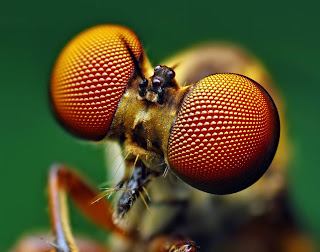
Robber fly - Nature photographer Thomas Shahan specializes in amazing portraits of tiny insects. It isn't easy. Shahan says that this Robber Fly (Holcocephala fusca), for instance, is "skittish" and doesn't like its picture taken.

Eye-popping bug photos

Nature by Numbers (Video)

"A Summary" – Apr 2, 2011 (Kryon channeled by Lee Carroll) (Subjects: Religion, Shift of Human Consciousness, 2012, Intelligent/Benevolent Design, EU, South America, 5 Currencies, Water Cycle (Heat up, Mini Ice Ace, Oceans, Fish, Earthquakes ..), Middle East, Internet, Israel, Dictators, Palestine, US, Japan (Quake/Tsunami Disasters , People, Society ...), Nuclear Power Revealed, Hydro Power, Geothermal Power, Moon, Financial Institutes (Recession, Realign integrity values ..) , China, North Korea, Global Unity,..... etc.) -
"The Quantum Factor" – Apr 10, 2011 (Kryon channeled by Lee Carroll) (Subjects: Galaxies, Universe, Intelligent design, Benevolent design, Aliens, Nikola Tesla (Quantum energy), Inter-Planetary Travel, DNA, Genes, Stem Cells, Cells, Rejuvenation, Shift of Human Consciousness, Spontaneous Remission, Religion, Dictators, Africa, China, Nuclear Power, Sustainable Development, Animals, Global Unity.. etc.) - (Text Version)


“ … Here is another one. A change in what Human nature will allow for government. "Careful, Kryon, don't talk about politics. You'll get in trouble." I won't get in trouble. I'm going to tell you to watch for leadership that cares about you. "You mean politics is going to change?" It already has. It's beginning. Watch for it. You're going to see a total phase-out of old energy dictatorships eventually. The potential is that you're going to see that before 2013.

They're going to fall over, you know, because the energy of the population will not sustain an old energy leader ..."

(Live Kryon Channelings was given 7 times within the United Nations building.)

"Update on Current Events" – Jul 23, 2011 (Kryon channelled by Lee Carroll) - (Subjects: The Humanization of God, Gaia, Shift of Human Consciousness, 2012, Benevolent Design, Financial Institutes (Recession, System to Change ...), Water Cycle (Heat up, Mini Ice Ace, Oceans, Fish, Earthquakes ..), Nuclear Power Revealed, Geothermal Power, Hydro Power, Drinking Water from Seawater, No need for Oil as Much, Middle East in Peace, Persia/Iran Uprising, Muhammad, Israel, DNA, Two Dictators to fall soon, Africa, China, (Old) Souls, Species to go, Whales to Humans, Global Unity,..... etc.)

"Recalibration of Free Choice"– Mar 3, 2012 (Kryon Channelling by Lee Caroll) - (Subjects: (Old) Souls, Midpoint on 21-12-2012, Shift of Human Consciousness, Black & White vs. Color, 1 - Spirituality (Religions) shifting, Loose a Pope “soon”, 2 - Humans will change react to drama, 3 - Civilizations/Population on Earth, 4 - Alternate energy sources (Geothermal, Tidal (Paddle wheels), Wind), 5 – Financials Institutes/concepts will change (Integrity – Ethical) , 6 - News/Media/TV to change, 7 – Big Pharmaceutical company will collapse “soon”, (Keep people sick), (Integrity – Ethical) 8 – Wars will be over on Earth, Global Unity, … etc.) - (Text version)

“… 4 - Energy (again)


The natural resources of the planet are finite and will not support the continuation of what you've been doing. We've been saying this for a decade. Watch for increased science and increased funding for alternate ways of creating electricity (finally). Watch for the very companies who have the most to lose being the ones who fund it. It is the beginning of a full realization that a change of thinking is at hand. You can take things from Gaia that are energy, instead of physical resources. We speak yet again about geothermal, about tidal, about wind. Again, we plead with you not to over-engineer this. For one of the things that Human Beings do in a technological age is to over-engineer simple things. Look at nuclear - the most over-engineered and expensive steam engine in existence!

Your current ideas of capturing energy from tidal and wave motion don't have to be technical marvels. Think paddle wheel on a pier with waves, which will create energy in both directions [waves coming and going] tied to a generator that can power dozens of neighborhoods, not full cities. Think simple and decentralize the idea of utilities. The same goes for wind and geothermal. Think of utilities for groups of homes in a cluster. You won't have a grid failure if there is no grid. This is the way of the future, and you'll be more inclined to have it sooner than later if you do this, and it won't cost as much….”


"Fast-Tracking" - Feb 8, 2014 (Kryon Channelling by Lee Carroll) - (Reference to Fukushima / H-bomb nuclear pollution and a warning about nuclear > 20 Min)

Obama unveils landmark regulations to combat climate change

Obama unveils landmark regulations to combat climate change
In a bid to combat climate change, US President Barack Obama announced the Clean Power Plan on Monday, marking the first time power plants have been targeted by mandatory regulations on carbon dioxide emissions in the US.
Google: Earthday 2013
Showing posts with label Brazil. Show all posts

Sunday, February 3, 2019

Brazilian indigenous community threatened in aftermath of dam burst

Yahoo – AFP, Rosa SULLEIRO, February 1, 2019

An indigenous woman of the Pataxo Ha-ha-hae community crying as she looks out
over the Paraopeba river, filled with mud after a disastrous dam collapse in Brazil's
Minas Gerais state (AFP Photo/Mauro Pimentel)

São Joaquim de Bicas (Brazil) (AFP) - In her 88 years, Antonia Alves has seen much hardship as a member of Brazil's indigenous community, whose people have often been driven from their ancestral lands over conflicts with farmers and loggers.

Until a few days ago, she had never seen an entire river die right before her eyes.

This is the unthinkable ecological nightmare her people are facing, however, after a dam storing mining waste collapsed in Minas Gerais state in southeast Brazil, engulfing the village of Brumadinho, where 110 people have been confirmed dead.

Another 238 unfortunates are still missing, hopes of their recovery all but gone in the toxic wave of sludge that engulfed them, suffocating everything in its path to the Paraopeba river.

The brown waters, which reek of dead fish, reached as far as Nao Xoha, a village sheltered by the Atlantic rainforest 14 miles (22 kilometers) from the burst dam.

Alves and her small branch of the Pataxo Ha-Ha-Hae indigenous people settled in the forest a year and a half ago, relocating from their strife-torn ancestral lands in the north to live in nature according to their customs.

"It is very sad because we lived off the river," said Alves, her face lined by age and sun, head crowned with a band of white and purple feathers.

A member of the Pataxo Ha-ha-hae community carrying a cooking pan along a
path through the forest (AFP Photo/Mauro Pimentel)

"We bathed there, took our water from it, washed our clothes there and fished from it. Indians live from fishing and hunting."

Alves' neighbor Jocelia Josi describes the stench as she pulled dead fish from what formerly an important tributary of the Sao Francisco, the longest entirely-Brazilian river.

'Village of resistance'

"Now we don't have any more food from there," said the 46-year-old, who is waiting for her daughter and three-month-old grandson to return from the state capital Belo Horizonte, where they were evacuated after the disaster.

It is lunchtime in Nao Xoha -- which means "warrior spirit" in the community's native tongue -- and Alves and her husband Gervasio, a serene elder of 93, are waiting for their daughter to finish cooking outside their modest hut.

But today is no normal day. Nothing has been normal here since Dam Number 1, owned by mining giant Vale, burst last Friday, dramatically changing the lives of the 27 families living in the village.

Nao Xoha lacks its own medic, but a doctor has checked up on the 15 people who were not evacuated, and volunteers have brought supplies to the community, which always lacked electricity and now has no water.

Hayo Pataxo ha-ha-hae, the 29-year-old leader of the indigenous community, 
looks at the Paraopeba river, filled with toxic mud from the Brumadinho dam
collapse, where his community used to catch fish to eat (AFP Photo/Mauro Pimentel)

To reach the village, visitors have to cross a railway line where cargo trains pass and then enter the verdant Atlantic rainforest.

The dam breach unleashed a torrent of almost 13 million cubic tons of mud that swept across the countryside before reaching the river.

But its impact spreads even further than the vast scar of mud that rescue services are probing for the bodies of the missing.

The government of Minas Gerais has warned that the metal-tainted waters present a health risk and organizations like the WWF have said the environmental impact will be felt for years to come.

"They have taken away part of our reserve, killed a part of it, but we are a village of resistance and we will get over this," said community leader Hayo Pataxo Ha-ha-hae, who sported a head dress made of palm fronds.

"We will carry on even if the river has died. Nature depends on us to preserve it."

'Lack of respect'

He had just attended another meeting with FUNAI -- the Brazilian government body responsible for indigenous peoples' interests -- and said it was too early to determine what action the community would take against Vale.

He simply insisted that his people would resist, and defend their traditional lifestyle, just as they have for centuries.

A dead fish in the waters of the Paraopeba river, near the town of Brumadinho where 
a dam full of mining waste collapsed on January 25 (AFP Photo/Mauro Pimentel)

"It shows a lack of respect towards us", said Tahh'a, a well-built watchman aged 55, his frown wrinkling the black paint on his face.

"The biggest loss for us is the fish, because we are not permitted to hunt around here," he said, holding a pointed stick in his hand, a machete dangling from his hip.

While the full extent of the environmental impact remains unclear, the precedents are not encouraging.

No one here can forget the destruction of the Rio Doce river, also in Minas Gerais, which was devastated by the collapse in 2015 of the Mariana dam, the biggest environmental disaster in Brazilian history. That barrier was also jointly owned by Vale.

"I want to tell not only Vale, but also our leaders, to punish those guilty of doing this to our indigenous nation, together with the farmers and the families who lost people," said 29-year Hayo.

"How many more people have to be killed before the justice department takes notice?" he demanded.

"It is very sad," added Alves. "When are they going to clean up the river? When will there be fish in it again?"

Related Article:


Friday, March 4, 2016

Brazil mine disaster company settles for $6.2 billion

Yahoo – AFP, Eugenia Logiuratto, 3 March 2016

A fireman rescues a dog that was trapped in the mud that swept through Bento 
Rodrigues, in Minas Gerais, Brazil on November 9, 2015 (AFP Photo/Douglas Magno)

Brasília (AFP) - The owners of an iron ore mine in Brazil where a burst dam spewed a toxic flood, flattening a village and killing 19 people, settled with the government Wednesday for $6.2 billion.

Representatives of Samarco -- co-owned by Brazil's Vale iron ore giant and the Anglo-Australian BHP Billiton, the world's biggest mining company -- signed the accord in the capital Brasilia.

President Dilma Rousseff said the settlement would help heal "a tragedy without precedent."

The funds, which will go toward social and environmental damages, will be paid out over 15 years.

BHP Billiton's chief commercial officer Dean Dalla Valle (L) attends the signing
 of the agreement between Brazil's federal government, the states of Minas Gerais
 and Espirito Santo, and mining company Samarco in Brasilia on March 2, 2016
(AFP Photo/Evaristo Sa)

Twenty billion reais ($5.1 billion) is earmarked for damages and an extra 4.4 billion reais ($1.1 billion) is specifically allocated for investments aimed at providing compensation for irredeemable losses.

Rousseff underlined that the heavy financial costs for Samarco might not end there.

"There will be complete restoration of socio-economic conditions and of the affected environment. And I want to emphasize: There will be no financial limits until there is full reparation," she said.

"We want to build a new life on the ruins."

Destruction and 'homicide'

The November 5 accident near Mariana in Minas Gerais state began when a tailings dam at Samarco's mine failed, unleashing the flood of polluted water and mud into the River Doce, one of the most important in Brazil.

Brazilian President Dilma Rousseff attends the signing of the agreement between 
the federal government, the states of Minas Gerais and Espirito Santo (Southeast 
Brazil) and mining company Samarco, at the Planalto Palace in Brasilia, on 
March 2, 2016 (AFP Photo/Evaristo Sa)

A village was destroyed, drinking water supplies for hundreds of thousands of people were interrupted and damage reached as far as the river's mouth on the Atlantic coast, with wildlife, tourism businesses and fishing communities all suffering.

Seventeen people were confirmed killed and two are missing, presumed dead.

BHP Billiton CEO Andrew Mackenzie called the agreement an important step toward recovery and said his company was making a "commitment to repairing the damage caused and to contributing to a lasting improvement in the Rio Doce."

Paulo Hartung, governor of Espirito Santo state, which also straddles the River Doce, said the toxic flood marked "the biggest environmental disaster in the history of Brazil."

Last month, police announced homicide charges against six Samarco executives, including the CEO at the time of the accident, and an engineer.

A general view on November 6, 2015 of the village of Bento Rodrigues, in Mariana,
Brazil where a dam burst at a mining waste site (AFP Photo/Douglas Magno)

Samarco and its powerful owners could still face further legal difficulties, despite Wednesday's deal.

Last week, a federal prosecutor said that he would challenge the settlement, arguing that not enough care was taken in assessing the true costs of the disaster.

"How can you define an amount if there are no criteria for evaluating the damage?" Jose Adercio Leite Sampaio said. "Where did they get this number? For us, it's a magic number... It could be 23 or 24, 30, 40 billion."

Vale reported last week that it lost $12.3 billion last year due to lower prices for iron ore, the sharp depreciation of the real, and the deadly accident at the Samarco mine. The 2015 loss followed a 2014 profit of $657 million.

Monday, December 21, 2015

Brazilian courts freezes companies' assets in mining spill

A court has blocked the Brazilian assets of mining giants Vale and BHP Billiton to ensure they pay for damage of a deadly toxic discharge that buried villages. The spill caused Brazil's worst environmental disaster.

Deutsche Welle, 20 December 2015


A judge in Brazil's state of Minas Gerais ruled late Friday that the Brazilian assets of mining giants BHP Billiton and Vale SA be frozen after their joint venture Samarco was unable to pay for damage caused by the bursting of a dam at its iron ore mining operation.

"In 30 days, the companies should make an initial deposit of 2 billion reais ($502 million, 462 million euros) to carry out the full recovery plan," the judge ruled. Vale and BHP Billiton will be fined $37,000 a day if they fail to comply.

The dam burst last November - considered Brazil's worst ever ecological disaster - killed more than a dozen people, left hundreds homeless and polluted a 800-kilometers (500-miles) stretch of the Doce River across two states and into the Atlantic Ocean.

Environment Minister Izabella Teixeira said it will take at least 10 years for the river basin to recover from the extensive mining waste that's permeated the watershed.

But despite the scale of the disaster, multinational mining giant Vale had argued its Samarco venture is an independent legal entity and wholly responsible for liability and cleanup.

Federal Judge Marcelo Aguiar Machado disagreed in his 19-page judgment: "I understand to be correct the allegation that Vale and BHP, as controllers of Samarco, can be classified as indirect polluters and as such responsible for the environmental damage caused."

Prosecutors plan to sue Vale and BHP Billiton for $5.2 billion for cleanup costs and damages relating to the disaster.

The collapse of two dams at a Brazilian mine has cut off drinking water for
 a quarter of a million people and saturated waterways downstream with dense
orange sediment that could wreck the ecosystem for years to come.

Farmers' livelihoods destroyed

A BHP spokesman said in a statement Sunday that it could not comment on the ruling as the mine company had yet to receive formal notification of the decision but made assurances it would assist with the cleanup.

"We are committed to supporting Samarco to rebuild the community and restore the environment affected by the breach of Samarco's Fundao and Santarem tailings dams, in the state of Minas Gerais," a company spokesman said.

The Australian company's share price has fallen more than 40 percent on the Australian Securities Exchange this year.

jar/sms (Reuters, AP)
Related Article:


Sunday, November 22, 2015

Pearl Jam donates concert proceeds to Brazil mine victims

Yahoo – AFP, 21 Nov 2015

Eddie Vedder from Pearl Jam performs during the fourth annual Global Citizen
 Festival in Central Park Manhattan on September 26, 2015 in New York
 (AFP Photo/Kena Betancur)

Rio de Janeiro (AFP) - US rock group Pearl Jam donated proceeds from a concert in Brazil to victims of a toxic mining spill that killed 12 people and was the country's worst environmental disaster.

The group's singer Eddie Vedder interrupted a show Friday night in Belo Horizonte, capital of the southeast state of Minas Gerais -- where the disaster occurred November 5 -- and called for the mining company involved to be severely punished.

As seen on a video on the news website G1, the group got a standing ovation when Vedder said the take from that concert would go to victims of the disaster.

It struck when a dam collapsed at the waste reservoirs of an iron ore mine, unleashing a torrent of yellowish muck that all but buried a village, left 280,000 people without water and smothered thousands of fish, turtles and other animals.

Besides the 12 dead, another 12 people remain missing.

The mining facility is owned by Samarco, a joint venture between the mining giants BHP Billiton of Australia and Vale of Brazil.

Environment Minister Izabella Teixeira said Friday it was the worst environmental disaster in Brazilian history and that it will take 30 years to clean the basin of the Doce River, into which the sludge flowed.

Samarco has already been hit with damages, fines and frozen funds totalling more than $400 million.

Related Article:


Wednesday, August 26, 2015

Micro-sensors stuck to honey bees to help solve mass deaths

Yahoo – AFP, 25 Aug 2015

Australian scientists use micro-sensors attached to honey bees as part of a global 
push to understand the key factors driving a worldwide population decline of the 
pollinators (AFP Photo/Saeed Khan)

Sydney (AFP) - Australian scientists revealed on Tuesday they are using micro-sensors attached to honey bees as part of a global push to understand the key factors driving a worldwide population decline of the pollinators.

There has been a sharp plunge in the population of honey bees, which pollinate about 70 percent of global crops, or one-third of food that humans eat including fruits and vegetables, raising fears over food security.

Researchers have said the falling hive numbers were caused by threats such as the sudden death of millions of adult insects in beehives -- known as "colony collapse disorder" -- a blood-sucking mite called Varroa, pesticides and climate change.

"The micro-sensors that we are using help us to ask different questions that we couldn't ask before because we've never really been able to quantify the behaviour of bees both out in the environment and in their hives," Gary Fitt from Australia's national science agency CSIRO told AFP.

The sensors, 2.5 millimetres (0.1 inches) in width and breadth and weighing 5.4 milligrams (0.0002 ounces) -- lighter than pollen that bees collect -- are glued to the back of European honey bees. Sophisticated data collection receptors are also built into hives.

The CSIRO -- working together with US technology firm Intel and Japanese conglomerate Hitachi -- is now offering free access to the sensor technology and data analytics to identify global patterns.

"What we are gathering with the sensors is environmental information from where the bees have been," said Fitt, the science director of the CSIRO's health and biosecurity division.

"It tells us about their changes in behaviour -- how often and how long they're foraging, whether they're feeding, whether they're collecting pollen, what they're doing in the hives.

In the US, beekeepers lost 42% of colonies over the 12 months to May 2015, the
second-worst year on record for US bee mortality, with the worst season reported
in 2012-13 (AFP Photo/Georges Gobet)

"We can then see if we can interpret those changes to tell us how they are responding to different stresses."

About 10,000 bees and their hives in the southern island state of Tasmania have been tagged, with others set to be monitored in the cities of Sydney and Canberra.

Around the same number of bees in Brazil were also being monitored by researchers, with interest expressed from scientists in Europe and North America, Fitt said.

"(We'll) use the same approaches and ask similar questions but in different parts of the world to get a much bigger picture of the problem and collectively find solutions," he added.

Australia's bee populations have not been devastated as the island continent has yet to be affected by the Varroa mite.

In countries such as the US, beekeepers lost 42 percent of colonies over the 12 months to May this year -- the second-worst year on record for US bee mortality, with the worst season reported in 2012-13, the US Department of Agriculture have estimated.

Monday, July 27, 2015

Miracle motorbike that goes 500km… on a liter of water! (VIDEO)

RT.com, 25 Jul, 2015


A Brazilian man, Ricardo Azevedo from Sao Paulo, has shown off his wonder bike to the world. The magic machine can travel up to 500 kilometers on a liter of water.

The so-called “T Power H20” vehicle is powered by water and an external car battery to produce electricity and split the hydrogen from the water molecules.


As a result, combustion is created giving the motorbike the impetus to move.

READ MORE: World has 10 years to combat climate change, prevent health catastrophe – scientists  

In the video, Azevedo first drinks from the bottle, proving that it’s indeed water and not some kind of other fuel. Then he fills the canister and rides off. 

Azevedo also demonstrates how the bike works. The inventor shows that even polluted waters from the Tiete River can be used to fuel the vehicle.

READ MORE: Bioengineers invent engine powered by water vapor, artificial muscles 

The Brazilian is promoting his creation as an environment-friendly machine. 

“The advantage of this motorcycle, which works with the hydrogen that comes from the water, is that the result that comes out of the exhaust is water vapor. This is different from gasoline, which [produces] carbon monoxide," he told RT.

Related Article:


Thursday, May 8, 2014

Antarctic Treaty signatories make marine protection progress

Yahoo – AFP,  8 May 2014

Brazilian Environment Minister Izabella Teixeira (foreground on screens) delivers
 a speech during the opening session of the XXXVII Antarctic Treaty Consultative
Meeting (ATCM), in Brasilia, on April 28, 2014 (AFP Photo/Evaristo Sa)

Brasília (AFP) - Antarctic Treaty signatories made progress towards future protection of the icy continent's marine life, NGO officials said.

Authorities at the treaty's annual meeting, in Brasilia this year, "sent a strong message of support" to the commission overseeing Antarctic wildlife protection, said Mark Epstein, director of the Antarctic and Southern Ocean Coalition.

Member countries strongly urged "designating marine protected areas in the Southern Ocean," he added.

The Commission for the Conservation of Antarctic Marine Living Resources was launched in 1982 to try to conserve marine life there amid rising commercial interest in Antarctic krill resources, a main component of the ecosystem.

Progress on the issue had been at a standstill since 2012. The commission, based in Hobart, Australia, has held three meetings since then and has been unable to get Russia and Ukraine on board.

"The Antarctic Treaty Consultative Meeting has breathed new life into the marine protected areas process after the last two years of challenges and disappointments," said the Antarctic Ocean Alliance's Steve Campbell, whose group includes large players such as the WWF and Greenpeace.

Waters off Antarctica had long been largely protected, but as fishing advances into the area, many species and ecosystems face previously unknown threats.

The Antarctic Treaty establishes that the continent will not be militarized, can be used for scientific research and should be free of territorial claims.

Related Articles:


“… Now, in the process of all of this, there's going to be renewed interest in Antarctica, and you're going to find some interesting things about the land under the ice. The topography of the land under the ice does not match the topography of the ice above. Some astonishing shapes will be revealed when you map the actual land under the ice. Points of mountains are going to be revealed, giving an entire different idea of what Antarctica might have been and what its purpose really is. The continent that is uninhabitable by Human Beings may very well be the engine of life for Human Beings. And I will leave it at that. …”

Friday, November 15, 2013

Brazil Amazon deforestation rose 28 pct in past year

Google – AFP, 14 November 2013

The deforestation area stops at the border of Indio's reservation area in Para
state, northern Brazil, on August 9, 2013 (AFP/File, Yasuyoshi Chiba)

Brasília — Deforestation in Brazil's Amazon region rose 28 percent over the past year, Environment Minister Izabella Teixeira said Thursday, announcing she was calling an emergency meeting to try to remedy the situation.

"We confirm a 28-percent increase in the rate of deforestation, reaching 5,843 square kilometers (2256 square miles)," Teixeira told a press conference, citing provisional statistics for August 2012 through July this year.

Izabella Teixeira, Brazil's Minister of 
Environment, speaks at a press
conference on September 18, 2013 at
The Museum of Natural History in
New York (AFP/File, Stan Honda)
Extensive farming and soybean production in the northern state of Para and the central western state of Mato Grosso were key factors behind the rise, said Teixeira, citing increases for the two states of 37 and 52 percent respectively.

Teixeira said she would meet with Amazon regional environment secretaries of state next week to demand explanations and measures to deal with the situation on her return from a UN climate change summit in Warsaw.

She also criticized the apparent ineffectiveness of monitoring by federal state authorities.

"The Brazilian government does not tolerate and does not accept any rise in illegal deforestation," the minister said, insisting Brasilia is firmly committed to drastically reducing deforestation.

Although large in percentage terms, the rise in absolute terms is the second smallest in recent years as 2012 saw 4,571 square kilometers of deforestation, following an even more disturbing 6,418 square kilometers in 2011.

The worst year on record was 2004, when 27,000 square kilometers of forest was lost.

Global agricultural production giant Brazil is caught between environmental pressures and the interests of large-scale farmers.

The country's forestry code requires landowners in the Amazon to devote 80 percent to native forests. But enforcement has been lax.

Related Article:


Monday, June 17, 2013

Oyster farmers in Brazil embrace sustainability

Deutsche Welle, 17 June 2013


Sustainable oyster farmers have turned Brazil's Bay of Guaratuba into a model of eco-friendly food production. They are producing some of the tastiest oysters in the world and educating locals about how to be green.

In the southern state of Paraná, a large inlet in the middle of dense Atlantic forest forms the Bay of Guaratuba. This is one of Brazil's most biologically rich ecosystems. On the calm waters of the vast bay, the tranquility is only broken by the occasional sound of human activity.

Nereu de Oliveira discovered this place about a decade ago. He liked the area so much that he decided to leave his job as a lawyer and open an oyster cultivation site on the bay. He built a restaurant and environment education center and started to get interested in new ways to protect the environment.

In 2005, he decided to partner with Cultimar, an initiative of the Federal University of Paraná. Cultimar's goal is to support sustainable aquaculture in Brazil.

Oliveira left his carreer as a lawyer
to pursue a life in aquaculture
Oliveira told DW that he farms oysters in a sustainable way, instead of extracting oysters from the wild population. This way, the shellfish continue to fill their place in the ecosystem.

In order to encourage oyter farmers to support sustainable practices, Cultimar has created a health certificate. This gives local oyster farmers - who are so proud of their world-famous oysters - an official standard to aim for.

Lab certification

Scientific testing of oyster quality is done at a university in Paraná's capital city Curitiba. Within the laboratories, water gurgles and bubbles in basins where ocean organisms are kept for examination. Researcher Karin Yamashiro explained how the oyster testing works.

"We open them up, collect the oyster as well as the intervulvar liquid, put it in sterile machines that homogenize the samples, then extract the liquid - one milliliter to test for E. coli and staphylococcus, another milliliter to identify salmonella," Yamashiro said.

Ostrensky says environmental education
has shifted thinking in this region
In addition to scientific monitoring, the Cultimar project works to distribute new knowledge and practices in local coastal communities. Antonio Ostrensky heads the university's aquaculture research institute. "The fact is, you can't just talk science to the oyster producers. They're not going to understand the science. You have to translate it for them. Simplify," Ostrensky told DW.

The health certificate is something any oyster farmer can understand and appreciate. The technical process adds value to the oyster and the certificate provides an easy tool for marketing sustainable practices.

And consumers like the extra safety measures. Oysters are ocean organisms that filter water and can carry disease. So consumers are willing to pay more for oysters they know are certified as safe for consumption.

Food security

As Brazil's economy expands, mariculture is becoming more important, especially because it has a lower impact on the environment than other food production activities. Communities involved in new sustainable oyster production also have an opportunity to generate stable income. They are also able to stay on their land. In nearby coastal regions, developers have looked to exapnd high-rise residential communities with waterfront views, instead of finding ways to preserve the environment and support local industry.

Small-scale production of oysters is a sustainable alternative to
traditional fishing

Oyster cultivation is a good alternative to the overfishing o that used to take place in Guaratuba before Cultimar came into the picture. Ostrensky says the project has shifted peoples' thinking.

"Nowadays if you go there, you see a culture that involves much more than production; it involves environmental education, restaurants, tourism," Ostrensky said. "I think the scale we've been working on has brought about a great transformation."

Guaratuba oysters are considered
some of the tastiest in the world
Oliveira says that a continued focus on oyster cultivation will help preserve the region, because healthy oysters demand water free from impurities. He agreed with Ostrensky that the project has transformed the region.

"You see an evolution in the people of the region. Altogether, it ends up improving the people's lives," Oliveira said. "The world needs protein for human consumption. Fish, oysters, shrimp and other seafood can all contribute to a healthy diet."

Oliveira even believes that sustainable fishing practices in Guaratuba could be replicated in other regions of Brazil, and around the world.

Saturday, December 29, 2012

Recycling food for Brazil's high rollers

Deutsche Welle, 28 December 2012


Huge amounts of food are thrown away every day in the restaurant and hotel industry, especially in the boom cities of Brazil. Now, one very famous Rio de Janeiro hotel is taking the lead with a unique, food waste plan.

The setting at this restaurant is simply too good to be true. A musician plays the piano as diners sit and enjoy a meal next to an open-air swimming pool situated in the middle of a gleaming white, Italianate-style building. The surrounding lights shimmer in the clear blue waters.

This is not just any restaurant. It's located in one of Rio de Janeiro's best known hotels, the Copacabana Palace, in the glamourous suburb of the same name. Many of the greats have stayed here, including Marlene Dietrich, Rita Hayworth, Princess Diana and Mick Jagger.

But the Copacabana Palace isn't resting on its laurels. In an age of disposable culture, they want to promote sustainability. They are turning the waste produced by the hotel's restaurants into something useful.


The Copacabana Palace hotel has won prizes for its leadership in
sustainable business practices

In Brazil, as in other countries, there are strict laws preventing restaurants from giving away food to poor families or homeless shelters. So the Copacabana has begun its own composting program, which it hopes will lead the way across the city of Rio de Janeiro.

'At the Copa, Copacabana'

Launched in 2008, the hotel's restaurant waste management and recycling program is well and truly up and running. More than seven thousand liters of cooking oil and fifty tons of bottles are recycled each year. In addition, the hotel also composts most of its food waste too.

Paulo Andre Pozzobon, Director of Engineering at Copacabana Palace, implemented the system. "It started out for economic reasons, but it is also supposed to be environmentally friendly and socially fair," he told DW in an interview.

"We started researching and found that the cost of managing waste was high and we wanted to reduce the volume of waste to reduce costs. We then bought a machine to crush the organic waste produced by the restaurant, which reduced 88 percent of the volume," he said.

Treasures in trash

The Copacabana Palace was awarded a sustainability prize in 2009 from the Brazilian Association of Hotels and is now considered a leader in green business. Green practices have spread from its restaurant into other operations. The hotel now recycles just about everything, including buckets and other plastics and even unused waste from pineapples and coconuts.

Although Pozzobon says recycling can be profitable, many restaurants in Rio de Janeiro continue to dump their food and other waste products directly into the trash. The city's larger restaurants produce between 200 and 1,000 kilograms of food scraps each day.


The UN's Food and Agriculture Organization says 1.3 billion tons of food
is wasted worldwide each year

Green entrepreneur Álvaro Oliveira runs a composting company from Rio de Janeiro called VideVerde. He sees a niche market for his services in Brazil.

"We went to Japan to study how they manage their waste and we visited a composting site and studied the technology," Oliveira said in an interview with DW. "We wanted to bring it to Brazil, where we realized there was a big demand in composting."

Sprinkling bacteria on top

Oliveira's company collects the organic leftovers from restaurants and turns them into healthy composting material.

"This is a bio-transformation of organic waste into compost using microorganisms, or bacteria if you will," he explained. "When we receive the organic waste, we spread bacteria on top."

"Everyone that works with it is excited when they see the organic waste arriving - even though it looks like garbage and smells a little, too," he said. "Then, in 45 days, which is the time that we manage to decompose organic waste, they see pure organic compost."

The result of the process can be seen, for example, in the gardening section of supermarkets in Rio de Janeiro, where the compost is sold as fertilizer in biodegradable plastic bags.

"You see people buying it, and then sometimes, when I go back a month later, I hear people who have bought the organic compost going on about it to their friends, praising it and suggesting they buy it," Oliveira said. "It very satisfying. It's even better than payday for us - knowing that the product works and everyone really accepts it."

Role models for change

Engineer Paulo Andre Pozzobon, of Copacabana Palace, hopes examples like his and Oliveira's will catch on throughout the Rio de Janeiro. He wants composting and combustion plants installed city-wide.

"We could change the whole profile of organic waste management," Pozzobon said.

Pozzobon believes that companies can improve their profits when they divert waste away from landfills and thereby build a green reputation for themselves.

"The landfills will also have a longer lifecycle too, which is good for everyone," he said. "It's not trash, it's not waste, it's reusable, it's recyclable, it's going back into the earth again."


Related Articles: