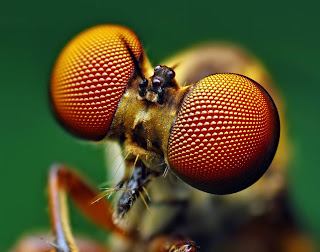
Robber fly - Nature photographer Thomas Shahan specializes in amazing portraits of tiny insects. It isn't easy. Shahan says that this Robber Fly (Holcocephala fusca), for instance, is "skittish" and doesn't like its picture taken.

Eye-popping bug photos

Nature by Numbers (Video)

"A Summary" – Apr 2, 2011 (Kryon channeled by Lee Carroll) (Subjects: Religion, Shift of Human Consciousness, 2012, Intelligent/Benevolent Design, EU, South America, 5 Currencies, Water Cycle (Heat up, Mini Ice Ace, Oceans, Fish, Earthquakes ..), Middle East, Internet, Israel, Dictators, Palestine, US, Japan (Quake/Tsunami Disasters , People, Society ...), Nuclear Power Revealed, Hydro Power, Geothermal Power, Moon, Financial Institutes (Recession, Realign integrity values ..) , China, North Korea, Global Unity,..... etc.) -
"The Quantum Factor" – Apr 10, 2011 (Kryon channeled by Lee Carroll) (Subjects: Galaxies, Universe, Intelligent design, Benevolent design, Aliens, Nikola Tesla (Quantum energy), Inter-Planetary Travel, DNA, Genes, Stem Cells, Cells, Rejuvenation, Shift of Human Consciousness, Spontaneous Remission, Religion, Dictators, Africa, China, Nuclear Power, Sustainable Development, Animals, Global Unity.. etc.) - (Text Version)


“ … Here is another one. A change in what Human nature will allow for government. "Careful, Kryon, don't talk about politics. You'll get in trouble." I won't get in trouble. I'm going to tell you to watch for leadership that cares about you. "You mean politics is going to change?" It already has. It's beginning. Watch for it. You're going to see a total phase-out of old energy dictatorships eventually. The potential is that you're going to see that before 2013.

They're going to fall over, you know, because the energy of the population will not sustain an old energy leader ..."

(Live Kryon Channelings was given 7 times within the United Nations building.)

"Update on Current Events" – Jul 23, 2011 (Kryon channelled by Lee Carroll) - (Subjects: The Humanization of God, Gaia, Shift of Human Consciousness, 2012, Benevolent Design, Financial Institutes (Recession, System to Change ...), Water Cycle (Heat up, Mini Ice Ace, Oceans, Fish, Earthquakes ..), Nuclear Power Revealed, Geothermal Power, Hydro Power, Drinking Water from Seawater, No need for Oil as Much, Middle East in Peace, Persia/Iran Uprising, Muhammad, Israel, DNA, Two Dictators to fall soon, Africa, China, (Old) Souls, Species to go, Whales to Humans, Global Unity,..... etc.)

"Recalibration of Free Choice"– Mar 3, 2012 (Kryon Channelling by Lee Caroll) - (Subjects: (Old) Souls, Midpoint on 21-12-2012, Shift of Human Consciousness, Black & White vs. Color, 1 - Spirituality (Religions) shifting, Loose a Pope “soon”, 2 - Humans will change react to drama, 3 - Civilizations/Population on Earth, 4 - Alternate energy sources (Geothermal, Tidal (Paddle wheels), Wind), 5 – Financials Institutes/concepts will change (Integrity – Ethical) , 6 - News/Media/TV to change, 7 – Big Pharmaceutical company will collapse “soon”, (Keep people sick), (Integrity – Ethical) 8 – Wars will be over on Earth, Global Unity, … etc.) - (Text version)

“… 4 - Energy (again)


The natural resources of the planet are finite and will not support the continuation of what you've been doing. We've been saying this for a decade. Watch for increased science and increased funding for alternate ways of creating electricity (finally). Watch for the very companies who have the most to lose being the ones who fund it. It is the beginning of a full realization that a change of thinking is at hand. You can take things from Gaia that are energy, instead of physical resources. We speak yet again about geothermal, about tidal, about wind. Again, we plead with you not to over-engineer this. For one of the things that Human Beings do in a technological age is to over-engineer simple things. Look at nuclear - the most over-engineered and expensive steam engine in existence!

Your current ideas of capturing energy from tidal and wave motion don't have to be technical marvels. Think paddle wheel on a pier with waves, which will create energy in both directions [waves coming and going] tied to a generator that can power dozens of neighborhoods, not full cities. Think simple and decentralize the idea of utilities. The same goes for wind and geothermal. Think of utilities for groups of homes in a cluster. You won't have a grid failure if there is no grid. This is the way of the future, and you'll be more inclined to have it sooner than later if you do this, and it won't cost as much….”


"Fast-Tracking" - Feb 8, 2014 (Kryon Channelling by Lee Carroll) - (Reference to Fukushima / H-bomb nuclear pollution and a warning about nuclear > 20 Min)

Obama unveils landmark regulations to combat climate change

Obama unveils landmark regulations to combat climate change
In a bid to combat climate change, US President Barack Obama announced the Clean Power Plan on Monday, marking the first time power plants have been targeted by mandatory regulations on carbon dioxide emissions in the US.
Google: Earthday 2013
Showing posts with label Food Systems. Show all posts

Sunday, January 21, 2018

Coca-Cola sets 100% recycling goal for 2030

Yahoo – AFP, January 19, 2018

Coca-Cola has introduced its World Without Waste campaign to collect the
equivalent of 100% of its bottles, and make new bottles completely recyclable
(AFP Photo/Cindy Ord)

Washington (AFP) - Coca-Cola is launching a campaign to collect and recycle 100 percent of its packaging by 2030, part of a drive to reduce consumer waste globally, the company announced Friday.

The Georgia-based company, which markets more than 500 brands of sodas, juices, water and teas, said it also is working to make all of its packaging 100 percent recyclable worldwide.

"The world has a packaging problem -- and, like all companies, we have a responsibility to help solve it," Coca-Cola President and CEO James Quincey said in a statement.

The iconic brand is calling the new campaign "World Without Waste," and through it "we are investing in our planet and our packaging to help make this problem a thing of the past," he said.

By 2030, the company said it will help reclaim one bottle or can for every one sold by the company and its independent bottlers, wholesalers and retailers.

It also is working to reduce waste by using an average of 50 percent recycled content in its drinks bottles by 2030, developing plant-based resins and reducing the plastics used in packaging.

As of 2016, Coca-Cola claimed its brands accounted for nearly two billion daily servings of soft drinks in more than 200 countries.

Tuesday, July 4, 2017

‘Misting’ keeps fruit and veg perky, says study

DutchNews, July 3, 2017

Misty…. not just good for Ella Fitzgerald

Automatic misting machines don’t just keep people from wilting on hot summer terraces: they also make fruit and vegetables last longer, a Danish university has found. 

Dutch Plus supermarket Van Gurp participated in the research and was pleased with the results, public broadcaster NOS reports. 

The technique of keeping fruit and vegetables pert and presentable by spraying them with water is already being used in supermarkets abroad. 

To see if misting would result in higher sales and less wastage, Danish university DTU spent three years monitoring the effects at Plus supermarket Van Gurp in Roosendaal. 

The results were encouraging: after a year the amount of fruit and vegetables that had to be binned went down by 25%. Turnover went up, while the energy bill went down, apparently due to savings in refrigeration costs. 

Spraying causes the temperature of products to fall by four to five degrees, which is the main reason the produce, including strawberries, peaches and nectarines as well as asparagus and cauliflower, remained perky up to three days longer. 

Albert Heijn will soon start a trial using misting machines. The researchers claim it is also good for the environment as it combats waste and uses relatively little water. 

According to an unnamed company for misting machines there is no danger of contracting Legionnaires’ disease.‘The quality of the water is monitored continually and the system is flushed every hour. This means it’s safe, as lab tests have also shown,’ the NOS quotes a spokesman for the company as saying. 

The report on the study, which ran from March 2015 to March 2017, is published here (Dutch and English).

Tuesday, September 29, 2015

On menu for world leaders - trash, and a message

Yahoo – AFP, Shaun Tandon, 28 Sep 2015

US chef Dan Barber takes part in the
 presentation of the Basque Culinary 
Center, on July 26, 2010, in the northern
 Spanish Basque city of San 
Sebastian (AFP Photo/Rafa Rivas)
United Nations (United States) (AFP) - World leaders accustomed to fine dining had a surprise on their plates Sunday at the United Nations -- trash.

Chefs cooked up a lunch made entirely of food that would have ended up in garbage bins, hoping to highlight the extraordinary waste in modern diets and its role in worsening climate change.

On the menu for the lunch at the UN headquarters was a vegetable burger made of pulp left over from juicing, which typically wastes most of the produce.

The burger came with fries created from starchy corn that would typically go to animal feed -- which along with biofuels is the end product of the overwhelming majority of the 90 million acres (36 million hectares) of corn grown in the United States.

"It's the prototypical American meal but turned on its head. Instead of the beef, we're going to eat the corn that feeds the beef," said Dan Barber, a prominent New York chef who co-owns the Blue Hill restaurant.

"The challenge is to create something truly delicious out of what we would otherwise throw away," he told AFP.

Barber crafted the menu with Sam Kass, the former White House chef who drove the anti-obesity "Let's Move" campaign of First Lady Michelle Obama.

Kass thought of the waste-lunch concept as he learned about year-end UN climate negotiations in Paris, which aim to reach a far-reaching global agreement to tackle the planet's worsening climate change.

US First Lady Michelle Obama (C) receives some planting advice from 
White House Assistant Chef Sam Kass (L) while planting vegetables with 
children at Bancroft Elementary School, May 29, 2009, in Washington, DC
(AFP Photo/Paul J. Richards)

"Everybody, unanimously, described it as the most important negotiation of our lifetime," he said.

But food waste "was not something that was being discussed at that point, except in small environmental circles," he said.

Vast contributor to climate change

Major world leaders took part in Sunday's lunch that was led by French President Francois Hollande and Peruvian President Ollanta Humala with an aim of building momentum for the Paris talks.

Secretary-General Ban Ki-moon, speaking to reporters afterward, said the lunch demonstrated how food waste was "an often overlooked aspect of climate change."

Russian Foreign Minister Sergey Lavrov speaks to the United Nations 
Sustainable Development Summit at the United Nations General Assembly
on September 27, 2015 (AFP Photo/Timothy A. Clary)

"That is shameful when so many people suffer from hunger," Ban said.

According to UN figures, 28 percent of agricultural lands around the world go to produce food that is lost or wasted.

The loss each year is the equivalent of 3.3 billion tonnes of carbon responsible for climate change -- which would make food waste, if it were a nation, the biggest emitter after China and the United States.

"It's just unthinkable, the inefficiency in our system, particularly when you look at something of this magnitude," Kass said.

'Delicious' social change

Barber earlier this year ran a pop-up restaurant in New York sourced from food scraps and is the author of the book "The Third Plate" that has championed a global approach to his farm-to-table philosophy.

He said that the elimination of food waste was in fact an ancient rather than modern idea, as cooks historically would use everything edible at their disposal.

"The idea of doing a 'waste dinner' would not have existed in the 1700s," he said.

White House Chef Sam Kass (C) serves food to members of the press, 
prepared with help from Zach Strief (R), a member of the 2010 Super Bowl
 Champion New Orleans Saints, at the Briefing Room at the White House in
Washington, DC, August 9, 2010 (AFP Photo/Saul Loeb)

"The Westernized conception of a plate of food is enormously wasteful because we've been able to afford waste," he said.

Food waste rates are even higher in the United States, which is blessed with vast agricultural resources.

Barber expressed hope that events such as the lunch could gradually change food culture.

"The long-term goal of this would be not to (be able to) create a waste meal," he said.

"You don't do that by lecturing -- you do it... by making these world leaders have a delicious meal that will make them think about spreading that message."

Tuesday, August 18, 2015

Sustainable farming reaping benefits for women in Cameroon

Improved soil management practices and better farming habits are putting smiles on the faces of women in Bafut, a community located about 400 kilometers (240 miles) from Cameroon's capital Yaounde.

Deutsche Welle, 17 Aug 2015

Women farmers in Cameroon

These innovations all fall within the field of "permaculture," a system of sustainable agriculture and design principles aimed at creating a more ecological relationship with the environment.

The innovation was brought to the women by Joshua Kankonko, who grew up in the area. Women say they are experiencing better harvests and putting more money in their pockets as a result. The project has been running for two years.

Kankonko is the developer behind an eco-village built using only local materials. Farmers in the village have implemented permaculture practices aimed to benefit residents through better management of soil and environmental resources. Simple practices such as composting and erosion control are helping to increase yields.

"This is the way our parents used to farm. All the kitchen waste was thrown behind the house where the vegetables were harvested. Everything that we produce, we get from the environment then we give it back to the environment," Kankonko said.

Small plots, big yeilds

Pressures on scarce fertile lands in Cameroon's northwest have historically fueled tribal conflicts. Permaculture sets out to replenish the soil and maximize yields on relatively small plots thereby limiting the need for conflict.

According to Project Coordinator Sonita Mdah Neh, one of the best ways to do this is through natural and mechanical erosion control. Natural erosion control uses plans to hold the soil and moisture together.

This hut was made using only
local materials.
"Natural erosion control is done with vertiva grass. We can also use pineapple, so we use what we call a plant family meaning that you put two plants together and they form a web. When they form a web, they hold the soil and water together," said Mbah Neh.

Mechanical soil control means that local, natural materials like bamboo and other woods are used to create barriers.

The project also stresses the use of organic fertilizers and the use of different plants and practices to maintain or even boost the amount of nutrients in the soil.

"A lot happens in the soil which we don't see. There are a lot of interactions between soil organisms," she said.

A revolution

The system is already working. Farmer Justina Lum hails the system. She says within two years her yields have doubled. She says even at home she switched to using traditional cooking methods.

"Smoke is channeled through a chimney and therefore our eyes are not exposed to smoke. Besides, it uses less wood and is not costly to build," said Lum.

Kankonko remembers his mother who used compost manure to fertilize her crops. As a student in the University of Yaounde, he was already making a living from township gardening. After leaving university, he decided to bring his experience home to his Bafut community.

Kankonko notes that the entire experiment has been a success story, not only improving family incomes, but also restoring the natural environment that continues to suffer from irresponsible use.

But the sustainability of the system will depend largely on youth involvement. Kankonko complains that many youths do not think there is a future in agriculture but instead leave to pursue white-collar jobs in the cities.

Related Article:

“..  Health

Normal good health is turning to simple physics for some of the simplest things. New kinds of foods are being grown with new physics, not chemistry. These will be physic-foods [Kryon name] that are not genetically altered or chemically altered, but benevolently enhanced by physics! This causes a new kind of super growth that can feed the planet in a way it's never been fed before. It will create food that is resistant to absolutely everything - insects, bacteria and disease - all through physics. Who thought of that? What you're expecting in the future regarding health is based upon the past. The big filter of past knowledge keeps you from thinking out of the box. You don't know what you don't know.  ….”

Monday, August 10, 2015

Scotland to ban genetically modified crops

Scotland's government says it plans to ban the cultivation of genetically modified crops. While widely grown in the Americas and Asia, there is more skepticism over the practice in Europe.

Deutsche Welle, 9 Aug 2015


Scotland's Environment Ministry announced Sunday it intended to ban the growth of genetically modified crops on its territory in order to cultivate its "clean and green brand" of products.

No GM crops are currently grown commercially in Britain, though the central government in London says it supports the use of GM crops if they are safe.

Richard Lochhead, the Scottish government's minister for the environment, food and rural affairs, said Sunday he planned to take advantage of new European Union rules allowing countries to opt out of growing EU-authorized GM crops.

GM crops, including maize, have been the
subject of numerous protests in the EU
"The Scottish government will shortly submit a request that Scotland is excluded from any European consents for the cultivation of GM crops, including the variety of genetically modified maize already approved and six other GM crops that are awaiting authorization," Lochhead said in a statement.

The minister said there is no domestic market for GM crops and it wanted to strengthen its brand of exports, especially its food and drink sector worth an annual 19.78 billion euros ($21.7 billion).

"Scotland is known around the world for our beautiful natural environment - and banning growing genetically modified crops will protect and further enhance our clean, green status," Lochhead said.

Health debate

GM crops are the subject of global debate, with some environmental and health groups questioning their environmental impact. Producers, however, insist they are safe.

The Scottish government in Edinburgh has been responsible for mainly domestic policies, including agriculture, since 1999 when power was devolved from the central government in London.

jar/cmk (Reuters, AFP)
Related Article:

“..  Health

Normal good health is turning to simple physics for some of the simplest things. New kinds of foods are being grown with new physics, not chemistry. These will be physic-foods [Kryon name] that are not genetically altered or chemically altered, but benevolently enhanced by physics! This causes a new kind of super growth that can feed the planet in a way it's never been fed before. It will create food that is resistant to absolutely everything - insects, bacteria and disease - all through physics. Who thought of that? What you're expecting in the future regarding health is based upon the past. The big filter of past knowledge keeps you from thinking out of the box. You don't know what you don't know.  ….”

Tuesday, May 26, 2015

Man who forced French supermarkets to donate food wants to take law global

Arash Derambarsh, a local councillor who kickstarted fight against food waste in his Paris suburb, wants to convince more countries to follow France’s example

The Guardian, Kim Willsher in Paris, Monday 25 May 2015

People shop in a supermarket in southern France. Photograph: Rremy
Gabalda/AFP/Getty Images

A councillor whose campaign against food waste led to a law forcing French supermarkets to donate unwanted food to charity has set his sights on getting similar legislation passed globally.

Arash Derambarsh.
Photograph:
Bertrand Guay/AFP
Arash Derambarsh said it was “scandalous and absurd” that food is wasted and in some cases deliberately spoiled while the homeless, poor and unemployed go hungry.

Derambarsh – a municipal councillor for the “Divers Droit” (diverse right) in Courbevoie, north-west of Paris – persuaded French MPs to adopt the regulation after a petition gained more than 200,000 signatures and celebrity support in just four months.

The amendment was approved as part of a wider law – the Loi Macron – that covers economic activity and equality in France and is expected to be passed by the national assembly on Tuesday, entering the statute books shortly afterwards.

It will bar supermarkets from throwing away food approaching best-before dates and deliberately poisoning products with bleach to stop them being retrieved by people foraging through bins.

Now Derambarsh wants to convince European countries and the wider world to adopt similar bans. “Food is the basis of life, it is an elementary factor in our existence,” he told the Guardian.

Arash Derambarsh began his drive to fight food waste and food
Poverty in Courbevoie. Photograph: Bertrand Guay/AFP

“I have been insulted and attacked and accused of being naive and idealistic, but I became a local councillor because I wanted to help people. Perhaps it is naive to be concerned about other human beings, but I know what it is like to be hungry.

“When I was a law student living on about €400 a month after I’d paid my rent, I used to have one proper meal a day around 5pm. I’d eat pasta, or potatoes, but it’s hard to study or work if you are hungry and always thinking about where the next meal will come from.”

Derambarsh started his campaign by collecting and distributing unwanted food from his local supermarket. “Every day we’d help around 100 people. Half would be single mothers with several children, pensioners or public workers on low salaries, the other half would be those living on the streets or in shelters,” he said.

Derambarsh is planning to table the issue – via the campaign group ONE, founded by U2 singer Bono – when the United Nations discusses its Millennium development goals to end poverty in September as well as at the G20 economic summit in Turkey in November and the COP21 environment conference in Paris in December.

An estimated 7.1m tonnes of food is binned in France each year – 67% of it by consumers, 15% by restaurants and 11% by shops. The figure for food waste across the EU is 89mtonnes while an estimated 1.3bn tonnes are wasted worldwide.

Thursday, April 30, 2015

Dutch saltwater potatoes offer hope for world's hungry

Yahoo – AFP, Maude Brulard, 29 April 2015

A worker sorts potatoes before packaging them at the Salty Potato Farm, 
in Den Horn, Netherlands (AFP Photo/Emmanuel Dunand)

Den Hoorn (Netherlands) (AFP) - A small field on an island off the Netherlands' northern coast promises one answer to the problem of how to feed the world's ever-growing population: potatoes and other crops that grow in saltwater.

Every day, swathes of farmland somewhere in the world become unusable because of salty soil, but farmers on windswept Texel are finding solutions using traditional methods.

The team headed by farmer Mark van Rijsselberghe has planted around 30 types of potato and their approach is simple: anything that dies in the saline environment is abandoned, and anything that lives "we try to follow up on," said Van Rijsselberghe. "It's faster."

Dutch farmer Mark van Rijsselberghe, 
who launched the Salty Potato Farm
(AFP Photo/Emmanuel Dunand)
The experiments do not just target potatoes, but also look at how other crops grow in saltwater, including carrots, strawberries, onions and lettuce.

The plants are irrigated using pumps that manage water down to the drop, so the plant and soil salinity can be accurately measured and the effect of "sweet" rainwater taken into account.

Van Rijsselberghe, 60, started the "Salty Potato Farm" around 10 years ago in the hope of helping the world's malnourished.

The team, supported by Amsterdam University, uses neither genetically modified organisms nor laboratories in their quest for food that grows in salty environments.

With more than 5,000 varieties, the potato is the world's fourth most popular food crop, according to the United Nations' Food and Agricultural Organisation (FAO).

Plants whose ancestors grew near or on the sea, but have moved inland with human populations, are likely still to have the necessary genes.

"It could be a hundred, it could be 1,000 years ago, they still are capable of coping with saline surroundings," said Van Rijsselberghe.

Food security

A worker sorts potatoes before packaging 
them at the Salty Potato Farm in Den Horn,
 in the Netherlands (AFP Photo/
Emmanuel Dunand)
While today much research is focused on improving the yield of crops, the Dutch team has taken the opposite approach: trying to grow crops on land previously considered unusable.

The bespectacled farmer jokes that in a country where much of the land lies below sea level, "we are so afraid of the sea that until 10 years ago we didn't dare to do anything with sea water and growing plants".

The world loses around 2,000 hectares (just under 5,000 acres) of agricultural land a day to salt-induced degradation in 75 countries, caused by bad or absent irrigation, according to the UN's Institute for Water, Environment and Health.

The problem today affects an area the size of France -- about 62 million hectares or 20 percent of the world's irrigated lands, up from 45 million hectares in the early 1990s.

Solutions to make the land cultivable once more are too expensive for most of the areas, including the basin of the Yellow River in China, the Euphrates in Syria and Iraq or the Indus Valley in Pakistan.

A testing field used by the Salty Potato
 Farm project to experiment with crops 
(AFP Photo/Emmanuel Dunand)
The Team on Texel has already sent thousands of its potatoes to Pakistan where they were "successful", said Van Rijsselberghe, who will send more plants next year.

These "salt" potatoes could transform the lives of thousands of farmers in affected regions and, in the long term, those of around 250 million people who live on salt-afflicted soil.

The potato was introduced to Europe from Peru in the 16th century and became popular because of its ability to feed people during the continent's frequent famines.

However, over-reliance on the crop was potentially disastrous, with a blight leading to the devastating 19th-century Irish potato famine.

Today, about 800 million people in the world are under-nourished, according to the FAO, with salt degradation threatening 10 percent of the global cereal crop.

Sweet taste not price

The potatoes grown here taste sweeter than those grown on normal land, because the plant produces more sugars to compensate for the salty environment.

Packaged pototoes at the Salty Potato
Farm (AFP Photo/Emmanuel Dunand)
The salt absorbed by the plant stays in the leaves, not in the flesh.

But the price of the potatoes is for now prohibitive, with one kilo (around two pounds) selling for five euros (just over $5), compared to less than a euro for the same amount of "normal" potatoes.

"We grow around 30,000 kilos per hectare, a farmer with good conditions around 60,000 kilos," said Robin Konijn, the farm's financial director.

Countries ranging from Egypt to Bangladesh and India have already asked for advice on planting their own salt-proof crops.

The team is also soon to start trying to cultivate potatoes in the salty wetlands of the Camargue in the south of France -- the so-called "Miss Mignon" (French for "Miss Cutie Pie").

Friday, October 3, 2014

Dutch food policy needs rethink on dairy and meat: WRR

DutchNews.nl, Friday 03 October 2014

The Netherlands is one of the world's biggest exporters of dairy products

The government needs to intervene to ensure people eat less meat, salt, sugar and fat, according to the influential scientific council for government policy (WRR) in a new report.

The WRR advises the government on ‘future developments of great public interest’ and focuses on sustainable food production in its latest report, the Volkskrant reports on Friday.

The organisation says despite the importance of agricultural exports to the Dutch economy, the Netherlands should produce less dairy and meat products. The Netherlands should also develop official policy toward food, rather than toward agriculture, the council says.

Production

The current approach, with the focus on production, has been very successful and led to an abundant supply of good, cheap food. However, natural resources are being depleted and agricultural land is become exhausted, the council warns.

In addition, the shortage of water and phosphates and a manure surplus are all having an impact on biodiversity. At the same time, obesity is an increasing problem internationally, as is the increase in resistant bacteria in factory farming.

Sustainability

To counteract the effects of current farming policy, we need to eat less meat and dairy products and grow food more sustainably, the WRR says in its recommendations. Fat, sugar and salt in food should be reduced and the current plethora of labeling be reduced to just two.

‘Production and consumption in the Netherlands are contributing to the global ecological problem,’ the council states. Dairy products and meat have a ‘disproportional impact’ and it would be good for both the environment and human health to produce and consume less, the council says.

The Netherlands no longer has an agricultural ministry and its work is now done by the economic affairs department, the Volkskrant points out. Deputy economic affairs minister Sharon Dijksma said in a reaction the report is an ‘important’ document which ‘asks the right questions’.

Related Articles:

You’re Doing Dairy Wrong: Dutch Farmers

Halve meat consumption, scientists urge rich world

Study: Alarming rise in obesity


(13) Question: Dear Kryon, I’m very concerned about the obesity epidemic, particularly in the U.S. Around me I see people getting bigger and more unhealthy, all for the sake of convenience and saving time. You mentioned at one point a famine, and I suspect the famine won’t be from a lack of food, but from an abundance of food that has no nutritional value.

I wonder how we can honor the Earth by eating nothing that comes straight from it? Of course this involves caring for the lands and oceans as part of a bigger issue and making that connection, too. Is this what it will finally take for people to switch to a healthier way of living?

Its amazing how detached people are from the food they eat. We don’t even honor our digestive processes, the way we combine foods. Whatever happened to nutrition? Atkins is no solution; there is no balance in it. Gastric bypass is all about quantity reduction, not quality increase. When will people make the direct connection between what/how they eat and their health? Is a change in diet and lifestyle part of the upcoming shift?

Answer: The shift has little to do with it. It’s a culture-specific problem and has to do with consciousness of health. Go study the cultures on your planet that have very few overweight Humans. Start with the Japanese. They have some of the same western work ethics and live in very sophisticated industrial-based environments. Yet they aren’t overweight. It’s about the core food groups and the combination of them.


(39) Question: Dear Kryon: I've noticed how many children are developing severe allergies to foods (my daughter included). When I've researched this, it seems that most of the allergies are essentially to seeds, grains, legumes, eggs, and dairy. I've noticed that these foods all hold the potential for life, or in the case of dairy, are essentially used to sustain the first stages of life in an animal's baby. My feeling is that because we're not releasing the life force within these foods (that is, sprouting, etc.), they're becoming harmful to us. I would like your impressions of this.

Answer: For thousands of years, these foods have worked for humanity. In these cases you speak about, the main culprit continues to be the way in which these foods are collected and processed. You won't find these allergies in third-world countries, and you won't find them within the children who work on farms, where they eat the foods directly. There will eventually have to come a day when you relax some of your efficiency attributes and go back to the way food was meant to be collected and eaten. And yes... there are effects from how the dairy animals are treated, too. Going back to some basics will help, and so will eliminating some of the procedures that supposedly create a "safer food." These procedures have instead made them begin to look like foreign food to the Human body.


(15) Question: Dear Kryon, please help us understand the increase of allergies. What can we do to heal this phenomenon?

Answer: Reduce the steps in your food chain, which are adding chemistry to fresh food.

Tuesday, September 30, 2014

Earth lost 50% of its wildlife in the past 40 years, says WWF

Species across land, rivers and seas decimated as humans kill for food in unsustainable numbers and destroy habitats


The Guardian, Damian Carrington, Monday 29 September 2014

Rubbish dumped on the tundra outside llulissat in Greenland stand in stark contrast
 to icebergs behind from the Sermeq Kujullaq or llulissat Ice fjord – a Unesco world
heritage site. Photograph: Global Warming Images/WWF-Canon

The number of wild animals on Earth has halved in the past 40 years, according to a new analysis. Creatures across land, rivers and the seas are being decimated as humans kill them for food in unsustainable numbers, while polluting or destroying their habitats, the research by scientists at WWF and the Zoological Society of London found.

“If half the animals died in London zoo next week it would be front page news,” said Professor Ken Norris, ZSL’s director of science. “But that is happening in the great outdoors. This damage is not inevitable but a consequence of the way we choose to live.” He said nature, which provides food and clean water and air, was essential for human wellbeing.

“We have lost one half of the animal population and knowing this is driven by human consumption, this is clearly a call to arms and we must act now,” said Mike Barratt, director of science and policy at WWF. He said more of the Earth must be protected from development and deforestation, while food and energy had to be produced sustainably.

The steep decline of animal, fish and bird numbers was calculated by analysing 10,000 different populations, covering 3,000 species in total. This data was then, for the first time, used to create a representative “Living Planet Index” (LPI), reflecting the state of all 45,000 known vertebrates.

“We have all heard of the FTSE 100 index, but we have missed the ultimate indicator, the falling trend of species and ecosystems in the world,” said Professor Jonathan Baillie, ZSL’s director of conservation. “If we get [our response] right, we will have a safe and sustainable way of life for the future,” he said.

If not, he added, the overuse of resources would ultimately lead to conflicts. He said the LPI was an extremely robust indicator and had been adopted by UN’s internationally-agreed Convention on Biological Diversity as key insight into biodiversity.


A second index in the new Living Planet report calculates humanity’s “ecological footprint”, ie the scale at which it is using up natural resources. Currently, the global population is cutting down trees faster than they regrow, catching fish faster than the oceans can restock, pumping water from rivers and aquifers faster than rainfall can replenish them and emitting more climate-warming carbon dioxide than oceans and forests can absorb.

The report concludes that today’s average global rate of consumption would need 1.5 planet Earths to sustain it. But four planets would be required to sustain US levels of consumption, or 2.5 Earths to match UK consumption levels.

The fastest decline among the animal populations were found in freshwater ecosystems, where numbers have plummeted by 75% since 1970. “Rivers are the bottom of the system,” said Dave Tickner, WWF’s chief freshwater adviser. “Whatever happens on the land, it all ends up in the rivers.” For example, he said, tens of billions of tonnes of effluent are dumped in the Ganges in India every year.

As well as pollution, dams and the increasing abstraction of water damage freshwater systems. There are more than 45,000 major dams – 15m or higher – around the world. “These slice rivers up into a thousand pieces,” Tickner said, preventing the healthy flow of water. While population has risen fourfold in the last century, water use has gone up sevenfold. “We are living thirstier and thirstier lives,” he said.

But while freshwater species such as the European eel and the hellbender salamander in the US have crashed, recoveries have also been seen. Otters were near extinct in England but thanks to conservation efforts now live in every county.


The number of animals living on the land has fallen by 40% since 1970. From forest elephants in central Africa, where poaching rates now exceed birth rates, to the Hoolock gibbon in Bangladesh and European snakes like the meadow and asp vipers, destruction of habitat has seen populations tumble. But again intensive conservation effort can turn declines around, as has happened with tigers in Nepal.

Marine animal populations have also fallen by 40% overall, with turtles suffering in particular. Hunting, the destruction of nesting grounds and getting drowned in fishing nets have seen turtle numbers fall by 80%. Some birds have been heavily affected too. The number of grey partridges in the UK sank by 50% since 1970 due to the intensification of farming, while curlew sandpipers in Australia lost 80% of their number in the 20 years to 2005.

The biggest declines in animal numbers have been seen in low-income, developing nations, while conservation efforts in rich nations have seen small improvements overall. But the big declines in wildlife in rich nations had already occurred long before the new report’s baseline year of 1970 – the last wolf in the UK was shot in 1680.

Also, by importing food and other goods produced via habitat destruction in developing nations, rich nations are “outsourcing” wildlife decline to those countries, said Norris. For example, a third of all the products of deforestation such as timber, beef and soya were exported to the EU between 1990 and 2008.

David Nussbaum, chief executive of WWF-UK said: “The scale of the destruction highlighted in this report should be a wake-up call for us all. But 2015 – when the countries of the world are due to come together to agree on a new global climate agreement, as well as a set of sustainable development goals – presents us with a unique opportunity to reverse the trends.

“We all – politicians, businesses and people – have an interest, and a responsibility, to act to ensure we protect what we all value: a healthy future for both people and nature.”

Related Articles:


Saturday, September 27, 2014

16-Year-Old Irish Girls Win Google Science Fair 2014 With World-Changing Crop Yield Breakthrough


Irish teenagers Ciara Judge, Émer Hickey and Sophie Healy-Thow, all 16, have won the Google Science Fair 2014. Their project, Combating the Global Food Crisis, aims to provide a solution to low crop yields by pairing a nitrogen-fixing bacteria that naturally occurs in the soil with cereal crops it does not normally associate with, such as barley and oats. The results were incredible: the girls found their test crops germinated in half the time and had a drymass yield up to 74 percent greater than usual.


All three girls love gardening. In 2011, at school, they were also studying the food crisis in the Horn of Africa and were thinking about ways they could help. One day Hickey pulled up some pea plants from her garden and brought them in to discuss strange nodules on the roots with the girls’ science teacher. Peas, like other leguminous plants, have a symbiotic relationship with diazatrophic rhizobia bacteria found in soil. This relationship leads to nitrogen fixing in the soil, which can reduce the need for added chemical fertilizers.


The girls decided to experiment with the effects of rhizobia on non-leguminous plants. After trialing over 10,000 barley and oat seeds, the results were astonishing. Two types of rhizobia in particular showed great potential for agricultural use. In their submission to the Fair the girls stated: “These results have significant potential for increasing yields of food crops and reducing losses due to adverse weather conditions. They also offer opportunities for reducing the environmental footprint of agriculture by reducing fertilizer usage. As demand for cereals increases with population growth, this discovery could act as a partial solution to the impending food poverty crisis. There is potential for future work in this area and we plan to investigate the biochemical mechanism involved and carry out more extensive field trials.”

The trio are not newcomers to scientific achievement. In 2013, they were awarded first place in a national science competition from a field of 2,000 entries. They then represented Ireland in the European Contest for Young Scientists in September 2013, where they also won first place. As the Grand Prize winners of the Google Science Fair 2014, Ciara, Émer and Sophie each receive a 10-day trip to the Galapagos Islands provided by National Geographic, a $50,000 scholarship from Google, a personalized LEGO prize provided by LEGO Education and the chance to participate in astronaut training at the Virgin Galactic Spaceport in the Mojave desert. You can sign up here to be notified when entries open for the Google Science Fair 2015.