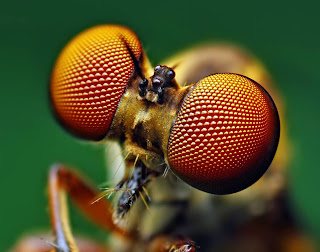
Robber fly - Nature photographer Thomas Shahan specializes in amazing portraits of tiny insects. It isn't easy. Shahan says that this Robber Fly (Holcocephala fusca), for instance, is "skittish" and doesn't like its picture taken.

Eye-popping bug photos

Nature by Numbers (Video)

"A Summary" – Apr 2, 2011 (Kryon channeled by Lee Carroll) (Subjects: Religion, Shift of Human Consciousness, 2012, Intelligent/Benevolent Design, EU, South America, 5 Currencies, Water Cycle (Heat up, Mini Ice Ace, Oceans, Fish, Earthquakes ..), Middle East, Internet, Israel, Dictators, Palestine, US, Japan (Quake/Tsunami Disasters , People, Society ...), Nuclear Power Revealed, Hydro Power, Geothermal Power, Moon, Financial Institutes (Recession, Realign integrity values ..) , China, North Korea, Global Unity,..... etc.) -
"The Quantum Factor" – Apr 10, 2011 (Kryon channeled by Lee Carroll) (Subjects: Galaxies, Universe, Intelligent design, Benevolent design, Aliens, Nikola Tesla (Quantum energy), Inter-Planetary Travel, DNA, Genes, Stem Cells, Cells, Rejuvenation, Shift of Human Consciousness, Spontaneous Remission, Religion, Dictators, Africa, China, Nuclear Power, Sustainable Development, Animals, Global Unity.. etc.) - (Text Version)

“ … Here is another one. A change in what Human nature will allow for government. "Careful, Kryon, don't talk about politics. You'll get in trouble." I won't get in trouble. I'm going to tell you to watch for leadership that cares about you. "You mean politics is going to change?" It already has. It's beginning. Watch for it. You're going to see a total phase-out of old energy dictatorships eventually. The potential is that you're going to see that before 2013.

They're going to fall over, you know, because the energy of the population will not sustain an old energy leader ..."
"Update on Current Events" – Jul 23, 2011 (Kryon channelled by Lee Carroll) - (Subjects: The Humanization of God, Gaia, Shift of Human Consciousness, 2012, Benevolent Design, Financial Institutes (Recession, System to Change ...), Water Cycle (Heat up, Mini Ice Ace, Oceans, Fish, Earthquakes ..), Nuclear Power Revealed, Geothermal Power, Hydro Power, Drinking Water from Seawater, No need for Oil as Much, Middle East in Peace, Persia/Iran Uprising, Muhammad, Israel, DNA, Two Dictators to fall soon, Africa, China, (Old) Souls, Species to go, Whales to Humans, Global Unity,..... etc.)
"Recalibration of Free Choice"– Mar 3, 2012 (Kryon Channelling by Lee Caroll) - (Subjects: (Old) Souls, Midpoint on 21-12-2012, Shift of Human Consciousness, Black & White vs. Color, 1 - Spirituality (Religions) shifting, Loose a Pope “soon”, 2 - Humans will change react to drama, 3 - Civilizations/Population on Earth, 4 - Alternate energy sources (Geothermal, Tidal (Paddle wheels), Wind), 5 – Financials Institutes/concepts will change (Integrity – Ethical) , 6 - News/Media/TV to change, 7 – Big Pharmaceutical company will collapse “soon”, (Keep people sick), (Integrity – Ethical) 8 – Wars will be over on Earth, Global Unity, … etc.) - (Text version)

“… 4 - Energy (again)


The natural resources of the planet are finite and will not support the continuation of what you've been doing. We've been saying this for a decade. Watch for increased science and increased funding for alternate ways of creating electricity (finally). Watch for the very companies who have the most to lose being the ones who fund it. It is the beginning of a full realization that a change of thinking is at hand. You can take things from Gaia that are energy, instead of physical resources. We speak yet again about geothermal, about tidal, about wind. Again, we plead with you not to over-engineer this. For one of the things that Human Beings do in a technological age is to over-engineer simple things. Look at nuclear - the most over-engineered and expensive steam engine in existence!

Your current ideas of capturing energy from tidal and wave motion don't have to be technical marvels. Think paddle wheel on a pier with waves, which will create energy in both directions [waves coming and going] tied to a generator that can power dozens of neighborhoods, not full cities. Think simple and decentralize the idea of utilities. The same goes for wind and geothermal. Think of utilities for groups of homes in a cluster. You won't have a grid failure if there is no grid. This is the way of the future, and you'll be more inclined to have it sooner than later if you do this, and it won't cost as much….”


"Fast-Tracking" - Feb 8, 2014 (Kryon Channelling by Lee Carroll) - (Reference to Fukushima / H-bomb nuclear pollution and a warning about nuclear > 20 Min)

Obama unveils landmark regulations to combat climate change

Obama unveils landmark regulations to combat climate change
In a bid to combat climate change, US President Barack Obama announced the Clean Power Plan on Monday, marking the first time power plants have been targeted by mandatory regulations on carbon dioxide emissions in the US.
Google: Earthday 2013
Showing posts with label Information Technology. Show all posts

Monday, February 25, 2019

Tech connection boosts NY vertical farmers

Yahoo – AFP, Juliette MICHEL, February 24, 2019

A Bowery Farming employee inspects some of their greens grown at the hydroponic
farming company in Kearny, New Jersey (AFP Photo/Don EMMERT)

Kearny (United States) (AFP) - Workers at Bowery Farming's warehouse near New York have swapped out a farmer's hoe for a computer tablet that takes real-time readings of light and water conditions.

Launched in 2015, Bowery is part of the fast-growing vertical farming movement, which employs technology in a controlled, man-made setting to grow fresh vegetables indoors all year long.

Champions of the practice see vertical farming as a key tool to meet the world's food needs at a time when the population is rising and the climate is changing.

The company's chief executive and co-founder, Irving Fain, said his company's Kearny, New Jersey site uses fewer resources than traditional farms and does not employ pesticides.

"I have been a big believer my entire life in technology as being able to solve not only hard problems, but also important problems," said Fain, who previously ran a company that provides data analysis for big companies on their loyalty programs.

Bowery employs more programmers than agricultural scientists. The company says its use of algorithms enables it to be 100 times more productive per area compared with a traditional farm and to use 95 percent less water.

Irving Fain, CEO and co-founder of Bowery Farming, talks about his hydroponic 
grown greens (AFP Photo/Don EMMERT)

Lower electricity costs

Vertical farming has long been practiced in Japan and some other places but it did not take off in the United States until recent technological leaps made it viable.

A key component has been LED bulbs, which have enabled indoor farmers to drastically cut electricity costs.

But Bowery is also making heavy use of robotics and artificial intelligence to keep prices under control.

The combination of these newer tools "is how we really rethink what agriculture will look like in the next century and beyond," Fain said.

The company has also benefited from more than $120 million in funding from tech titans including Google Ventures and Uber Chief Executive Dara Khosrowshahi.

The Silicon Valley connection has also boosted San Francisco-based Plenty, another prominent vertical farming company, which has garnered more than $200 million from Amazon Chief Executive Jeff Bezos, Softbank and others.

US-based Crop One and Emirates Flight Catering have launched a $40 million joint venture to build a giant vertical farming facility in Dubai.

Greens are grown at Bowery Farming, a vertical farming site founded in 2015 
(AFP Photo/Don EMMERT)

Profitable?

The world's biggest vertical farm is in Newark, New Jersey and operated by AeroFarms.

The company, founded in 2004 and considered a pioneer in the sector, remains privately-held and does not disclose financial data. But the company says it is now profitable after a series of fumbles.

David Chang, founder of the noodle restaurant brand Momofuku, is an investor.

AeroFarms exclusively uses company-made technology that has now made its way to China, the Middle East and Europe, said its co-founder Marc Oshima.

In a warehouse that was once a steel mill with 40-foot (12-meter) ceilings, the company is growing kale and arugula leaves set in rows of 12 metal racks each. The roots are suspended in the air as they are intermittently irrigated while the leaves bask under LED lights.

AeroFarms experiments regularly with lighting and nutrients with an eye towards finding the optimal recipe for each plant and developing the best algorithm.

The company produces watercress that reminded a reporter of her grandmother's soup, kale as tender as spinach and arugula with a hint of spice.

Basil from Bowery Farming was tinged with the flavor of lemon.

AeroFarms's vertical grow towers in Newark, New Jersey (AFP Photo/Angela Weiss)

But it can take a while for vertical farms to find solutions that are viable.

"The big, big vertical farms are having a difficult time being profitable because they are so capital-intensive at the beginning," said Henry Gordon-Smith, founder of Agritecture, a consultancy.

Large farms typically need seven or eight years before they are profitable, with smaller farms requiring perhaps half as long.

But entrepreneurs in the business are confident in their prospects as more young people in cities express worry about climate change and pesticides.

"Vertical farming is not THE solution to food security," said Gordon-Smith. "It is one out of the possible solutions."

Critics of vertical farming say it has a large carbon footprint due to heavy use of lighting and ventilation.

But defenders say that this negative impact is more than offset from the benefits of lower water use, the location near population centers and the non-use of pesticides.

A bigger issue may be the limitations of the output itself, at least in terms of nutrition.

"You can't feed the world with salad alone," said Princeton University plant researcher Paul Gauthier, who says vertical farmers will need to develop more protein-rich offerings.

Gauthier -- who grew spicier peppers in his own lab by subtly increasing potassium levels -- said vertical farming could supply fresh food to so-called food "deserts" where it is absent and could in the long-term meet growing food demand as the climate changes.

Monday, September 28, 2015

Diesel cars break emission limits in real-world tests: TNO

DutchNews, September 27, 2015

A 2013 report by Dutch research institute TNO showed that diesel car systems in the Netherlands were adapted to appear as if the vehicles were less polluting than they actually were, current affairs programme Nieuwsuur said on Sunday. 

The report, which did not name the manufacturers involved, said the nitrogen oxide emissions from ‘a number’ of diesel cars which officially met Euro 6 emission standards were higher than would have been expected in practical situations. 

The reports said that systems had been installed so that ‘they operated during functional driving conditions in a test but in real-world situations were (partly) switches off for economic reasons’, Nieuwsuur reported. 

The TNO research was carried out on behalf the transport ministry. A ministry spokesman told Nieuwsuur that the ministry was not aware of the deliberate manipulation of the emissions data. In addition, the ministry had not read into the report the claim that the systems had been adapted or switched off, the spokesman said. 

Real world

In a 2015 English-language summary of four reports into diesel car emissions, TNO stated: ‘almost all Euro 6 vehicles that were measured emitted significantly more NOx in real-world conditions on the road than during a type-approval test in the laboratory.’ 

The report continued: ‘It is striking that in real-world conditions the NOx emissions are more than eight times higher than the type-approval value.’ TNO is campaigning to have real-world conditions incorporated into official emissions tests, which are currently lab based. 

Two German newspapers said on Sunday Volkswagen’s own staff and one of its suppliers warned years ago about software designed to thwart emissions tests. Last week, Volkswagen acknowledged installing software in diesel engines designed to hide their true emissions of toxic gasses.

US government has expanded its investigation of pollution-skirting devices in
 diesel vehicles to other manufacturers after Volkswagen admitted it used them
to thwart environmental standards (AFP Photo/Thomas Samson)


Friday, September 18, 2015

Dutch company launches plan for recycled plastic roads

DutchNews, September 17, 2015

An artist's impression of how the plastic roads would work

Dutch company KWS Infra is developing a new sort of road made from recycled plastic. This, the company says, will not only cut down on plastic waste but reduce CO2 output from road building and usage, and make roads more sustainable and safer. Esther O’Toole reports. 

An estimated eight billion tons of plastic is floating around in the oceans and 55% of our plastic waste is still incinerated. Innovative Dutch companies have been busy looking at feasible ways of fishing the plastic out of the sea and shipping it to shore. Now KWS Infra, part of the VolkerWessels construction group and the biggest road builder in the Netherlands, has come up with a plan to turn that kind of plastic waste into roads. 

The roads themselves would be made from prefab sections prepared offsite from 100% recycled plastic and brought en masse to the building site, with road markings and guard rails already in place. Being light weight and easy to transport they could take months off construction times. 

The fabric is thought to be more durable than asphalt and needs little or no maintenance, being weather proof and impervious to weeds. The other major advantage is that they are hollow allowing space for piping, electric cables and – another hot topic for VolkerWessels – internet connections. 

Internet 

VolkerWessels is now investing in multiple projects for urban renewal and connected city innovation, including placing internet receivers along roads, be they antennas and masts or embedded in street lights and wind turbines. Plastic roads fit into this picture perfectly. If the space inside the decking could also be used to house net connectors, losing reception in a tunnel would become a thing of the past. 

Driverless cars, cheap and affordable ones too, will be on the open market as early as next year. What benefits will be reaped from these innovative technologies when they begin to converge? With uninterrupted mobile internet connections along all main highways, a long commute could be set to become the most productive part of the day. 

No wonder then that VolkerWessels is not having trouble garnering interest for their projects. Rotterdam city council was the first to show interest in piloting the PlasticRoad, in early July. 

Interest 

Since then the company has had interest from cities all over the world and are looking to finalise partnerships with plastics and recycling experts soon, spokesman Anne Koudstaal told DutchNews.nl. The aim is to have a team in place by December and to run a feasibility pilot within three years.

‘We are feeling very positive about it,’ he said. ‘All the good reactions [to July’s announcement] are a huge boost for us and the idea. It makes it all seem so much more realisable.’ 

If all goes to plan, the roads themselves may in turn be recyclable. This would bring PlasticRoad completely in line with the ‘cradle to cradle’ notions of the circular economy being implemented by other innovative ideas such as The Ocean Clean Up Project and the Plastic Madonna art project. 

The Netherlands, despite being one of the smallest countries in the developed world by land mass, has one of the highest carbon footprints per capita; especially in relation to fossil fuel use and cement production. Cutting emissions related to road usage and building would seriously reduce that footprint. Especially when one considers that the road network in the country covers approximately 135,470 km and most of it is tarmacked.
Related Article:


An impression of how the system might look. Photo: Ocean Cleanup

Thursday, September 17, 2015

Eyes on elephants as Google cameras snap Kenya reserve

Yahoo - AFP, September 15, 2015

A Google Street View vehicle collects imagery for Google Maps while driving down
a street in Calais, northern France, on July 29, 2015 (AFP Photo/Philippe Huguen)

Samburu (Kenya) (AFP) - For once, Google was unlikely to face privacy complaints as the US Internet giant on Tuesday launched its Street View service in Kenya's Samburu park, in a move conservationists said could help protect endangered elephants.

Special cameras have taken panoramic images of the reserve while driving down dusty tracks -- and have also been fixed to a backpack to penetrate deep into the bush.

Some of Google's previous Street View forays have brought complaints on privacy grounds.

A lioness stands near an oryx at the Samburu
National Park in Kenya (AFP Photo/
Pedro Ugarte)
But this time there were no demands to blur out faces -- the main residents of the 165 square kilometre (65 square mile) reserve are 900 elephants.

The idea is to allow viewers to click and view the elephant herds close up.

"We hope that by bringing Street View to Samburu, we will inspire people around the world to gain a deeper appreciation for elephants," said Farzana Khubchandani of Google Kenya.

Slightly larger than a basketball, Google's camera contains 15 individual fixed-focus lenses that simultaneously capture a 360 degree image roughly every three metres.

The Kenya project was launched in collaboration with conservation group Save the Elephants.

"It's exciting to open a window onto Samburu, and to help us better protect its elephants," said Save the Elephants chief Iain Douglas-Hamilton, speaking in Samburu, some 300 kilometres (185 miles) north of the Kenyan capital Nairobi.

Kenya is struggling to stem poaching to protect its remaining elephant population -- currently estimated at 30,000 -- and just over a thousand rhinos.

With ivory raking in thousands of dollars a kilo in Asia, conservationists have warned that African elephants could be extinct in the wild within a generation.

"Giving people a virtual tour will bring Samburu to the world, and inspire the world to come to Samburu," county governor Moses Lenolkulal said.

"The more people experience our culture, our people and the majestic elephants and other wildlife with which we co-exist, the more we are able to conserve and sustain the Samburu culture and its fragile ecosystem for generations to come."

Wednesday, August 26, 2015

Micro-sensors stuck to honey bees to help solve mass deaths

Yahoo – AFP, 25 Aug 2015

Australian scientists use micro-sensors attached to honey bees as part of a global 
push to understand the key factors driving a worldwide population decline of the 
pollinators (AFP Photo/Saeed Khan)

Sydney (AFP) - Australian scientists revealed on Tuesday they are using micro-sensors attached to honey bees as part of a global push to understand the key factors driving a worldwide population decline of the pollinators.

There has been a sharp plunge in the population of honey bees, which pollinate about 70 percent of global crops, or one-third of food that humans eat including fruits and vegetables, raising fears over food security.

Researchers have said the falling hive numbers were caused by threats such as the sudden death of millions of adult insects in beehives -- known as "colony collapse disorder" -- a blood-sucking mite called Varroa, pesticides and climate change.

"The micro-sensors that we are using help us to ask different questions that we couldn't ask before because we've never really been able to quantify the behaviour of bees both out in the environment and in their hives," Gary Fitt from Australia's national science agency CSIRO told AFP.

The sensors, 2.5 millimetres (0.1 inches) in width and breadth and weighing 5.4 milligrams (0.0002 ounces) -- lighter than pollen that bees collect -- are glued to the back of European honey bees. Sophisticated data collection receptors are also built into hives.

The CSIRO -- working together with US technology firm Intel and Japanese conglomerate Hitachi -- is now offering free access to the sensor technology and data analytics to identify global patterns.

"What we are gathering with the sensors is environmental information from where the bees have been," said Fitt, the science director of the CSIRO's health and biosecurity division.

"It tells us about their changes in behaviour -- how often and how long they're foraging, whether they're feeding, whether they're collecting pollen, what they're doing in the hives.

In the US, beekeepers lost 42% of colonies over the 12 months to May 2015, the
second-worst year on record for US bee mortality, with the worst season reported
in 2012-13 (AFP Photo/Georges Gobet)

"We can then see if we can interpret those changes to tell us how they are responding to different stresses."

About 10,000 bees and their hives in the southern island state of Tasmania have been tagged, with others set to be monitored in the cities of Sydney and Canberra.

Around the same number of bees in Brazil were also being monitored by researchers, with interest expressed from scientists in Europe and North America, Fitt said.

"(We'll) use the same approaches and ask similar questions but in different parts of the world to get a much bigger picture of the problem and collectively find solutions," he added.

Australia's bee populations have not been devastated as the island continent has yet to be affected by the Varroa mite.

In countries such as the US, beekeepers lost 42 percent of colonies over the 12 months to May this year -- the second-worst year on record for US bee mortality, with the worst season reported in 2012-13, the US Department of Agriculture have estimated.

Sunday, May 17, 2015

Internet ecosystem; Big data could help the environment in China

Want China Times, Staff Reporter 2015-05-17

A worker at a sewage treatment plant in Liuzhou, Guangxi, June 7, 2014
(File photo/Xinhua)

The capital market has recently taken note of the realizable value of environmental information as the age of big data for environmental information has arrived with the potential to help resolve environmental issues via the application of big data in China, Shanghai's China Business News reports.

Beijing Jinkong Automatic Technology Co is offering its more than 100 corporate clients a platform of data mines related to water plants, water-related enterprises and companies offering services, products and technologies, which will share all kinds of information via the platform, said Jinkong chair Yang Bin.

Via the platform, sewage treatment plants can know beforehand whether equipment should be replaced and other related information via monitoring so equipment providers can step in in a timely manner, Yang said.

On April 3, the State Council published the key points for the opening of government information, which called for the further opening of information related to air and water quality, pollutant emissions and sources of pollution, among others.

The capital Beijing has already followed the national standard to release quarterly the results of its monitoring of state-owned enterprises, beginning to release the data on 27 main polluting companies and listed enterprises from early 2015.

CITIC Securities, in a recent report about the internet and big data for environment, said the government's overall controls related to environmental quality, monitoring of pollutants and reduced emissions will help expand the internet for environmental protection, transform equipment sales to resolution projects, as well as further the connection of environmental consultancy and follow-up work.

Moreover, the government is likely to accelerate the promotion of emissions trading, a market-based approach used to control pollution by providing economic incentives for achieving emissions reductions.

The nature of the internet is to connect with everything, and only via sharing and opening can the industry establish a real ecosystem, said Yang. He said however that before a big data system is established, some fundamental problems such as standard procedures must be followed closely.

Kflow Environmental Technology Co has set up water quality monitoring into its water purifiers and has sent these monitoring results via Wi-Fi to cloud platforms, making its water purifier not only a product but also a monitoring facility, according to its chairperson Yan Ling.

Thursday, May 14, 2015

Renewable energy vital for Internet lifestyles: Greenpeace

Yahoo – AFP, Glenn Chapman, May 12, 2015

A Greenpeace report charges utilities with hampering efforts to use renewable
 energy to power data centers needed for services hosted in the cloud (AFP
Photo/Martin Bureau)

San Francisco (AFP) - A Greenpeace report released on Tuesday charged utilities with hampering efforts to use renewable energy to power data centers needed for services hosted in the cloud.

Greenpeace praised moves made by Apple, Google and other Internet titans to fill a skyrocketing demand for electricity with solar, wind or other environmentally-friendly sources but lamented expansion of data center capacity in places where utilities reliant on carbon-spewing coal fuel dominate markets.

"A growing number of companies have begun to create a corner of the Internet that is renewably powered and coal free," the report said in an executive summary.

A Greenpeace activist sets miniature
 windmills in front of Strasbourg's railway
 station during an action aimed at 
increasing public awareness of 
energetical transition on February 11,
2012 (AFP Photo/Frederick Florin)
Internet companies that have committed to being completely powered by renewable energy sources include Apple, Facebook, and Google, according to Greenpeace.

Those commitments have driven growth of renewable power in several key markets, and caused some utilities to invest more heavily in that kind of electricity generation to meet demand, the report stated.

However, some locations that have attracted data center investments are in markets ruled by utilities with generation powered mostly by coal, gases from which are a culprit in climate change.

Examples listed included Duke Energy in North Carolina, Dominion Resources in Virginia, and Taiwan Power Company in Taiwan.

"These utilities represent the biggest obstacles to building a green Internet, and will require collaborative pressure from data center operators and other electricity customers to secure the policy changes needed to open the market up to competitors that offer meaningful options for renewable energy," Greenpeace said.

Apple leads the charge

Apple continued to "lead the charge" in using clean energy to power Internet operations even as the California-based company rapidly expanded, according to the report.

Apple on Sunday announced broadened renewable energy and environmental protection initiatives in China, including a project with the World Wildlife Fund to promote responsible forest management.

The forestland project aims to protect up to a million acres of working forests used for fiber for paper and wood products, according to Apple.

The project is expected to generate as much as 80 million kilowatt hours annually of clean electricity, enough to power about 61,000 Chinese homes.

About 87 percent of Apple's global operations run on renewable energy, and the Sichuan Province solar farms will move the company closer to 100 percent, according to the maker of iPhones, iPads, iPods, Macintosh Computers, and Apple Watch.

Apple continues to "lead the charge" in using clean energy to power Internet 
operations even as the California-based company rapidly expanded, 
according to the report (AFP Photo/Philippe Huguen)

Google is also pushing to rely on renewable energy, but its progress is under threat by monopolies held by coal-using utilities in some data center locations such as Georgia, Singapore, Taiwan, and the Carolinas, according to Greenpeace.

Amazon, Microsoft, eBay, and Oracle were among technology giant's who scored low grades from Greenpeace when it came to green energy deployment and advocacy.

"The magic of the Internet seems almost limitless," Greenpeace said. "But each new internet enabled magic trick means more and more data."

Increasing demand for data, particularly streaming video, and processing power in the cloud means ramped up demand for power by data centers doing the online work.

"While there may be significant energy efficiency gains from moving our lives online, the explosive growth of our digital lives is outstripping those gains," Greenpeace said.

Wednesday, April 8, 2015

Aluminium battery can charge phone in one minute, scientists say

US scientists hail breakthrough in technology they say could provide safer, more convenient, greener alternative for laptops and mobiles

The Guardian, Press Association, Tuesday 7 April 2015

The researchers said their prototype battery achieved ‘unprecedented
charging times’. (Photograph: Alamy)

Scientists say they have invented a new battery that could fully charge a smartphone in just one minute.

The researchers have created an aluminium battery which they hope could replace the lithium models commonly found in laptops and mobile phones.

And as well as the “unprecedented charging times” of their aluminium prototype, the team said it was also safer than lithium-ion batteries as it was less prone to catching fire and more environmentally friendly than alkaline models such as AA and AAA.

Publishing the findings in the journal Nature, Hongjie Dai, a professor of chemistry at Stanford University, hailed it as a breakthrough in battery technology that went further than previous attempts using aluminium.

He said: “We have developed a rechargeable aluminium battery that may replace existing storage devices, such as alkaline batteries, which are bad for the environment, and lithium-ion batteries, which occasionally burst into flames. Our new battery won’t catch fire, even if you drill through it.

“Millions of consumers use 1.5-volt AA and AAA batteries. Our rechargeable aluminium battery generates about two volts of electricity. That’s higher than anyone has achieved with aluminium.”


The prototype was said to be more durable, withstanding more than 7,500 cycles without any loss of capacity and surpassing previous aluminium batteries which died after just 100 charge-discharge cycles, while a typical lithium-ion battery lasts about 1,000 cycles.

“This was the first time an ultra-fast aluminium-ion battery was constructed with stability over thousands of cycles,” the report’s authors wrote.

Dai added that lithium batteries could “go off in an unpredictable manner” and cited a ban by US airlines Delta and United on bulk shipments on passenger planes.

And the new design could be used to store renewable energy of the electrical grid, the researchers suggested.

Meanwhile, co-author Ming Gong said: “Another feature of the aluminium battery is flexibility. You can bend it and fold it, so it has the potential for use in flexible electronic devices. Aluminium is also a cheaper metal than lithium.”

Tuesday, February 24, 2015

Apple to invest 1.7bn euros in Ireland, Denmark data centres

Yahoo – AFP, 23 Feb 2015

Apple's two data centres, set to begin operations in 2017, will run entirely on
renewable energy. They will support such online services iTunes, App Store,
iMessage, Maps and Siri for European customers (AFP Photo/Yasuyoshi Chiba)

New York (AFP) - US tech giant Apple said Monday it would invest 1.7 billion euros ($1.9 billion) in two data centres located in Ireland and Denmark, to boost online services in the European market.

“This significant new investment represents Apple’s biggest project in Europe to date," said Apple CEO Tim Cook in a statement.

The two data centres, set to begin operations in 2017, will run entirely on renewable energy. They will support such online services iTunes, App Store, iMessage, Maps and Siri for European customers.

Apple currently employs 18,300 people across 19 European countries and has added over 2,000 jobs in the last 12 months alone, the company said.

"We’re thrilled to be expanding our operations, creating hundreds of local jobs and introducing some of our most advanced green building designs yet," said Cook.

The facility in Ireland will be built in Athenry, County Galway, and the other in Viborg in Denmark's central Jutland.

This month Apple became the first company to be valued at over $700 billion after recently posting an unprecedented $18 billion in quarterly profits, thanks in large part to record sales of its iPhone.

Related Articles:


Sunday, January 25, 2015

Dutch to experiment with self-driving cars that cooperate with each other

DutchNews.nl, January 24, 2015

Ministers have approved the large-scale testing of self-driving cars and trucks on public roads in the Netherlands arguing the technology could cut jams, improve road safety and reduce pollution. 

The cabinet wants the Netherlands to take a ‘leading role’ in the development of self-driving cars and systems to allow vehicles to communicate with each other, the infrastructure ministry said in a statement.

Large scale testing is planned to start in the summer, if parliament approves changes to current legislation, a ministry spokeswoman told news agency AFP. 

Last November, infrastructure minister Melanie Schultz kicked off the first Dutch test on a public road. Testing is currently largely confined to private roads because of legal restrictions.

The Dutch system does not involve doing away with drivers altogether, but with getting cars to work together instead. 

‘Vehicles which communicate with each other and accelerate or break in unison will contribute to smoother traffic flow,’ the ministry statement said. ‘The vehicles can travel more closely together and use the available road space more efficiently.’ 

A number of companies and institutes have already expressed an interest in taking part in the trials, the ministry said. For example, the TNO research institute is working with DAF, Rotterdam’s port authority and the transport industry lobby group TLN to develop self-driving lorries. 

A number of other trials of self-driving cars are underway worldwide. Google, for example, is working on its own robot car project, unveiling a prototype at the end of last year.


Related Articles:


Thursday, December 25, 2014

'Smart agriculture' changing lives of China's farmers

Want China Times, Staff Reporter 2014-12-25

A rice field in Huzhou, Zhejiang province, Dec. 21. (File photo/Xinhua)

The internet is changing China's agriculture sector through the use of sensors, the Internet of Things, cloud computing and big data, which are helping create semi-industrialized production methods, Guangzhou's 21st Century Business Review reports.

"The use of big data and the maturing of the Internet of Things will compensate the shortcomings of traditional agriculture, making the industry more scientific," said Fang Fahe, chief technology officer at Beijing-based iSoftStone.

The company has begun building its model for smart agriculture, setting up sensors with cameras in farms in northern China's Hebei province to collect data about crops, temperatures, precipitation and humidity. The data, along with that recorded by farmers through mobile devices given by the company are then uploaded to the cloud and analyzed to help better manage the farms, according to the magazine.

The process also allows regulators to easily trace sources of food when there are safety concerns and allows better management of production, inventory and logistics, the magazine added.

"We now offer clients comprehensive solutions. The environment was quite restricting in the past because of lagging development, but the conditions have matured," Fang said.

Fang also told the magazine that growing demand for equipment used for the Internet of Things has pushed the development of new technology and microelectronics.

Market researcher Gartner has forecast that the new equipment to be deployed for the Internet of Things will grow by 30 percent from 3.8 billion to 4.9 billion next year, and to 25 billion in 2020.

The use of the internet will lead the industry's efforts to push production by order, since the use of technology can help reduce water needs in agricultural production and keep farmers in touch with market demand, Fang said.

Several e-commerce companies including market leader Alibaba have expanded into agriculture, which Fang described as a positive development for a sector that relies on the use of big data, since Alibaba itself is competing with the edge of being the owner of a sizeable amount of data.

Friday, August 1, 2014

Mobile Gadgets That Connect to Wi-Fi without a Battery

Simple devices that can link up via Wi-Fi but don’t need batteries could make it easier to spread computing throughout your home.

Air power: This antenna harvests signals from TV, radio, and cellular
transmissions so that small Wi-Fi devices can get by without batteries.

A new breed of mobile wireless device lacks a battery or other energy storage, but it can still send data over Wi-Fi. These prototype gadgets, developed by researchers at the University of Washington, get all the power they need by making use of the Wi-Fi, TV, radio, and cellular signals that are already in the air.

The technology could free engineers to extend the tendrils of the Internet and computers into corners of the world they don’t currently reach. Battery-free devices that can communicate could make it much cheaper and easier to widely deploy sensors inside homes to take control of heating and other services.

Smart thermostats on the market today, such as the Nest, are limited by the fact that they can sense temperature only in their immediate location. Putting low-cost, Wi-Fi-capable, and battery-free sensors behind couches and cabinets could provide the detailed data needed to make such thermostats more effective. “You could throw these things wherever you want and never have to think about them again,” says Shyam Gollakota, an assistant professor at the University of Washington who worked on the project.

The battery-free Wi-Fi devices are an upgrade to a design the same group demonstrated last year—those devices could only talk to other devices like themselves (see “Devices Connect with Borrowed TV Signals and Need No Power Source”). Versions were built that could power LEDs, motion detectors, accelerometers, and touch-sensitive buttons.

Adding Wi-Fi capabilities makes the devices more practical. Gollakota hopes to establish a company to commercialize the technology, which should also be applicable to other wireless protocols, such as Zigbee or Bluetooth, that are used in compact devices without access to wired power sources, he says. A paper on the new devices will be presented at the ACM Sigcomm conference in Chicago in August.

Engineers have worked for decades on ways to generate power by harvesting radio signals from the air, a ubiquitous resource thanks to radio, TV, and cellular network transmitters. But although enough energy can be collected that way to run low-powered circuits, the power required to actively transmit data is significantly higher. Harvesting ambient radio waves can collect on the order of tens of microwatts of power. But sending data over Wi-Fi requires at least tens of thousands of times more power—hundreds of milliwatts at best and typically around one watt of power, says Gollakota.

The Washington researchers got around that challenge by finding a way to have the devices communicate without having to actively transmit. Their devices send messages by scattering signals from other sources—they recycle existing radio waves instead of expending energy to generate their own.

To send data to a smartphone, for example, one of the new prototypes switches its antenna back and forth between modes that absorb and reflect the signal from a nearby Wi-Fi router. Software installed on the phone allows it to read that signal by observing the changing strength of the signal it detects from that same router as the battery-free device soaks some of it up.

The battery-free Wi-Fi devices can’t harvest enough energy to receive and decode Wi-Fi signals in the conventional way. But they can detect the presence of the individual units, or “packets,” that make up a Wi-Fi transmission. To send data to the battery-free device, a conventional Wi-Fi device sends a specific burst of packets that lets the receiving device know it should listen for a transmission. The data is then is encoded in a stream of further packets with gaps interspersed between them. Each packet signals a 1 and each gap a 0 of the digital message.

Ranveer Chandra, a senior researcher in mobile computing at Microsoft Research, says the technology could help accelerate dreams of being able to deploy cheap, networked devices that have been slow to arrive. “Given the prevalence of Wi-Fi, this provides a great way to get low-power Internet of things devices to communicate with a large swath of devices around us,” he says. RFID tags, which also lack batteries, are the closest technology in use today, says Chandra. But they can only communicate with specialized reader devices, he says. The Washington approach fits better with existing infrastructure.

However, increasing the range of the system will be important for it to be widely useful, notes Chandra. The upcoming paper on the technology reports a range of only 65 centimeters, which barely spans a small table, let alone a single room in a house. Gollakota says that in recent, still unpublished experiments, the range has been extended to just over two meters, and 10 meters and beyond should be possible.

Related Article: