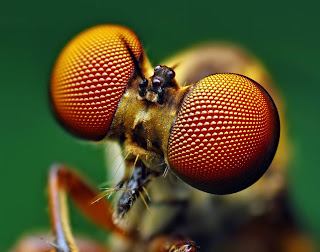
Robber fly - Nature photographer Thomas Shahan specializes in amazing portraits of tiny insects. It isn't easy. Shahan says that this Robber Fly (Holcocephala fusca), for instance, is "skittish" and doesn't like its picture taken.

Eye-popping bug photos

Nature by Numbers (Video)

"A Summary" – Apr 2, 2011 (Kryon channeled by Lee Carroll) (Subjects: Religion, Shift of Human Consciousness, 2012, Intelligent/Benevolent Design, EU, South America, 5 Currencies, Water Cycle (Heat up, Mini Ice Ace, Oceans, Fish, Earthquakes ..), Middle East, Internet, Israel, Dictators, Palestine, US, Japan (Quake/Tsunami Disasters , People, Society ...), Nuclear Power Revealed, Hydro Power, Geothermal Power, Moon, Financial Institutes (Recession, Realign integrity values ..) , China, North Korea, Global Unity,..... etc.) -
"The Quantum Factor" – Apr 10, 2011 (Kryon channeled by Lee Carroll) (Subjects: Galaxies, Universe, Intelligent design, Benevolent design, Aliens, Nikola Tesla (Quantum energy), Inter-Planetary Travel, DNA, Genes, Stem Cells, Cells, Rejuvenation, Shift of Human Consciousness, Spontaneous Remission, Religion, Dictators, Africa, China, Nuclear Power, Sustainable Development, Animals, Global Unity.. etc.) - (Text Version)


“ … Here is another one. A change in what Human nature will allow for government. "Careful, Kryon, don't talk about politics. You'll get in trouble." I won't get in trouble. I'm going to tell you to watch for leadership that cares about you. "You mean politics is going to change?" It already has. It's beginning. Watch for it. You're going to see a total phase-out of old energy dictatorships eventually. The potential is that you're going to see that before 2013.

They're going to fall over, you know, because the energy of the population will not sustain an old energy leader ..."

(Live Kryon Channelings was given 7 times within the United Nations building.)

"Update on Current Events" – Jul 23, 2011 (Kryon channelled by Lee Carroll) - (Subjects: The Humanization of God, Gaia, Shift of Human Consciousness, 2012, Benevolent Design, Financial Institutes (Recession, System to Change ...), Water Cycle (Heat up, Mini Ice Ace, Oceans, Fish, Earthquakes ..), Nuclear Power Revealed, Geothermal Power, Hydro Power, Drinking Water from Seawater, No need for Oil as Much, Middle East in Peace, Persia/Iran Uprising, Muhammad, Israel, DNA, Two Dictators to fall soon, Africa, China, (Old) Souls, Species to go, Whales to Humans, Global Unity,..... etc.)

"Recalibration of Free Choice"– Mar 3, 2012 (Kryon Channelling by Lee Caroll) - (Subjects: (Old) Souls, Midpoint on 21-12-2012, Shift of Human Consciousness, Black & White vs. Color, 1 - Spirituality (Religions) shifting, Loose a Pope “soon”, 2 - Humans will change react to drama, 3 - Civilizations/Population on Earth, 4 - Alternate energy sources (Geothermal, Tidal (Paddle wheels), Wind), 5 – Financials Institutes/concepts will change (Integrity – Ethical) , 6 - News/Media/TV to change, 7 – Big Pharmaceutical company will collapse “soon”, (Keep people sick), (Integrity – Ethical) 8 – Wars will be over on Earth, Global Unity, … etc.) - (Text version)

“… 4 - Energy (again)


The natural resources of the planet are finite and will not support the continuation of what you've been doing. We've been saying this for a decade. Watch for increased science and increased funding for alternate ways of creating electricity (finally). Watch for the very companies who have the most to lose being the ones who fund it. It is the beginning of a full realization that a change of thinking is at hand. You can take things from Gaia that are energy, instead of physical resources. We speak yet again about geothermal, about tidal, about wind. Again, we plead with you not to over-engineer this. For one of the things that Human Beings do in a technological age is to over-engineer simple things. Look at nuclear - the most over-engineered and expensive steam engine in existence!

Your current ideas of capturing energy from tidal and wave motion don't have to be technical marvels. Think paddle wheel on a pier with waves, which will create energy in both directions [waves coming and going] tied to a generator that can power dozens of neighborhoods, not full cities. Think simple and decentralize the idea of utilities. The same goes for wind and geothermal. Think of utilities for groups of homes in a cluster. You won't have a grid failure if there is no grid. This is the way of the future, and you'll be more inclined to have it sooner than later if you do this, and it won't cost as much….”


"Fast-Tracking" - Feb 8, 2014 (Kryon Channelling by Lee Carroll) - (Reference to Fukushima / H-bomb nuclear pollution and a warning about nuclear > 20 Min)

Obama unveils landmark regulations to combat climate change

Obama unveils landmark regulations to combat climate change
In a bid to combat climate change, US President Barack Obama announced the Clean Power Plan on Monday, marking the first time power plants have been targeted by mandatory regulations on carbon dioxide emissions in the US.
Google: Earthday 2013
Showing posts with label Organic. Show all posts

Wednesday, January 25, 2023

EU eyes more help for shrinking bee populations

Yahoo – AFP, January 24, 2023 

The EU on Tuesday announced proposals to try to reverse an "alarming decline" in the number of bees -- and other insects that pollinate the bloc's crops -- including by rewarding organic farming. 

The European Commission said a review of a 2018 EU Pollinators Initiative showed there were gaps, and "significant challenges" needed to be addressed with revised measures. 

The proposal calls for promoting farming -- organic or otherwise -- that protects pollinating insects, cutting back on pesticides, better monitoring of pollinator populations, and better conservation of habitats including in urban areas. 

At stake is much of the European Union's agricultural output. 

The commission estimates that pollinators -- mostly bees, but also hoverflies, moths, and some beetles and other insects -- contribute around five billion euros ($5.5 billion) a year to the bloc's food production. 

Yet intensive farming practices, pesticides, pollution, changed land-use, other introduced species and climate change have all taken a serious toll on their populations. 

"Pollinating insects have declined dramatically in diversity and abundance in the last decades, with many of them being threatened with extinction," the commission said in a statement. 

Its proposal, made to the European Parliament and the 27 EU member states, looks to reverse pollinator decline by the end of this decade. 

It focuses on wild populations of bees and other pollinators as the EU has other tools aimed at supporting honeybee farms. 

It also is designed to work alongside the EU's farm subsidy scheme, called the Common Agricultural Policy, by rewarding farmers who implement sustainable methods. 

The EU's environment commissioner, Virginijus Sinkevicius, said that "in the case of pollinators, these small insects will define the future of nature and long-term food security". 

He said he hoped the EU's steps towards saving them "can inspire similar action in the entire world".

Thursday, August 27, 2020

World's biggest rooftop greenhouse opens in Montreal

Yahoo – AFP, Sebastien St-Jean, August 26, 2020

Lufa Farms just opened what it says is the world's largest commercial rooftop
greenhouse, seen in this aerial photo in Montreal

Building on a new hanging garden trend, a greenhouse atop a Montreal warehouse growing eggplants and tomatoes to meet demand for locally sourced foods has set a record as the largest in the world.

It's not an obvious choice of location to cultivate organic vegetables -- in the heart of Canada's second-largest city -- but Lufa Farms on Wednesday inaugurates the facility that spans 160,000 square feet (15,000 square meters), or about the size of three football fields.

"The company's mission is to grow food where people live and in a sustainable way," spokesman Thibault Sorret told AFP, as he showed off its first harvest of giant eggplants.

It is the fourth rooftop greenhouse the company has erected in the city. The first, built in 2011 at a cost of more than Can$2 million (US$1.5 million), broke new ground.

Since then, competitors picked up and ran with the novel idea, including American Gotham Greens, which constructed eight greenhouses on roofs in New York, Chicago and Denver, and French Urban Nature, which is planning one in Paris in 2022.

A local Montreal supermarket has also offered since 2017 an assortment of vegetables grown on its roof, which was "greened" in order to cut greenhouse gas emissions linked to climate change.

Tomatoes are viewed at Lufa Farms, a company that just opened what it says
is the world's largest commercial rooftop greenhouse in Montreal

'Reinventing the food system'

Lebanese-born Mohamed Hage and his wife Lauren Rathmell, an American from neighboring Vermont, founded Lufa Farms in 2009 with the ambition of "reinventing the food system."

At Lufa, about 100 varieties of vegetables and herbs are grown year-round in hydroponic containers lined with coconut coir and fed liquid nutrients, including lettuce, cucumbers, zucchini, bok choy, celery and sprouts.

Bumblebees pollinate the plants, while wasps and ladybugs keep aphids in check, without the need for pesticides.

Enough vegetables are harvested each week to feed 20,000 families, with baskets tailored for each at a base price of Can$30.

The company's "online market" also sells goods produced by local partner farms including "bread, pasta, rice, etcetera," Sorret said.

On the ground floor of the new greenhouse, a huge distribution center brings together nearly 2,000 grocery products for offer to "Lufavores," including restaurants.

Shopper Catherine Bonin tells AFP she loves the freshness of the produce but laments that some items are always out of stock. "I can never get peppers," she says.

Lufa Farms spokesman Thibault Sorret shows off vegetables grown at what it 
says is the world's largest commercial rooftop greenhouse in Montreal

Sales doubled during pandemic

"We are now able to feed almost two percent of Montreal with our greenhouses and our partner farms," said Sorret.

"The advantage of being on a roof is that you recover a lot of energy from the bottom of the building," allowing considerable savings in heating, an asset during the harsh Quebec winter, he explains.

"We also put to use spaces that were until now completely unused," he said.

Fully automated, the new greenhouse also has a water system that collects and reuses rainwater, resulting in savings of "up to 90 percent" compared to a traditional farm.

Lufa "more than doubled" its sales during the new coronavirus pandemic, a jump attributable "to contactless delivery from our online site," says Sorret.

Profitable since 2016, the private company now employs 500 people, around 200 more than before the pandemic, according to him.

It is currently working on the electrification of its fleet of delivery trucks and is in the process of exporting its model "to different cities around the world," starting with Canada and the United States, Sorret said.

"What's a little crazy," he recalls, is that none of the founders "had grown a tomato in their life" before opening the business.

Thursday, January 23, 2020

More farmland goes organic, but the Netherlands still trails in Europe

DutchNews, January 22, 2020 

Organic curly cale being farmed in Noord Holland. Photo: DutchNews.nl

The amount of Dutch farmland devoted to organic fruit, cereals and vegetables grew by 4% last year, according to figures from official regulator Skal. 

In total, the amount of land used for organic farming has doubled in 10 years, and now just over 2,000 of the 50,000 Dutch farming companies are classified as organic. 

Nevertheless, despite the growth, the Netherlands is still trailing in European terms. Just 3.2% of the total amount of cultivated land in the Netherlands is farmed without pesticides and artificial fertiliser, compared with a European average of 7.5%. In Austria almost a quarter of farmland is devoted to organic farming. 

One reason for this, according to Michael Wilde, from organic farming lobby group Bionext, is that the Dutch government does not provide any subsidies for organic farming. 

And one scheme, to help farmers move from traditional to organic farming was scrapped several years ago, Wilde told the Financieele Dagblad.

Thursday, August 8, 2019

Italian hydroponics farm bets on 'red gold

Yahoo – AFP, Ella IDE, August 7, 2019

Luigi Galimberti says his farm can produce a kilogramme of tomatoes using just
two litres of water, compared to 75 in the fields (AFP Photo/ALBERTO PIZZOLI)

Grosseto (Italy) (AFP) - The Italian tomato is prized around the world, but its reputation has soured in recent years over reports of mafia infiltration, slave labour and toxic fires that poison water sources.

Southern Europe's biggest hydroponics farm is out to change all that, by growing pesticide-free crops in environmentally friendly greenhouses -- and getting bees to do the hard work.

Set among organic vineyards in Tuscany, Sfera Agricola was launched in 2015 by Luigi Galimberti as a response to repeated UN warnings that food production will need to increase sharply to feed the growing global population.

"The UN reminds us every year that by 2050 there will be 10 billion of us, and we'll need double the amount of water and double the land to produce food for everyone," Galimberti told AFP.

"Along with the problems of a suddenly-changing climate, which is having an ever-greater impact on farming, it pushed me to imagine a more efficient, technological way of farming that produces more with less," he said.

Hydroponics is a method of growing plants without soil, using water fortified with mineral nutrients and oxygen instead.

Hydroponics is a method of growing plants without soil, using water fortified with 
mineral nutrients and oxygen instead (AFP Photo/ALBERTO PIZZOLI)

Galimberti's farm produces a kilogramme of tomatoes or lettuce using just two litres of water, compared to 75 in fields, he says.

Of those two litres, over 90 percent is collected rainwater.

It relies on natural organisms to control pests and disease and the few plants that need to be treated chemically are separated and their fruit destroyed.

'Insect predators'

"We use bumblebees to pollinate the flowers, and we release a series of insect predators to combat the insects we fear," Galimberti said, adding that it had led to the creation of new bee colonies in a boost for the local ecosystem.

Pickers shuttle back and forth on solar-powered platforms, delicately tying back the plants' upper branches as the fruit below ripens.

Further on, vast basins shimmer in the midday heat where styrofoam boards holding baby lettuces are floated on a nutrient-rich, oxygenated solution.

As his farm expands, Luigi Galimbert hopes to grow cabbages, spinach, courgettes, 
peppers and aubergines as well (AFP Photo/ALBERTO PIZZOLI)

As the company expands, it hopes to grow cabbages, spinach, courgettes, peppers and aubergines as well.

Galimberti tapped private investors and banks to raise the 20 million euros ($22.4 million) needed to open the 13-hectare greenhouse, which now employs 230 people and produces crops every day of the year.

Italian tomatoes -- particularly the canned variety -- have received bad press in recent years, with rights charities warning that foreign workers are effectively used as slave labour.

The fruit dubbed "red gold", destined for supermarket shelves around the world, is plucked in back-breaking conditions under a pitiless sun, for pitiful wages, largely by Africans who live in shanty towns.

The illegal dumping and burning of toxic waste particularly in southern Italy has also spooked consumers over recent decades, amid reports of contaminated farm produce and a sharp rise in cancers, malformations and birth defects.

The so-called "agro-mafia" business -- the infiltration of organised crime along the agri-food chain in Italy, from pickers to distributors -- is worth 24.5 billion euros, according to a July report by farming association Coldiretti.

Luigi Galimberti plans to build 500 hectares of hydroponic greenhouses in the
next 10 years (AFP Photo/ALBERTO PIZZOLI)

"The exploitation of workers combined with exhausting conditions make picking in the south an ignoble job," said Galimberti, who says his company's proper contracts and paid overtime are "a rare thing in the sector".

'Flavour advantage'

Sfera Agricola has bet on a return to the Italian tomato's glory days, producing three varieties that have fallen out of favour with farmers and distributors, but that the company is "bringing back to supermarket shelves".

"Over the last 50 years, the market has evolved rapidly for distribution and commercial reasons. Tomato skins have thickened so they last longer on the shelf, and the fruit no longer drops off the vine when ripe," he said.

Thanks to the cubes of rockwool -- a hydroponic growing medium that mimics soil and supports the roots -- "the plant is protected and we can use older, weaker varieties," he added.

Those have thinner skins and tend to fall off the plant when ripe, so they have to be picked and eaten relatively quickly, he said.

Sfera Agricola is betting on a return to the Italian tomato's glory days (AFP Photo/
ALBERTO PIZZOLI)

"But they do not have 'innovative' characteristics, which gives them a flavour advantage," Galimberti said.

He aims to build 500 hectares of hydroponic greenhouses in the next 10 years, to become one of the biggest players in the sector in Europe.

But his toughest competition may be much smaller, and closer to home.

"In Italy almost everyone has someone in their family who produces their own tomatoes. Or their neighbour does, or the old man next door."

Related Articles:


Monday, February 18, 2019

Germany moots tougher insect protections

The StraitsTimes – AFP, 17 Feb 2019

German Environment Minister Svenja Schulze has put forth an action plan for
 protecting insects that would provide annual funding of 100 million euros
(S$153 million) to the cause. (Photo: AFP)

FRANKFURT (AFP) - Germany plans an insect protection law to slash use of pesticides and pump tens of millions of euros into research, a minister said Sunday (Feb 17), as global concern grows over mankind's impact on the crucial invertebrates.

"We human beings need insects, they deserve to be protected with their own law," Environment Minister Svenja Schulze told weekly Bild am Sonntag.

Her "action plan for protecting insects", seen by news agency DPA, would provide annual funding of 100 million euros (S$153 million) for the cause, including 25 million euros for research.

Germany would also stop covering new land with concrete for roads or home construction until 2050, and limit light emissions at night to avoid disorienting the six-legged creatures.

The federal government would set rules for "environmentally and naturally bearable application of pesticides and significant reduction of their input and that of other harmful substances into insect habitats," according to the document.

Schulze's scheme would include a ban by 2023 for hotly-debated herbicide glyphosate - overtaking neighbour France, which has yet to set a firm date.

But the Social Democratic Party (SPD) minister could face difficulty pushing her law past members of Chancellor Angela Merkel's Christian Democratic Union (CDU).

The senior coalition partner in Berlin holds the critical agriculture ministry and is traditionally closer to farmers.

"We wouldn't only be protecting stag beetles and bumblebees, but above all ourselves" by preserving insects, Schulze said.

Campaigners worldwide have highlighted the risks of declining insect numbers, noting the arthropods are vital for pollenating plants - including food crops - and as food sources for larger animals like birds.

Last week, a record 1.75 million people in prosperous south German state Bavaria signed a petition for a referendum to "save the bees", calling for more organic farming and green spaces and increased protection from agricultural chemicals.

The referendum campaign was opposed by the powerful regional farmers' association, which warned of potential financial costs to the industry and urged the population to "stop bashing farmers".

Thursday, August 23, 2018

'Trash is gold' as Benin community turns waste into biogas

Yahoo – AFP, Josué MEHOUENOU, August 22, 2018

The facility processes around six tonnes of organic waste every week, turning it
into 200 cubic metres of biogas (AFP Photo/Yanick FOLLY)

Houegbo (Bénin) (AFP) - Garbage has never smelled so sweet for a small village in southern Benin since it opened a pilot waste treatment centre to turn household rubbish into gas -- and cash.

"Our trash has become gold. We no longer throw it into the bush. We use it to make money," beams Alphonse Ago, who lives next to the centre in Houegbo village.

ReBin, a Swiss foundation for sustainable development, built the 1.3-hectare (3.2-acre) facility, which every week turns around six tonnes of organic waste into 200 cubic metres of biogas -- saving some 164 tonnes of wood from being used to make charcoal.

The centre, which opened late last year, also plans to produce around 400 tonnes of organic fertiliser per year.

So far, around 100 households in the area have signed up to the scheme to deposit their waste at the centre on a daily basis.

Every 10 kilogrammes (22 pounds) of waste fetches 250 CFA francs (around 50 euro cents, 57 US cents), paid either in cash or credit -- to buy biogas.

The fuel is a precious commodity in a rural region where electricity remains scarce.

Agnes Avoce, a shopkeeper and mother of five, proudly straps a large plastic bag of the gas onto her back.

So far, around 100 households in the area have signed up to the scheme. Every 
10 kilogrammes of waste fetches 250 CFA francs (around 50 euro cents), paid 
either in cash or credit -- to buy biogas (AFP Photo/Yanick FOLLY)

Biogas, she says, is much cleaner and more efficient for cooking than charcoal -- which "darkens the pots and makes me sick" -- and she is more than happy to make the switch.

Avoce is not alone; five other women are waiting to pick up gas.

"There are queues here since we opted for biogas," another customer says.

'Goldmine'

Symphorien Adonon, 35, drops off a week's worth of carefully sorted waste, smiling as he pockets his cash payment.

"Now I have enough to do the shopping for dinner," says Adonon, who drives a motorcycle taxi.

ReBin Benin Foundation chief Mark Giannelli was inspired to launch the project 
after noticing mountains of discarded pineapple skins in Benin, Africa's fourth-biggest 
exporter of the fruit (AFP Photo/Yanick FOLLY)

The centre has treated more than 20 tonnes of waste since it began operations late last year.

In addition to the customers' household waste, there is also rubbish collected by a local non-government organisation, Astome.

The NGO's chief, Florent Gbegnon, says he used to collect it on a push cart, but he now uses a tricycle provided by the centre.

"It's a huge relief," he says as he dumps a load of pineapple skins. "Pushing the cart was a real burden."

It was the massive amounts of waste such as pineapple skins that originally caught the attention of ReBin's founder, Mark Giannelli, and inspired him to set up the treatment centre in Houegbo.

"I saw this not as a problem, but as an opportunity, and I thought it was a goldmine," Giannelli told AFP.

Benin is Africa's fourth-biggest exporter of pineapples. And in Houegbo, which has one of the busiest markets in the region, local sources estimate that more than a tonne of waste is generated every day from that fruit alone.

Giannelli told AFP that he had been searching for a potential site for his project in Benin's West African neighbours Ghana and Togo.

Sewai Mardochee, director of the Toffo facility, says it should be duplicated across 
Benin. 'We can then create jobs and clean up our living environment by reducing
the use of firewood and coal' (AFP Photo/Yanick FOLLY)

But it was the enthusiasm with which the locals embraced his idea that finally convinced him to set up the waste treatment centre here, he said.

'Source of happiness'

The goal is to establish "a real economy that serves the population and protects the environment," he says. "We have to take the problems locally and adapt them to local solutions."

Once the necessary expertise has become more firmly established in Houegbo, Giannelli hopes to extend the project to larger municipalities and let local entrepreneurs run it.

The centre's director, Sewai Mardochee, suggests duplicating it in all of Benin's 77 municipalities.

"We can then create jobs and clean up our living environment by reducing the use of firewood and coal," he said.

Nicolas Hounje, a retired official, has put himself forward to take over the company.

"We did not know here that garbage can become a source of happiness," he says.


Saturday, March 3, 2018

Supermarket fruit and veg will be ‘PlanetProof’ from next year

DutchNews, March 2, 2018


Fruit rose in price 4.3% last year Dutch supermarkets are poised to launch a new quality label for fruit and veg which will require growers to use fewer pesticides and fertilizers and reduce the amount of greenhouse gases. 

The new label PlanetProof, which will replace the current Milieukeur label from next year, was two years in the making, Trouw reported on Friday. 

Participating supermarkets include Jumbo, Aldi, Lidl and Superunie outlets such as Spar, Plus and Coop, who share two thirds of supermarket sales between them. Market leader Albert Heijn has not opted into the new system because it has its own, comparable, agreements with environmental organisation Natuur & Milieu, Trouw said. 

Gijs Dröge, director of Milieukeur, which formulated and checks the new PlanetProof requirements, said AH’s stance complicates matters for growers. ‘If a grower sells to Albert Heijn as well as to other supermarkets and both have different sets of requirements then that is not straightforward,’ he told Trouw. 

Dröge says the new label will be an important step towards sustainable agriculture in the Netherlands. Until now, less than 10% of potatoes, fruit and vegetables carried sustainability labels, such as the Max Havelaar label for sustainable bananas. Dutch produce, of which 80% is exported, will also carry the label abroad. . 

Greenpeace said the new label is a step in the right direction but would prefer if consumers opted for organic produce which has to comply with even more stringent requirements. 

Not all farmers are happy either because the requirements came late and were communicated to them when the growing season was about to begin, Trouw said. 

PlanetProof is another addition to a growing number of sustainability labels consumers have to contend with. According to Milieu Centraal, there were some 90 at the last count.

Wednesday, August 16, 2017

English football team's eco dream as first vegan club

Yahoo – AFP, Maxime MAMET, Aug 14, 2017

Meat is banned and all the cuisine is vegan at the Forest Green Rovers football
club (AFP Photo/GEOFF CADDICK)

Nailsworth (United Kingdom) (AFP) - English football club Forest Green Rovers, run by a former nomad turned renewable energy entrepreneur, are proudly boasting their credentials as a pioneer in environmental sustainability.

As at every football ground in the country, chips, pies and beer are on offer at New Lawn, their 5,000-capacity, eco-friendly ground in Nailsworth, a 6,000-strong town in the picturesque rolling Cotswold Hills of Gloucestershire, southwest England.

But there are no hot dogs -- meat is banned and all the cuisine is vegan. The pitch is kept lush with captured rainwater, the paint contains no chemicals, and 20 percent of the energy comes from solar panels on the roofs of the stands.

There are charging points for electric cars and their lime green and black team strip bears the logo of marine wildlife conservation group Sea Shepherd UK.

Founded in 1889, Rovers were promoted to the professional leagues in May. They opened their campaign in the fourth-tier League Two on August 5.

Despite their name, Forest Green only started going green when Dale Vince took over as chairman in 2010.

A former New Age Traveller, club chairman Dale Vince sees himself more as 
an environmentalist than a businessman (AFP Photo/GEOFF CADDICK)

"We felt we had an opportunity to bring our message to an audience that really weren't exposed to it typically," he told AFP.

"The audience I'm talking about is football fans and the message is around the environment and things that we all need to do to live more sustainably.

"So we thought, this is great, this is not preaching to the choir, let's go in there and talk about food and talk about transport."

Organic pitch

Vince, 53, founded Ecotricity, which claims to be the world's first green electricity company, supplying power from renewable sources.

The former New Age Traveller sees himself more as an environmentalist than a businessman. Vince built his first wind turbine in 1990, when he was still living in a camper van on a hill near the stadium.

Success on the pitch is critical to spreading the eco message, he says.

A former New Age Traveller, club chairman Dale Vince sees himself more as
an environmentalist than a businessman (AFP Photo/GEOFF CADDICK)


"We have an organic pitch. That doesn't mean anything if it's not a great football pitch," he adds.

Vince dreams of moving his club two divisions up to the Championship, one step below the top Premier League, and aims within four years to open an Eco Park with a new stadium designed by Zaha Hadid Architects.

The plans feature what Vince describes as the first stadium made entirely from wood, alongside an incubator for green start-up businesses.

Bees and players benefit

At the club's current site, its passionate groundsman Adam Witchell describes the challenges of managing an entirely organic vegan pitch.

"We can't just use organics. We don't use anything that's derived of an animal," he says, ruling out options such as organic fertilisers made from animal faeces.

"It's healthier for myself, it's healthier for the bees and, fundamentally, it's healthier for the players."

Veganism is not enforced on the players in their private lives but some have 
opted to go vegetarian (AFP Photo/GEOFF CADDICK)

Witchell also has a "more hands-on" approach than usual: he weeds the grass manually.

What goes for the pitch -- mowed by a solar-powered robot -- also goes for the food served to players and spectators.

"I thought, what a fantastic thing to do, to share really good food with a really large audience," chef Em Franklin says, of taking on the club's kitchen.

Franklin describes the vegan diet as "easily accessible" -- proven by increasing food sales at the club -- and one which also benefits the players.

"With regards to getting the nutrients, and especially with athletes, it's not hard to get that amount of protein," she says, preparing a match day dish of chickpea curry.

What do fans say?

Manager Mark Cooper also sees improved results on the pitch, speaking to AFP after Forest Green Rovers were beaten by 1-0 by third-tier visitors Milton Keynes in the League Cup first round on Tuesday.

"In extra time, we looked as fit as a team in the league above us," Cooper said.

While not a vegan himself, he gave up meat six months ago and is positive about his new diet: "I loved a bacon sandwich on a Sunday morning, but not any more!"

Veganism is not enforced on the players in their private lives, away from the club, but, like Cooper, some have opted to go vegetarian.

Some of the fans are less enthusiastic about the choice of food on offer at New Lawn.

"(It) resembles cardboard and chilli sauce," says Paul, of his unfinished vegetable burger. "I'm not against vegan food; I just wish there was a choice."

Fellow diner Martin, however, enjoyed his vegan meal: "It's not my most favourite food but, when you're hungry you have to eat… If it looks good, I will try it."

But the football fans do agree when it comes to beverages, deeming tea with soya milk undrinkable. Beer, they conclude, is a preferable alternative.

Monday, July 17, 2017

Organic farming reaches record level in Germany

Increasing numbers of German farmers are relying on organic production, with 7.5 percent of all arable land now cultivated ecologically. The government has set its sights on an ambitious target of 20 percent.

DeutscheWelle, 16 July 2017


According to new figures from the Federal Office of Agriculture and Food (BLE), the total area of ecologically cultivated land in Germany in 2016 rose 14.9 percent in comparison with the year before to reach 1.25 million hectares (3.09 million acres). That represents 7.5 percent of all arable land.

As a comparison, in 2015, 6.5 percent of all arable land was cultivated ecologically, up from 3.2 percent at the turn of the millennium. The number of organic farms also rose last year by 9.6 percent to 27,132.

Compared to the year 2000, the number of organic farms has more than doubled from 12,740.

"Organic farming has established itself alongside conventional agriculture as an important pillar of the German agriculture and food industry," German Agriculture Minister Christian Schmidt told reporters from the Funke media group.

He said, however, that the government was still far from achieving its goal of increasing the share of organic farming to 20 percent of the total agricultural area. No specific date has yet been given for its implementation.

Germany is the largest organic market in Europe, but the scarcity of land available for organic farming could threaten its long-term development.

EU to talk eco-farming

EU agriculture ministers ars scheduled to discuss a new legal framework for organic farming at a meeting in Brussels on Monday.

Schmidt wants to ensure that the growth potential of organic agriculture is not slowed down. "I am in favor of growing demand for organic products being covered by domestic production," he said.

The aim, he said, was to adopt regulations at the EU level that would provide legal certainty and reliability to small and medium-sized enterprises.

On Saturday, Environment Minister Barbara Hendricks called for a changed approach to agriculture tending to ecological cultivation. She warned of massively decreasing insect populations in Germany over the past 35 years, attributing the reduction partly to the use of pesticides in agriculture.

According to the Bund Ökologische Lebensmittelwirtschaft (BÖLW), an organic market working group, the organic food market in Germany grew to 9 billion euros in 2016, its best year on record. A decade ago, it was worth 2.9 billion euros.

Sunday, November 13, 2016

Vanilla and spice next to bloom in Dutch greenhouses

Yahoo – AFP, Maude Brulard, November 12, 2016

University of Wageningen researcher Filip van Noort and vanilla grower Joris
Elstgeest inspect vanilla orchids, part of four years of ground-breaking research
(AFP Photo/Maude Brulard)

Bleiswijk (Netherlands) (AFP) - Flowers more exotic than the humble tulip will soon flourish for the first time in Dutch greenhouses after intensive research into growing the capricious vanilla orchid to harvest one of the world's most expensive spices.

In the middle of potato fields in a central Dutch rural town, scientists from Wageningen University have for the past four years been nurturing vanilla orchids. And their research has been deemed a success.

"Based on our information, businesses believe vanilla is a plant with a lot of potential for Dutch greenhouses and have decided to start growing it," said researcher Filip van Noort.

How many orchids will be planted will be decided at the start of the next growing season in the spring, and it will take at least three years before the first Dutch-grown vanilla hits the market.

In Bleiswijk, home to the ground-breaking research, vines from about 100 plants stretch metres high in hot, tropical greenhouses. Hidden under fleshy, oval-shaped leaves are the buds, that will eventually become the vanilla pods so prised by chefs the world over.

"The challenge is to ensure the plants blossom and then to be able to pollinate them in a cost-effective way," said van Noort.

Cultivation of the vanilla orchid is hugely labour intensive as the orchid's flowers 
only last one day and must be pollinated by hand if they are to produce fruit
 (AFP Photo/Maude Brulard)

Black gold

Cultivation is hugely labour intensive. The orchid's flowers only last one day and must be pollinated by hand if they are to produce fruit. So it was an apt challenge for the Dutch -- renowned for their green fingers and their expertise in greenhouse cultivation.

"A few years ago we were looking for new plants which could be grown in Dutch greenhouses," explained van Noort.

The aim was to increase the variety of crops grown by Dutch farmers as they search for improved profits.

Vanilla made sense. Currently the Indian Ocean island of Madagascar holds a quasi-monopoly over world supply producing some 80 percent of global vanilla bean stocks.

It is also the world's second most expensive spice, with prices climbing to 350 euros ($380) a kilo this month -- compared with 60 euros in 2014.

"In the past the price was too low to be interesting. But today, with demand increasing, the prices are rising," said orchid expert Joris Elstgeest.

The long, black vanilla pods, with their distinctive caramel and at times woody scent, have to be collected by hand from the vines and then dried before being sold.

It is the sticky tiny black seeds scraped from inside the pods which are a baker's delight, lending an almost intoxicating flavour to everything from cakes and ice-cream.

The long, black vanilla pods, with their distinctive caramel and at times woody scent, 
have to be collected by hand from the vines and then dried before being sold 
(AFP Photo/Maude Brulard)

All organic

Originating from Mexico, the vanilla orchid was brought to Europe by Spanish explorer Christopher Columbus. But all attempts to grow it in milder climates failed for lack of the type of bee which pollinated the flowers.

It was not until 1841 that someone on the island of Reunion figured out how to pollinate the flowers one-by-one.

That method finally paved the way towards large-scale production, with Madagascar proving the most effective of growers.

But even if prices fall and as other countries explore possible vanilla crops, Dutch growers believe it will prove a good investment.

In past decades, synthetic vanilla flavourings were increasingly adopted by the food industry. But with a return to all things authentic and organic, the real stuff is making a welcome return.

Bleiswijk vanilla is wholly organic, say its Dutch growers, unlike in Madagascar, they claim.

Vanilla is also the world's second most expensive spice, with prices climbing
 to 350 euros ($380) a kilo this month -- compared with 60 euros in 2014 
(AFP Photo/Maude Brulard)

Half of Madagascar's vanilla is exported to Europe, and a third to the United States. But clients say the quality has been slipping, with producers harvesting the pods before they reach maturity to cash in on the price boom.

Some Madagascans even speculate the vanilla industry is being used as a front for the illegal trade in rosewood –- a sought-after product in China.

The Dutch consortium behind the project says it has already received lots of interest from local high-end restaurants as well as food companies.

The Netherlands is a global leader in the art of greenhouse growing with almost 10,000 hectares of this lowlands country set with rows of glasshouses growing all kinds of flowers, fruits and vegetables -- compared to just 1,900 hectares in France.

And researchers are already setting their sights on other spices.

"We've also got black pepper, which seems to be adapting well," said van Noort, adding indigo used to dye blue jeans was another project.

And perhaps saffron -- the world's most expensive spice derived from the saffron crocus -- could be next to flourish here.